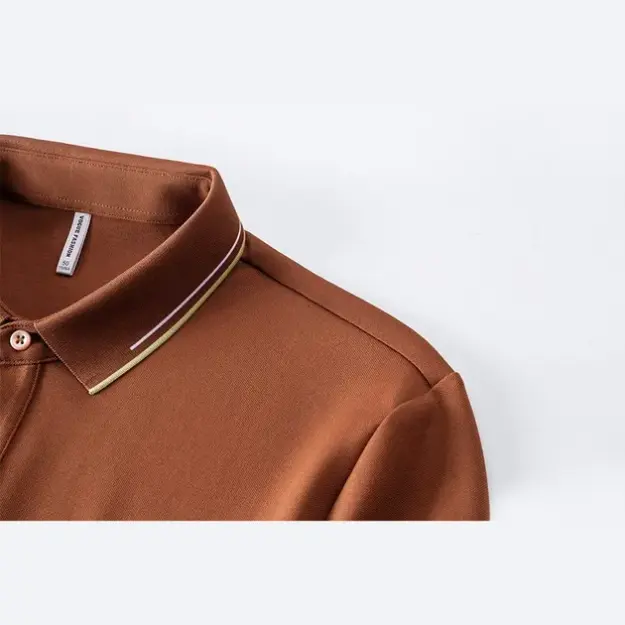
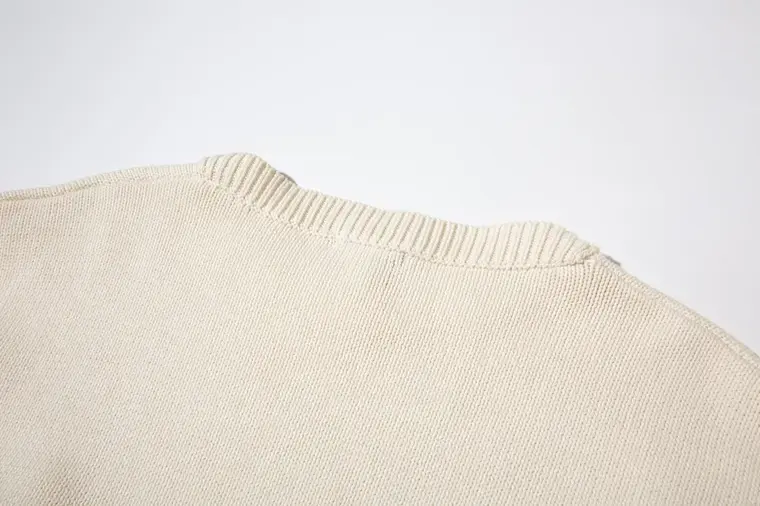
Hold two merino cardigans side by side and the difference is rarely in the yarn. One hangs straight when open, the fronts falling in a clean line; the other curls at the placket and sags below the lowest button. Same fibre, same gauge, different build.
Merino cardigan trim weight is the balance between a fine knit that drapes and a closure system that pulls. A button, a buttonhole, a facing and a seam all add weight to a fabric that was knitted to be light, and the balance is decided in construction rather than in the yarn specification.
Merino cardigan trim weight: the short answer
Merino cardigan trim weight works as a balance: the lighter the knit, the more the placket has to carry the buttons without stretching. Stabilise the front with a taped or faced placket, choose buttons by size and weight rather than by look alone, space them to spread the load, and check the hung garment before bulk.
The sections below follow the decisions in the order they arise: placket, button, spacing, finishing, and the sample checks that catch a mistake.
Two cardigans, one yarn
The first cardigan had a narrow self-facing, no tape and four small shell buttons. Open, it hung well for a minute and then began to bow at the top buttonhole. The second had a faced placket with a stabilising tape, five slightly larger buttons and a firmer hem band, and it held its line through an afternoon on a hanger.
The second garment weighed more, cost more to make and sold better. That is the trade-off in one sentence: a fine merino cardigan needs enough structure at the front to carry its own closure, and structure is added by construction, not by using a heavier yarn everywhere.
Decision one: the placket construction
A placket is the strip that holds the buttons and buttonholes. In a fine knit it has three jobs: to stop the front edge curling, to carry the button load without stretching, and to look like part of the garment rather than an addition.
The simplest version is a self-facing, where the front is folded back and stitched. It works on a firm, heavier knit and struggles on a light merino, because the fabric has little resistance to the pull of a button. A faced placket with a strip of tape or a stable woven tape behind the buttonholes adds structure exactly where the load arrives.
A third option is to knit the placket in a denser structure, such as a tight rib or a double-faced band. It looks integral and behaves better than a plain self-facing, at the cost of a slightly firmer hand at the front edge.
| Placket build | Stability | Hand | Typical fit |
|---|---|---|---|
| Plain self-facing | Low on fine yarns | Soft, matches the body | Heavier knits and loose fits |
| Self-facing with tape | Good at the button line | Soft with a firm edge | Fine merino, regular fit |
| Dense knitted band | Good throughout | Firmer at the front | Structured cardigans |
| Faced placket with interfacing | Highest | Noticeably firmer | Longline styles and heavy buttons |
The table is about behaviour rather than price. The simplest build that holds the closure is usually the right one, and that is rarely the least expensive build overall.
Decision two: the button
Button weight is the variable buyers underestimate. A large horn or metal button can weigh several times what a small shell button does, and the load is carried by two or three stitches of yarn at the placket edge. A light knit with heavy buttons will stretch at the buttonholes before the first wash.
Size matters as much as material. A larger button spreads the load over more fabric and needs a wider placket to sit on. A small button on a narrow placket concentrates the pull, which is why a four-button cardigan with tiny buttons tends to bow between them.
Holes and finish are practical details. Two-hole buttons sit flatter and are easier to attach securely; four-hole buttons allow a crossed stitch that holds better on a knitted fabric. Whatever the choice, the attachment should be tested by pulling the button away from the placket once the sample is made.
Weight is additive. Five large buttons on a longline cardigan add more load than three on a hip-length one, so the placket has to be specified for the total rather than for one button. Where the design calls for decorative buttons that do not function, attach them to the facing rather than through both layers.
Decision three: spacing and buttonholes
Spacing distributes the load. Even spacing looks correct and tends to concentrate the pull at the top and bottom, where the garment opens. Many knitwear patterns use a slightly tighter spacing near the bust and a longer gap toward the hem, which keeps the front closed where the body moves.
Buttonholes in knitwear need their own reinforcement. A plain buttonhole in a fine knit stretches with wear; a buttonhole worked with a reinforcing cord or a small piece of tape behind it holds its size. The buttonhole size should match the button diameter, not the button’s visual size, or the closure will pop open.
Test the closure with the garment on a body. A cardigan that closes flat on a table can gap between buttons once it is worn, and the gap is the fault the customer notices first.

Decision four: finishing and wash behaviour
A merino cardigan grows when it hangs. The weight of the buttons and the open front pulls the garment downward, and a knit that was measured on a table will read longer after a day on a rail. That is not a fault in the yarn; it is a reason to test the garment hanging rather than only flat.
Washing changes the picture again. Merino relaxes and then recovers with careful drying, and a cardigan dried flat will return closer to its drafted length than one hung wet. The care label should say what the sample actually survived, not what the yarn supplier recommends in general.
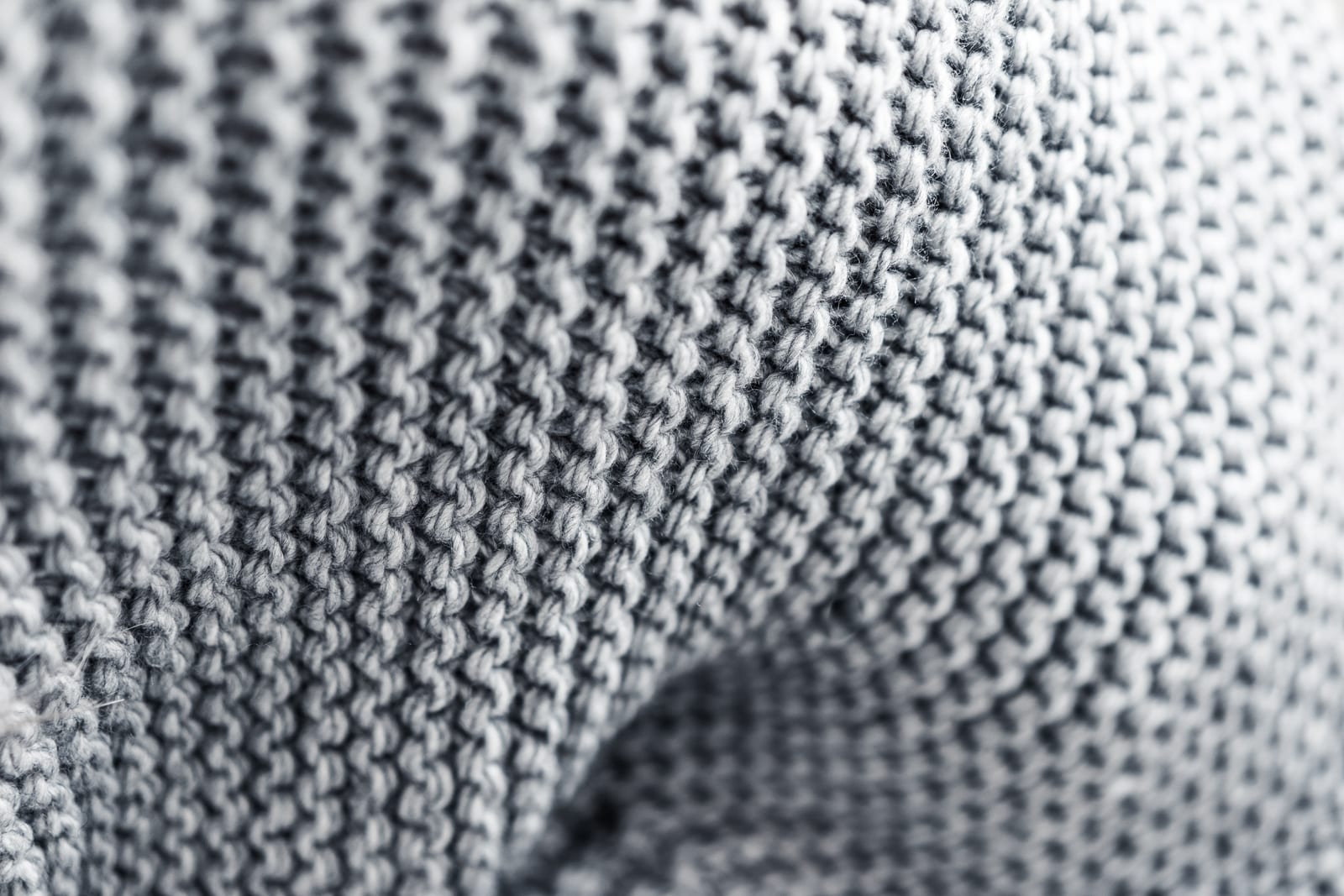
Ribbed trims at the hem and cuffs resist some of the growth, because a rib is denser and recovers better than the body. A narrow rib on a light cardigan does less than a deeper one, and the depth is a decision to make with the placket, not after it.
Ask how the factory intends to dry the garment after finishing. A cardigan pressed on a frame and one dried flat can reach the same measurements with different drape, and the second sample should use the same method as bulk.
What the sample must prove
Approve a cardigan hanging, closed and open. Hang it for a day with the buttons done up and check the placket line, the buttonholes and the hem. Then open it and check whether the fronts curl.
Check the button attachment by pulling each button gently away from the fabric. Check the buttonholes by closing and opening the garment a few times. Then wash it as the care label instructs, dry it flat, and repeat both checks.
Where a program uses a heavier button or a longer body, ask for the sample in that configuration. A placket that works on a hip-length cardigan can fail on a longline version, because the extra length adds weight below the last button.
Photograph the pinned-up sample from the side, because the placket line is easiest to judge in profile. A front-on photograph flatters a sagging front, and the buyer’s first complaint is usually visible in the side view.
FAQ
Do merino cardigans need interfacing?
Not always, but a fine merino usually needs some stabilisation behind the button line. A tape is enough for a regular placket; a faced and interfaced build suits longer styles and heavier buttons. Too much interfacing makes the front feel like a jacket.
How many buttons should a cardigan have?
Enough that the gaps between them do not open when the garment is worn. The count follows the length and the spacing, so a hip-length cardigan usually needs fewer than a longline one. Decide the spacing first and the count follows.
Will a heavier yarn solve the placket problem?
It helps, because a denser knit resists stretching better. It also changes the whole garment, which may not be the product you set out to make. Stabilising the placket keeps the fine hand and solves the closure at the same time.
Can the placket be added after knitting?
It can be sewn on, and many cardigans are made that way. A sewn placket adds a seam and a little bulk at the front edge. A knitted-on band carries the buttonholes more cleanly but limits how much structure can be added later.
Getting the balance right before bulk
The order of decisions is short: placket, button, spacing, finishing. Get them in that order and the fine knit keeps its hand while the closure does its job.
Send the button weight and size with the tech pack, because the placket cannot be specified without them. Our zip-front cardigan notes cover the alternative closure for the same yarn, and the cable cardigan and longline cardigan programs show how the placket changes with length and structure.
One useful habit: keep the button and placket specification in the same document as the measurements. When the button changes, the placket tolerance changes with it, and a separate file hides that connection.
Sources: The Woolmark Company, OEKO-TEX Standard 100, Intertek, EU Regulation 1007/2011 on textile fibre names, Higg and Control Union.
Working on a knitwear project?
Let’s talk yarn, gauge and timing.
Send a reference or tech pack and we will come back with a practical development route.