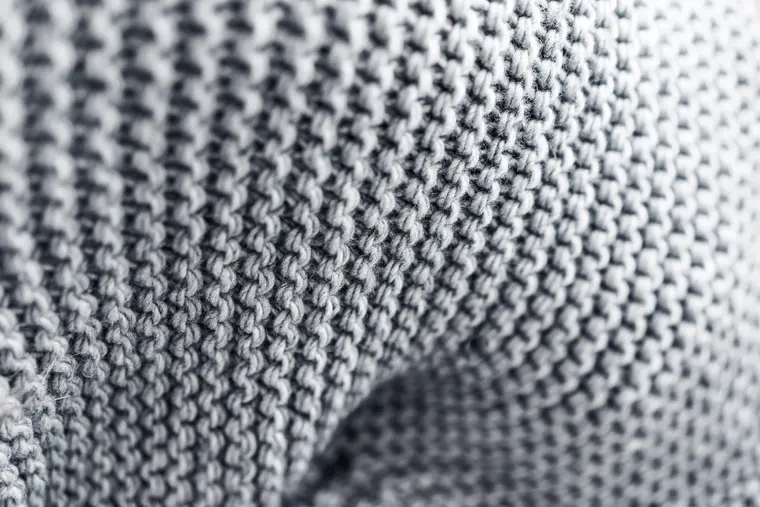
The cuffs gave up in the third month. The sweater was a lambswool rib, knitted at a tension that felt right at approval, and by the end of the season the cuffs hung open and the hem had lost its line. The rib had been asked to recover without anything in it that recovers, and wool can only do so much.
That is the failure elastane in knitwear development is meant to prevent, and it is also the reason elastane gets added to garments that do not need it. The question is not whether stretch is desirable. It is whether the garment has to return to its shape, and whether the structure can do that on its own.
Two kinds of stretch
Knitted fabric stretches because of its structure: loops slide and open, and a rib stretches further than a jersey. That is structural stretch, and it recovers only as well as the yarn and the stitch allow. Elastane adds fibre stretch: the yarn itself returns, and the fabric recovers more completely and more quickly.
The two are not interchangeable. A rib with good structure can hold a cuff for a season; a rib with elastane can hold it for several. The difference is not the amount of stretch but the reliability of the return.
Elastane in knitwear development
Elastane in knitwear development earns its place when the garment needs to recover rather than merely stretch: rib cuffs, waistbands, close-fitting tops and fine-gauge knits that must return to shape after wear. It is not needed where the structure already provides the stretch, and adding it changes the hand, the care and the label.
So the decision starts with a question about recovery, not about fit. A garment that must grip and return will usually need it; a garment that hangs from the shoulder usually will not.
When it earns its place
Cuffs, waistbands and neckbands are the classic case, because they are stretched every time the garment goes on and are expected to return. Close-fitting tops and dresses are the second, because the garment has to follow the body without bagging at the elbow and the seat.
Fine-gauge knits are the third. A thin fabric has less structure to rely on, so a small percentage of elastane does more work there than it would in a chunky knit. Ribbed trims on an otherwise relaxed garment are the fourth: the body can hang, but the trim still has to hold.
When it costs more than it gives
Elastane changes the hand. A yarn with elastane feels springier and slightly less soft, and in a cashmere or a fine merino that difference is the product. It also changes the care: heat degrades elastane, so a hotter wash or a tumble dry shortens the garment’s useful life in a way the label has to warn about.
The label is the third cost. Fibre content must state the elastane percentage, and a garment sold as pure wool or pure cashmere cannot contain it without saying so. That is a marketing decision as much as a technical one, and it belongs in the brief before the yarn is ordered.
| Garment area | Structural recovery alone | With elastane |
|---|---|---|
| Rib cuff and hem | Holds for a season, then relaxes | Holds longer, feels firmer |
| Waistband | Depends on rib depth and tension | More consistent across sizes |
| Close-fitting body | Can bag at elbow and seat | Returns after wear and wash |
| Relaxed sweater body | Adequate; the garment hangs | Little gain, changes the hand |
| Cashmere or fine merino | Soft, recovers slowly | Springier, less soft, label changes |
Care, heat and the label
Elastane is damaged by heat and by chlorine, and a care label written for a wool garment may not protect it. If a style contains elastane, the wash temperature and the drying instruction should be set with the fibre in mind, and the label should say what the garment needs rather than what is convenient. That is a production instruction as much as a consumer one: the care routine you specify is the routine the test house will use on the sample.
The fibre content statement is a legal requirement in the EU under Regulation 1007/2011, and elastane must appear with its percentage. A care label that says “hand wash” on a garment whose elastane cannot take heat is consistent; one that says “tumble dry” is not.
Testing recovery
Recovery is testable, and the test is the same whether or not elastane is present. Mark a length on the swatch, stretch it to a stated extension, hold it, release it, and measure after a minute and after an hour. Then wash it and repeat. A swatch that returns within tolerance after three washes is doing the job.
- Knit two swatches at the intended gauge, one with elastane and one without.
- Measure stretch and recovery at the width the garment will use.
- Wash both to the proposed care label and measure again.
- Fit both on a body and note the hand and the grip.
- Choose the lower percentage that meets the recovery target, not the highest available.
- Record the percentage and the test result in the specification, with the care instruction.
Step five is the one that saves money and hand. Elastane is usually effective at a low percentage; adding more buys a firmer feel rather than a better recovery, and the firmer feel is not always what the design wants.
What elastane does to a wool yarn
Elastane is usually blended into a wool yarn at a low percentage, wrapped or core-spun so the wool stays on the outside and the elastane supplies the return. The hand comes from the wool; the recovery comes from the core. That is why a small percentage can change the behaviour without making the garment feel synthetic.
It also means the wool choice still matters. A merino sweater with a little elastane keeps its shape and still feels like merino; a cashmere sweater with the same addition feels springier and slightly less soft, and the difference is easier to feel than to describe.
Percentage and the gauge
The percentage needed depends on the gauge and the structure, not on the fibre alone. A fine gauge has less fabric to resist distortion, so a small percentage does more work; a chunky gauge has more mass and its own stability, so the same percentage can feel unnecessary.
The gauge and hand-feel decision and the elastane decision are therefore the same conversation. Knit both options at the intended gauge, wash both, and compare them on a body before choosing a percentage.
Buying yarn with elastane
Ask the spinner three questions: the percentage, whether it is core-spun or plated, and which lot the sample came from. The first sets the label, the second sets the hand, and the third decides whether the sample can be repeated.
Ask too for the care recommendation that goes with the yarn, and write it into the specification beside the fibre content. A yarn that needs a cool wash will not survive a label written for a standard wool cycle, and the mismatch surfaces as a claim rather than as a fault.
Cotton and the alternative to elastane
Cotton rib recovers worse than wool, and a cotton cuff without elastane will relax within a season of washing. For cotton programmes, the alternatives are a firmer rib tension, a deeper cuff or a small percentage of elastane. The first two change the fit; the third changes the label.
Many brands take the elastane route for trims and leave the body without it, which keeps the label simple and the hand consistent. That split is worth writing down: body fibre content, trim fibre content, and the care instruction that covers both.
FAQ
Does elastane make a knit warmer?
Not meaningfully. It changes the hand and the recovery more than the warmth, and a high percentage can make a garment feel tighter rather than warmer. Warmth comes from the fibre, the weight and the air in the structure.
Can a pure wool rib recover well enough?
It can, with a firm tension and a good yarn, for a season or two. If the garment has to hold its shape over years, elastane is the reliable answer, and the label has to say so.
Is recycled elastane available?
It exists, and it is worth asking about, but the traceability documents matter more than the marketing. Ask what the certificate covers and which percentage of the yarn it applies to.
Does elastane affect the care label?
Yes. Heat and chlorine shorten its life, so the wash and dry instructions should be written for the fibre, and the percentage must appear in the fibre content statement.
Sources: The Woolmark Company on wool specification, OEKO-TEX Standard 100, Control Union certification, Intertek textile testing, Higg facility indexing, and EU Regulation 1007/2011 on textile fibre names.
Working on a knitwear project?
Let’s talk yarn, gauge and timing.
Send a reference or tech pack and we will come back with a practical development route.