The first delivery looked right. By the third laundry cycle the pale grey set had picked up a green cast from a mixed load, the ribbed cuffs had lost their grip, and the woven labels had curled at the corners. Nothing in the specification had mentioned how the hotel actually washes its linen.
Hotel spa knit loungewear sourcing is a laundry problem before it is a design problem. Garments in a hotel are washed far more often than a retail purchase, by a process the brand does not control, and the material and trim choices have to survive that process rather than a domestic care label.
Hotel spa knit loungewear sourcing: the short answer
Hotel spa knit loungewear sourcing should start by documenting the laundry: temperature, detergent, drying method, ironing and turnaround. Then choose fibre, construction and trims that survive that cycle, prove them in a wash trial, and specify packaging and reorder terms so a replacement set matches the original.
The steps below follow that sequence, because a material chosen before the laundry is known is a guess with a purchase order attached.
The set that came back green
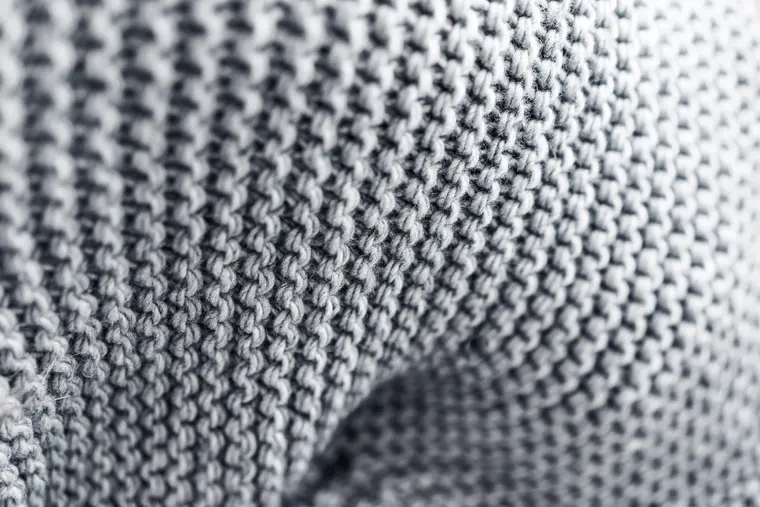
The failure had three causes and only one was the fabric. The dye in the grey set was not fast to the detergent the laundry used, so it absorbed colour from a darker load. The rib had been set with a soft finish that relaxed after repeated hot washing. The labels were a printed satin that curled at the edge when pressed.
Each of those could have been caught before bulk. A wash trial would have shown the shade shift; a recovery check after washing would have shown the rib; and a label sample pressed at the laundry temperature would have shown the curl.
None of the fixes required a different design. They required the laundry information to arrive before the material was chosen.
Step one: document the laundry
Ask the housekeeping or laundry manager for the process, not for a summary. The useful list is short: wash temperature, detergent type and dose, whether bleach is used, the drying method and temperature, whether the garment is pressed or steamed, and the turnaround time from collection to return.
Ask what else shares the load. A hotel that washes loungewear with pool towels is a different proposition from one that runs a separate delicate cycle, and the difference decides how much colour fastness margin the garment needs.
Finally, ask how many cycles a garment is expected to survive before replacement. That number sets the test target, and it is a commercial decision rather than a technical one.
| Laundry parameter | What it affects | What to specify |
|---|---|---|
| Wash temperature | Shrinkage, dye loss, rib recovery | A fibre and finish tested at that temperature |
| Detergent and bleach | Colour fastness and fibre strength | A dye and fibre tested with that chemistry |
| Drying method | Shrinkage and hand feel | A construction that survives tumble or line drying |
| Pressing | Label and trim durability | Labels and trims tested at that temperature |
| Turnaround | Spare stock and replacement cycle | Reorder lead time and buffer quantity |
Every row is a question for the laundry, not an assumption for the supplier. Where an answer is missing, the specification should say so rather than fill the gap with a default.
Step two: choose the fibre and construction
Cotton and cotton-rich blends are the usual choice for hotel loungewear because they tolerate heat and detergent. A soft poly-cotton can feel smoother and dry faster, at the cost of a slightly synthetic hand. Wool-rich knits are unusual in this channel because the laundry rarely offers the conditions wool needs.
Construction matters as much as fibre. A ribbed cuff that recovers well holds its shape through washing; a loose rib gives up quickly. A flat seam reduces abrasion in the wash, and a bound neckline survives pressing better than a raw edge.
Trims are where the failure often hides. Woven labels hold through washing, printed satin labels can curl, and metal hardware can corrode. For a hotel set, the label and the cord are as important as the fabric.

Sizing for a shared wardrobe
Hotel loungewear is worn by bodies the property has never measured. A sized set fits better and lasts longer, but it needs a size spread that covers the guest population and a size marking that survives the laundry.
Where a one-size set is chosen, the fit has to be generous without looking like a sack, and the rib has to be firm enough to hold the garment on a smaller frame. Test the sample on a range of wearers rather than on one, and photograph it on two of them.
Step three: prove it in a wash trial
Ask for a trial that follows the hotel’s process rather than a standard domestic cycle. Where the laundry will run a trial piece, use that; where it will not, have a laboratory run the closest equivalent and record the conditions.
Test the whole set, not a swatch: seams, rib, labels and cord. A fabric that passes alone can fail at a seam, and a label that survives a wash can fail a press.
Record the results against the number of cycles the hotel expects. A trial of one wash tells you about the first week; a trial of several tells you about the replacement schedule.
Weight is a decision too. A heavier knit feels more substantial and lasts longer in a laundry, while a lighter one dries faster and costs less to replace. Ask the laundry which matters more in practice before the fibre is fixed.
Step four: specify packaging and spares
Hotel loungewear is usually packed one set per bag, with a size sticker and sometimes a hanger. Polybags need the appropriate warning, and the bag should be sized to the folded garment rather than to a generic carton.
Spare buttons and a small repair kit are worth specifying for a hotel, because a missing button takes a garment out of service and the laundry will not replace it. Bag them with the set, labelled with the style.
Where the set is branded for the property, the labels have to survive the laundry and the logo has to match the property’s standard. A woven label is the safer choice in this channel.
Where the property’s logo must appear on the garment, agree the position with the laundry as well as with the property. A logo at the cuff can be abraded in the wash, while a chest placement survives better.
Step five: plan the reorder
Hotel stock is replaced in batches, and a batch that does not match the previous one is visible in a guest room. Record the lot, the shade standard and the label revision for each delivery, and keep a sealed sample with the file.
Agree the reorder terms at the start: the minimum quantity, the sampling window and the colour continuity. Sampling is 7–12 days after fabric and tech pack approval, with bulk typically 20–35 days after sample approval, and a hotel that replaces stock seasonally needs those windows in the calendar rather than in a conversation.
Agree who owns the laundering risk. A supplier can guarantee the garment as delivered, but the wash process belongs to the property. Writing that boundary down prevents an argument that neither side can win.
FAQ
Can hotel loungewear be washed at high temperature?
Some can, and the fibre and dye have to be chosen for it. Cotton and cotton-rich blends tolerate heat better than wool. Confirm the actual temperature from the laundry and test at it before approving bulk.
How many wash cycles should the fabric survive?
The number comes from the property’s replacement schedule, not from a generic standard. Ask how long a set stays in service, then test to that figure with the laundry’s process.
Should the set be one size or sized?
Sized sets fit better and last longer, because the seams are not overstretched. One-size sets suit a spa where guests take the garment home, but they wear faster in a hotel laundry. Choose with the replacement model in mind.
What is the most common failure in this channel?
Colour fastness under the property’s detergent, followed by rib recovery and label durability. All three are testable before bulk, and all three are usually discovered after the first delivery.
Specifying a set that survives the laundry
Document the laundry, choose for it, prove it through a trial, and record the lot for the reorder. The order of those steps is the difference between a set that looks right on delivery and one that still looks right in its second year.
Send the laundry details with the brief. Our knit blankets, scarves and beanies pages cover the accessories that often accompany a hotel set.
Keep a laundering log for the first delivery: cycles, failures and replacements. It becomes the evidence for the next order, and the argument for a different fibre if the first choice does not hold.
Sources: The Woolmark Company, OEKO-TEX Standard 100, Intertek, EU Regulation 1007/2011 on textile fibre names, Higg and Control Union.
Working on a knitwear project?
Let’s talk yarn, gauge and timing.
Send a reference or tech pack and we will come back with a practical development route.