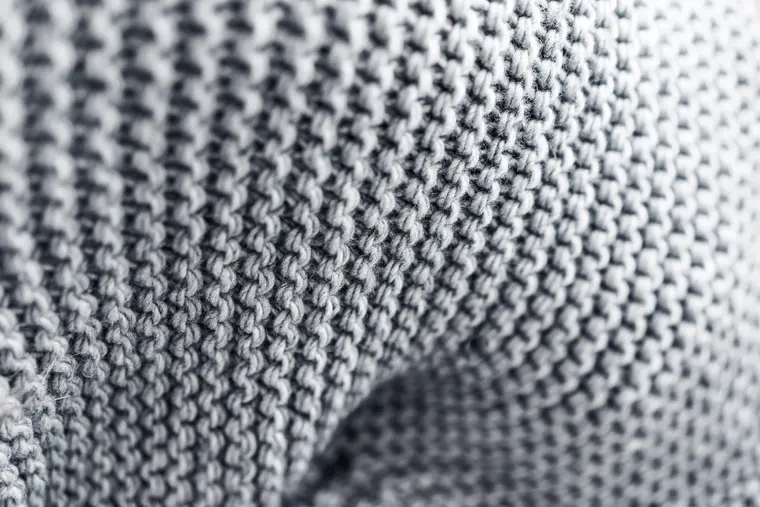
A cable panel does not add width to a sweater. It takes width away. Two stitches crossed every sixth row pull the fabric in at the panel, and a body knitted to the same stitch count as a plain sweater finishes narrower than the pattern says. That is why cable garments are drafted from a measured swatch rather than from a formula.
Cable sweater sizing pattern take up is measured rather than guessed, and the work runs in a fixed order: knit the cable swatch and record the take-up, draft the body to the finished width, place the panel against the neckline, grade the sides without scaling the cable, then approve a size set. Skip the first step and the rest is guesswork.
Cable Sweater Sizing Pattern Take Up: What the Swatch Tells You
Take-up is the width a cable pattern loses when it pulls the fabric in. Measure it on a relaxed cable swatch against a plain one in the same yarn: the difference tells you how much wider to draft the body. Without that number, a cable sweater grades narrower at every size.
The number is not a formality. It decides the stitch count on the machine, and it decides whether the garment measures what the size chart promises once it has relaxed on a hanger.
Why Cables Pull In
Crossing stitches consumes yarn that would otherwise sit flat, so the panel tightens in the row and draws the neighbouring stitches with it. The effect is strongest where the crossings are largest and most frequent, and it is visible before the garment is washed.
The take-up also moves with the yarn. A soft merino relaxes into the cable and opens slightly after blocking, while a firm lambswool holds the pull-in. Two sweaters with the same panel and the same stitch count can finish a size apart, which is why the swatch has to be knitted in the yarn the order will use.
Row gauge moves with the cable too. A crossed row sits tighter than a plain row, so the panel measures shorter as well as narrower, and the length of the garment has to be planned from the same swatch that set the width.

Step 1: Knit the Swatch and Measure Take-Up
Knit the whole panel, not one cable. A single cable shows the pattern; the panel shows how the pattern behaves beside plain knitting, which is the part that decides the finished width.
Measure the swatch relaxed, then block it the way the finished garment will be finished, then measure again. Record both numbers. The gap between them is relaxation, and a cable garment that is drafted on the unblocked measurement usually arrives wide and then shrinks into the size below.
Compare the cable swatch with a plain swatch from the same yarn and gauge. The difference in width, expressed as a proportion, is the take-up you will apply to the pattern.
Step 2: Draft the Body to the Finished Width
Compensate at the sides rather than in the panel. The cable keeps its stitch count and its width; the plain areas either side take the extra stitches that make the finished body measure what the chart promises.
Do not solve the problem by stretching the panel during blocking. It will relax back, and the garment will finish narrower than the sample that was approved. The width has to be knitted in, not pressed in.
Step 3: Place the Panel Against the Neckline
The panel and the neckline negotiate. A centre cable that runs into the neck opening looks intentional; one that stops short of it and then restarts above looks like a mistake, and the eye finds it across a room.
Decide where the cable resolves before the neckline is shaped, and keep the panel symmetrical about the centre front. If the neckline is deep, the panel can be split and mirrored; if it is high, the panel may need to finish in a small motif rather than run to the edge.
Sketch the neckline over the panel before the front is knitted. A drawing that puts the shoulders in the right place costs a few minutes, while a panel that has to be re-knitted because the neckline lands on a crossing costs a sample round.
Step 4: Grade the Sides, Keep the Cable
Cable sweaters are graded at the sides. The panel stays the same width across the range because a cable cannot be scaled without redrawing the crossings, and a redrawn cable is a different design at every size.
Width comes from the plain areas, and so does the armhole. Keep the panel centred as the body grows, and check the largest size for the one thing that goes wrong at scale: a panel that now occupies a smaller proportion of the chest and reads as a stripe rather than a feature.
Length grades separately. A cable pattern that repeats every twelve rows can be lengthened by adding repeats, but the repeat has to land correctly at the hem and at the shoulder.
Step 5: Approve a Size Set
Approve at least three sizes and measure each one after blocking. The check list below is the order that finds problems fastest.
| Check | What to measure | Why it matters |
|---|---|---|
| Take-up | Cable swatch against plain, relaxed | Sets the stitch count for the body |
| Panel width | Across the cable, relaxed and blocked | Confirms the panel did not drift |
| Chest width | Finished, after blocking | The number the size chart promises |
| Neckline alignment | Panel centre against centre front | Symmetry reads at a glance |
| Armhole | Depth and width at the largest size | Where added side width distorts fit |
| Length | Hem to shoulder after blocking | Catches a repeat that does not land |
Measure the largest size first. A grade that works at medium and drifts at the top of the range is a grade that costs money in the sizes that sell least and complain most.
What the Spec Sheet Should Record
Write the take-up measurement and the blocked gauge, not only the finished measurements. A factory that receives the finished numbers without the swatch data will knit to the chart and discover the take-up on the first sample, which is the round you were trying to avoid.
Record the panel width, the number of stitches in the panel, the yarn and the gauge. Then record the blocking method: how the sample was wetted, how it was pinned and how long it rested. The finishing standard is part of the pattern when a cable is involved.
Keep a photograph of the approved panel beside the numbers. A photograph is not a measurement, but it answers the question a measurement cannot: whether the cable still looks like the one that was signed.
If the customer needs Woolmark, RWS or GRS claims for the yarn, name the requirement before the swatch is knitted. Horssle Knit can source those yarns by requirement, with traceability documents where available, and the yarn ticket is where the claim starts.
Where the Pattern Meets the Price
Take-up has a cost. A cable panel uses more yarn than plain knitting of the same width, and it takes longer to knit because every crossing is a hand or machine operation. The cable knit sweater brief should therefore carry the panel width and the yarn quantity together, because one decides the other.
The same logic applies across fibres. A cashmere cable and a lambswool one have different take-up and different relaxation, and a crewneck with a narrow panel behaves differently from a wide one on the same body.
Sampling at Horssle Knit runs 7–12 days after fabric and tech pack approval, and bulk typically takes 20–35 days after sample approval, with a 300-piece minimum per style. A swatch measured before the first sample is knitted is the least costly way to keep those windows intact.
FAQ
Can the take-up be estimated from a single cable swatch?
Not reliably. A single cable shows the pattern but not how it pulls the plain fabric beside it. Knit the full panel width, because the edges are where the take-up actually shows.
Why does the cable panel stay the same width in every size?
Because a cable is a fixed arrangement of crossings. Scaling it means redrawing the pattern for each size, which turns one design into five. The sides carry the grade instead.
Does blocking hide a take-up error?
It hides it in the sample room and reveals it after the first wash. Blocking can open a panel slightly, but it relaxes back, and the finished garment returns to the knitted width.
How much wider should the body be drafted?
The amount the swatch lost, applied as a proportion rather than a fixed number, because the take-up changes with the yarn and the panel. Measure both swatches and let the difference set the figure.
Sources: The Woolmark Company, OEKO-TEX Standard 100, Intertek for test methods, EU Regulation 1007/2011 on textile fibre names, and Control Union for certification scope.
Working on a knitwear project?
Let’s talk yarn, gauge and timing.
Send a reference or tech pack and we will come back with a practical development route.