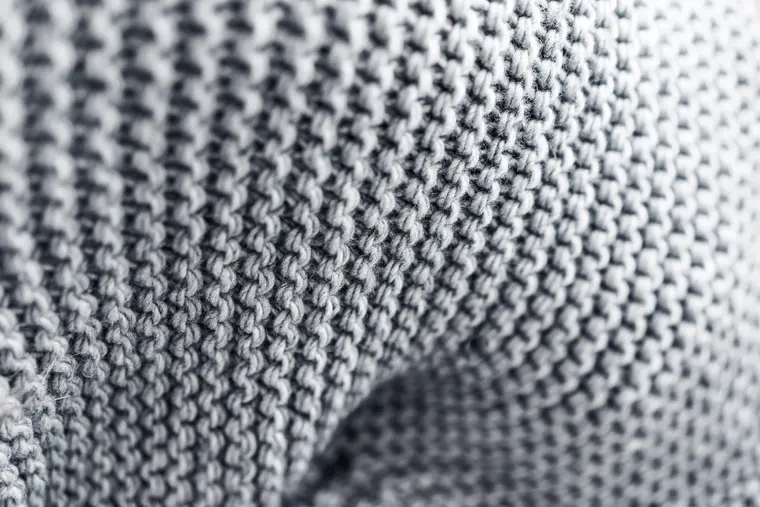
The complaint said the side seams were sewn crooked. The photographs showed both seams leaning the same way, which is what a crooked seam never does. The fabric had rotated, and it had rotated in the same direction on every piece in the lot, because the torque was in the cloth rather than in the sewing.
That is the counter-intuitive part of t shirt spirality after washing. A twisting t-shirt looks like a workmanship problem and is usually a fabric property that the cutting room can only make worse or better. Finding the cause starts with knowing which of the two you have.
What spirality is, and what it is not
Spirality is a rotation of the garment’s wales relative to the side seam. In a single jersey, the loops lean, and when the fabric is washed the torque built into the yarn and the structure is released, so the panel untwists and the seam appears to travel toward the front or the back.
It is not shrinkage, though the two arrive together. Shrinkage shortens the garment; spirality rotates it. It is not a seam allowance problem either, unless the panels were cut off grain, which is the second cause and the one a factory controls.
T shirt spirality after washing
T shirt spirality after washing happens when a single jersey untwists itself: the yarn torque built in at spinning and knitting is released by water and heat. It is a fabric property before it is a sewing fault, which is why a garment cut on grain can still twist.
The practical consequence is that the test must happen on a washed garment, not a greige panel. A fabric that looks straight on the table has not yet been asked the question.

Where the torque comes from
Yarn twist is the first source. A tightly twisted single yarn stores more energy, and a jersey knitted from it will rotate more when wetted. Plying balances the twist, which is why two-ply yarns tend to twist less than single yarns of the same count.
Knitting tension and machine direction add to it. A fabric knitted at high tension, or one that is finished on a stenter with unequal pull, carries more residual torque. Compacting and open-width finishing can reduce it; a tubular finish that is slit late can preserve it.
Cutting and sewing: the second cause
If the panels are cut off grain, the garment twists even when the fabric is well balanced. Grain is easy to lose in a busy cutting room: a marker laid slightly askew, a roll with a bow, a panel stretched during handling. The symptom is different from fabric torque: off-grain cutting usually twists in one direction for one panel and the other for its pair.
Check both. Cut a square from the middle of the roll and wash it; if the square rotates, the torque is in the fabric. If it stays square but the garment twists, the cutting or the seam alignment is the cause.
| Symptom | Likely cause | What to check |
|---|---|---|
| All pieces rotate the same way | Yarn or fabric torque | Washed square test from the roll |
| Left and right panels rotate differently | Off-grain cutting or marker | Grain line on the cut panels |
| Twist appears only after washing | Relaxation shrinkage releasing torque | Wash record before and after |
| Seam waves without rotating | Seam tension, not spirality | Stitch density and seam sample |
| Neckline rotates with the body | Panel alignment at assembly | Wales against the seam at the shoulder |
Tracking it with a wash record
A wash record turns a complaint into a measurement. Photograph the garment flat, mark the side seam at the underarm and at the hem, then wash and dry to the care label and measure the offset at both points. Repeat after the third wash, because torque often continues to release.
Record the fabric lot, the roll number and the cutting date against the result. Two lots of the same quality can behave differently, and the record is what tells you whether the problem is the fabric or the batch.
Specifying against it
The first lever is the yarn. Ask for a balanced or two-ply yarn, and ask the mill for a torque or spirality figure on a washed sample rather than a statement that the fabric is fine. The figure is what can be held to.
The second is finishing. Compacting, open-width processing and a relaxation period before cutting all reduce residual torque. A cotton T-shirt programme that specifies these is easier to keep straight than one that specifies only the fabric weight.
The third is the cutting room. Mark the grain on every panel, rest the roll before cutting, and check the first garment off the line against the washed square. A oversized T-shirt shows spirality more than a fitted one, because there is more fabric hanging from the same seam.
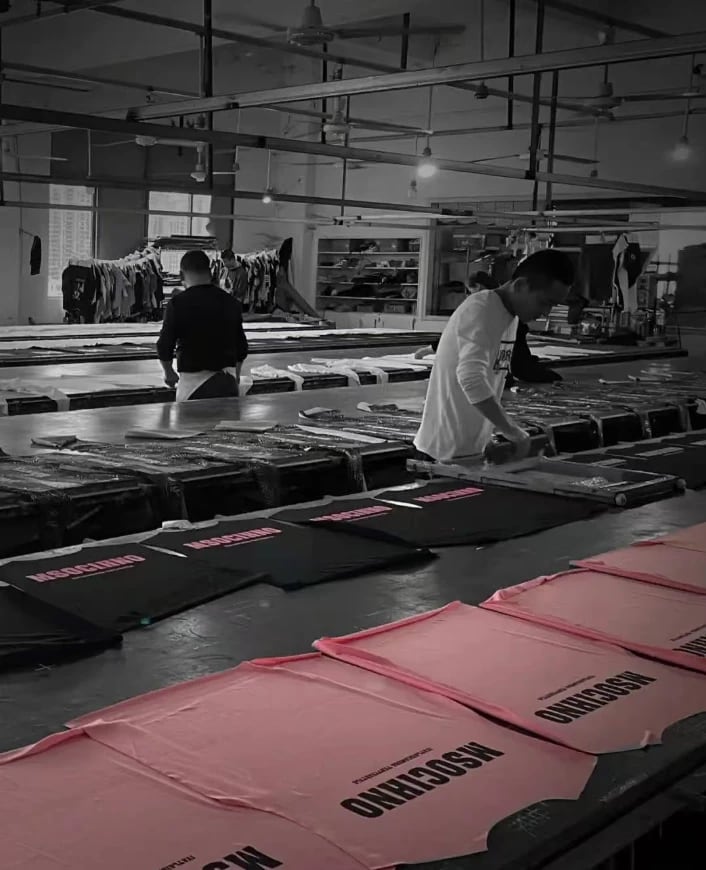
Decoration makes the problem obvious, which is useful. A print or an embroidery placed relative to the side seam will rotate with it, and the customer sees the tilt before they see the seam. If a style carries a large print, add the print’s alignment to the wash record.
What the mill can prove
Ask for a washed spirality figure, not an assurance. The test is simple: cut a square, wash it to a stated routine, and measure the rotation of the wales against the square’s edge. A mill that can quote the figure has measured it; one that cannot has an opinion.
Ask also for the yarn specification: single or two-ply, twist direction and twist level. Those numbers explain the figure and let a buyer compare two suppliers on the same basis. A gym T-shirt in a light, tightly twisted jersey is a harder brief than a heavyweight basic, and the yarn record is what shows whether the mill understood it.
A troubleshooting sequence
Work from the fabric outward. First, wash a square from the roll: rotation means torque. Second, check the cut panels against the grain line: a panel cut off grain explains a twist that the square did not show. Third, check the seam alignment at the underarm and the hem: panels sewn with an offset will pull the garment into a spiral even in balanced cloth.
Only after those three should the sewing machine be blamed, and rarely is it. Most spirality complaints end with a yarn or a finishing change, and the sequence is what gets there without wasting a second sample round.
Clauses to copy into the order
The specification that prevents most spirality fits in four lines, and each one is checkable at delivery. They cost a paragraph in the tech pack and a washed square in the sample round.
- Yarn. Single or two-ply, with the twist direction and twist level stated.
- Fabric. A washed spirality figure, the test routine used and the limit accepted.
- Cutting. Grain line marked on every panel and checked on the first garment of each lot.
- Approval. A washed garment measured at the underarm and the hem before bulk is released.
Four lines move the argument from opinion to record. Where the style carries a print or an embroidery, add its alignment to the fourth line, because the decoration is what the customer sees first when the body rotates.
Sampling and bulk
Horssle Knit samples in 7–12 days after fabric and tech pack approval and runs bulk in typically 20–35 days after sample approval, with inspection to AQL 2.5. For a jersey prone to spirality, the sample round should include a washed garment measured at the seam, and the figure should travel into the bulk specification.
A minimum of 300 pieces per style applies. If the lot is large enough to span more than one roll, ask for a washed square from each roll before the cutting starts; the cost is a few centimetres of fabric and the saving is a re-make.
FAQ
Does spirality always get worse after washing?
Not always, but the first wash releases most of the torque and later washes can add to it. Test after one wash and again after three, and judge the trend rather than a single result.
Is spirality a defect I can reject on?
Yes, if the specification states a limit and the garment exceeds it. Without a stated limit, a twisting shirt becomes an argument about tolerance. Write the limit and the test method into the order.
Can a twisted shirt be pressed straight?
Temporarily. Pressing moves the fibres back for a wear or two, and the twist returns after the next wash. It is not a correction, and it is not worth doing to a bulk lot.
Do heavier jerseys twist less?
Weight is not the variable; twist and structure are. A heavy single jersey can twist as much as a light one if the yarn is tightly twisted. Ask for the washed figure, not the weight.
Sources: OEKO-TEX Standard 100, EU Regulation 1007/2011 on textile fibre names, Intertek textile testing, Higg facility indexing, US CBP informed compliance, and The Woolmark Company on fibre specification.
Working on a knitwear project?
Let’s talk yarn, gauge and timing.
Send a reference or tech pack and we will come back with a practical development route.