
Two orders, 300 pieces each. The first is one colour across six sizes; the second is five colours across the same six. Same total, same style, same fabric. The second carries thirty SKUs, an average of ten pieces per SKU, five dye bookings and cartons holding a ratio nobody wrote down. The unit price rises, and fabric is not the reason. The split is.
Treat the split as a checklist rather than one decision. A 300 piece apparel order size breakdown is never a single number: colour count, size curve, cut yield and carton ratio pull on each other, and a choice made in one of them turns up as a cost in the other three.
What the 300-piece minimum covers, and what it does not
The minimum is 300 pieces per style. That figure describes the style, not the split inside it, and the two get confused the moment a brief arrives with five colours on it. A style is sampled once; the colours inside it are booked separately at the dyehouse.
The first question is not how many colours a buyer can have, but what the minimum per colour is on that fabric. It moves with the fabric, the shade and the batch the mill is running, which is why it is quoted rather than published. Ask for it in writing, per fabric.
Dye lots are the other half of the same question. Two batches of one colour, dyed separately, can differ enough to show when pieces are laid side by side. In a small order the real exposure is between batches of a single colour, not between colours.
A 300 piece apparel order size breakdown, worked through
Split a 300-piece order in three steps: fix the colour count, set a size curve for your market, then round each cell to a quantity the factory can cut and pack. Three colours across five sizes, weighted to the middle, is a common starting shape.
Below is that shape with numbers attached, assuming one style, one fabric and 300 pieces. Treat it as an illustration: the per-colour minimum and your own sell-through decide where the cells land. The arithmetic holds for a T-shirt, a hoodie or a sweater from our custom apparel range, though the grade underneath changes.
| colour | S | M | L | XL | XXL | Total |
|---|---|---|---|---|---|---|
| Ecru | 15 | 30 | 30 | 15 | 10 | 100 |
| Navy | 10 | 35 | 35 | 15 | 5 | 100 |
| Olive | 15 | 30 | 30 | 20 | 5 | 100 |
| Total | 40 | 95 | 95 | 50 | 20 | 300 |
Read the table as fifteen cells, not three colours. The smallest is five pieces, the largest thirty-five, and both carry a cutting ticket, a bundle and a line in the packing sheet. That is where labour per unit becomes visible.
The shape is worth noticing too: M and L take 190 of the 300 pieces, 63 percent. That concentration is what lets the order cut cleanly, and what leaves a brand short if its customers skew to larger sizes.
Deciding the colour count before the size curve
colour count is the multiplier, and it divides the order. Two colours across five sizes is ten cells, three across five is fifteen, five across six is thirty. The total stays at 300, so each colour added takes pieces from every other cell.
At thirty cells the average is ten pieces. A ten-piece cell still needs a marker, a spread, a bundle ticket and a line in the pack, and sewing time per unit does not fall with quantity. Overhead per unit rises, and the quote follows it.
For a first 300-piece order the workable range is usually two to four colours: core shades carry volume, one fashion shade carries its own minimum. A shade that sells twenty pieces is a fair test, until it takes cutting capacity from the colour that would have sold two hundred.
Building a size curve for the market you sell into
A size curve is not a house standard. It follows the bodies you sell to, and those shift with market, age, category and channel. A uniform program usually needs a longer tail above XL than a fashion drop does; a direct-to-consumer base skews by audience, not by the country on the label.
If you have sell-through from a previous season, use it, even when the sample is small. A few hundred units of history beat a default curve, and the reorder is where a wrong curve shows up as a missing size.
Without history, weight the middle, keep a plausible tail, and approve a size set before bulk so the grade is checked on real wearers rather than a flat pattern. Catching a short body on a size set is cheaper than catching it on 300.

How the split changes cut yield
Fabric consumption is set by the marker, and the marker follows the curve. A spread carrying mostly M and L nests tightly; a curve spread across six sizes with small cells produces short markers and more waste. The fabric is bought against whichever split was live that day.
Two questions get a useful answer. Ask which curve the quotation assumes, and ask to see the marker for the intended split before the order is signed. A supplier who prices one average consumption across every size is pricing a garment nobody ordered.
What the matrix does to production
The same 300 pieces can be five cells or thirty. The table compares three structures on the parameters that change actual work rather than on price, because price is a quotation and these are structural.
| Structure | SKUs | Average pieces per SKU | Separate dye bookings | Cutting tickets | Packing complexity |
|---|---|---|---|---|---|
| 1 colour, 5 sizes | 5 | 60 | 1 | 5 | One ratio sheet, solid cartons |
| 3 colours, 5 sizes | 15 | 20 | 3 | 15 | Three ratio sheets, colour-assorted cartons |
| 5 colours, 6 sizes | 30 | 10 | 5 | 30 | Five ratio sheets, mixed cartons, highest pick risk |
Assumes one style, one fabric and 300 pieces. The number of dye bookings also depends on the batch available, which is why it is quoted per order.
The middle row is where most first orders land: each colour big enough for one dye lot, every size a cell the cutting room can bundle, room for a fashion shade if the minimum allows. The bottom row is a range decision, and it should be taken with the packing consequences priced in.
Ratio packing and carton configuration
Packing often decides the split more firmly than sewing does. A retailer who wants solid-size cartons forces a different curve than a distributor who receives ratio packs, and a ratio of one S, two M, two L, two XL and one XXL per carton pulls the cells into shape whether or not anyone planned it.
Ask for the retailer’s ratio sheet before the split is fixed. If none exists, agree a ratio in the order and repeat it on the carton marking, because mixed cartons cost receiving time and that cost tends to come back as a charge.
Where the split gets fixed: sampling and approval
The split does not need to be final in the first email, but it does need to be final before fabric is booked. Sampling runs 7–12 days after fabric and tech pack approval, bulk typically 20–35 days after sample approval, and a late change touches the marker, the dye booking and the dates.
Use the sample round to test the shape. Ask for a size set in the intended curve, check the grade against the measurement sheet, and confirm the smallest cell is still something the cutting room can handle. The order is inspected at AQL 2.5 against that sample.
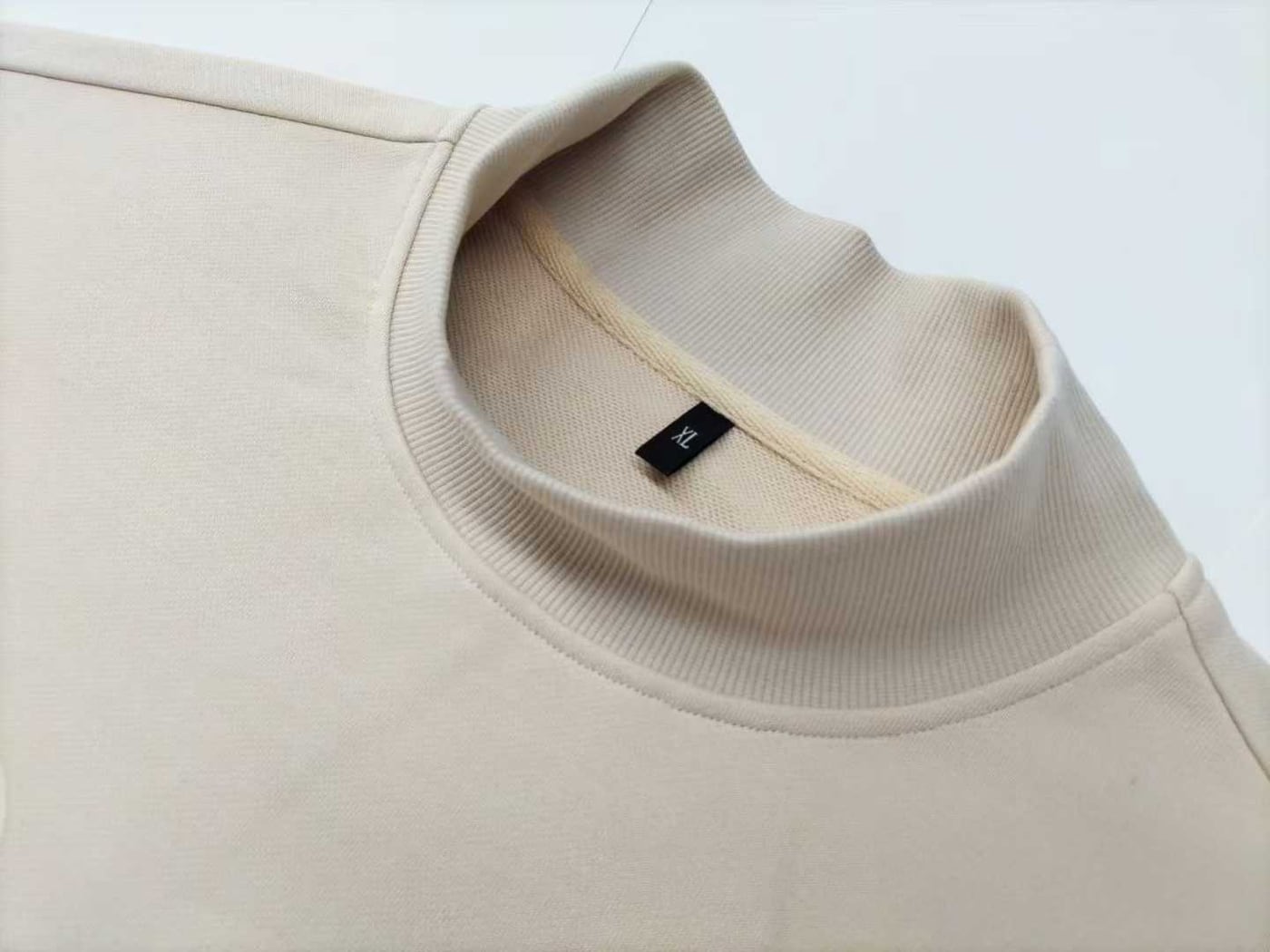
The pre-order checklist
Seven items, in the order they are worth settling. Each is a decision the factory cannot make for you.
- Total pieces per style, checked against the 300-piece minimum.
- Minimum per colour, quoted per fabric and shade, in writing.
- colour count, each shade large enough for one dye lot.
- Size curve, with the grade and measurement sheet attached.
- Every cell rounded to a quantity the cutting room can handle.
- Ratio sheet and carton configuration agreed with the receiver.
- Final matrix in the purchase order, with a version date.
Most are cheap before the order and expensive after it. The version date matters as much as the numbers, because a split that changed without a record is a split nobody agreed to.
FAQ
Does the 300-piece minimum apply per colour or per style?
Per style. The colour minimum is a separate number, quoted per fabric and per shade, because dyeing is booked in batches.
Can I split 300 pieces across two styles?
Only if each style still meets its own minimum. Two styles at 150 pieces fall below 300 per style, so the practical routes are one style at 300 pieces or two separate orders.
What size curve should a first 300-piece order use?
Start from your own sell-through. Without history, weight M and L, keep a tail to XL and XXL where your market needs it, and approve a size set before bulk.
Can the split change after the purchase order?
Before fabric is booked, usually yes, with a revised matrix and a new version date. After booking, the marker and dye lot are committed and the 20–35 day bulk window is at risk.
If the split is still open, send the style, the target quantity and the colour list: the contact form reaches the sampling team, and a short reply will say which cells need a decision first. Past programs are summarized in the case studies.
Sources: OEKO-TEX Standard 100 on restricted substances, EU Regulation 1007/2011 on fibre names and labelling, US CBP informed compliance on import documentation, Intertek on textile testing, and Better Work on labour compliance.
Working on a knitwear project?
Let’s talk yarn, gauge and timing.
Send a reference or tech pack and we will come back with a practical development route.

