Seven to twelve days. That is the window one knitwear sample round occupies after fabric and tech pack approval, and it is the number that decides how a development calendar gets built. A buyer who treats every sample as a full validation of the garment will spend that window three times where once would have done.
Most knitwear sample types explained in a single list, as a ladder from swatch to pre-production, miss the point. Each sample answers a different question, takes a different input and ends in its own sign-off. Treating them as stages of one approval is what turns one window into three.
Knitwear sample types explained by purpose, not by order
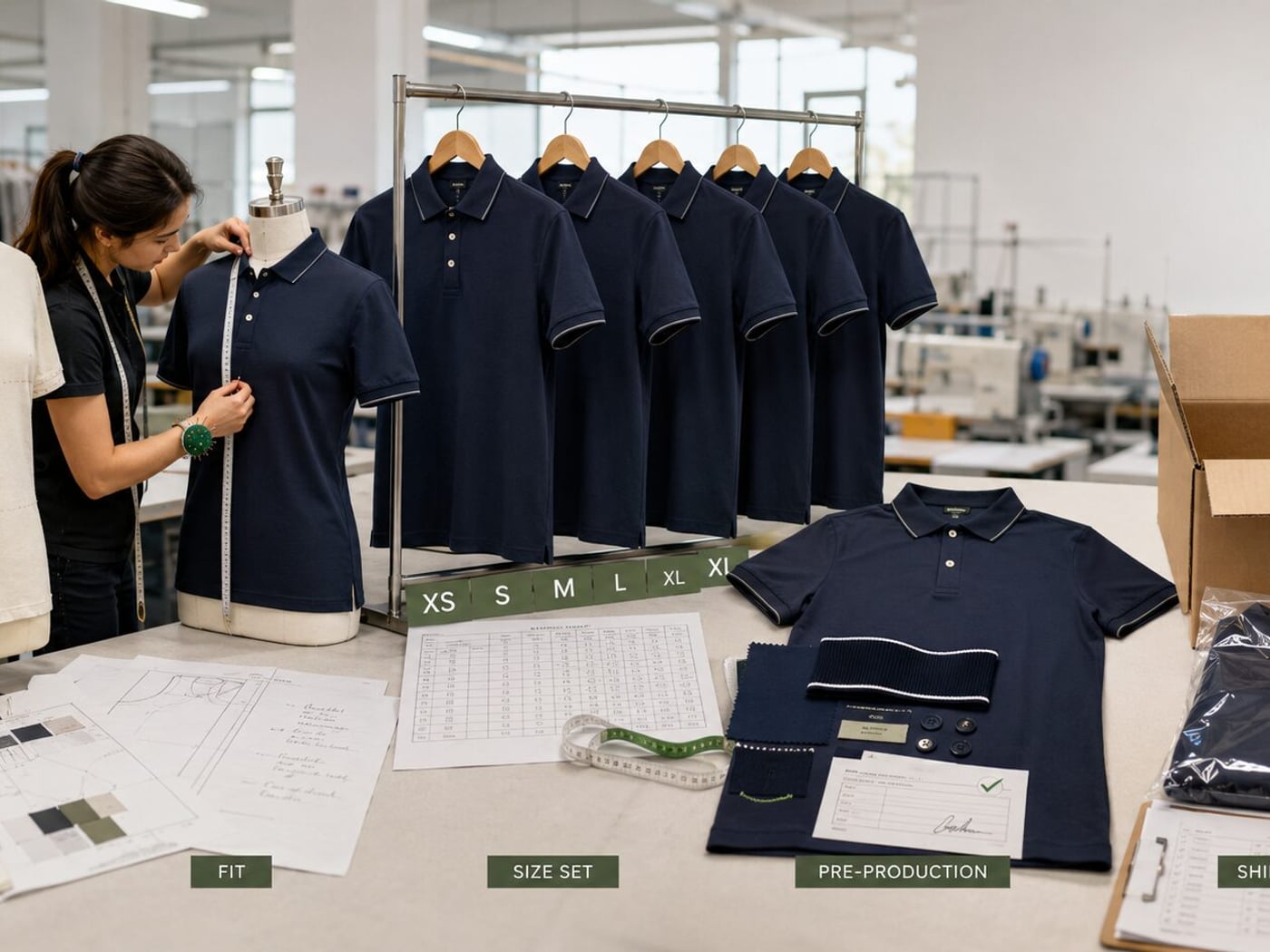
Knitwear sample types are defined by the question each one answers: a swatch answers what the fabric feels like, a fit sample answers whether the shape works, a size set answers whether the grade holds, and a pre-production sample answers whether the factory can repeat it.
That is not a naming argument. The purpose decides what you send, what you measure when the sample returns, and what you are entitled to approve. A sample asked to prove everything proves nothing quickly, and the delay lands at the end of the calendar rather than the start.
Swatches: the first answer, and the least costly to change
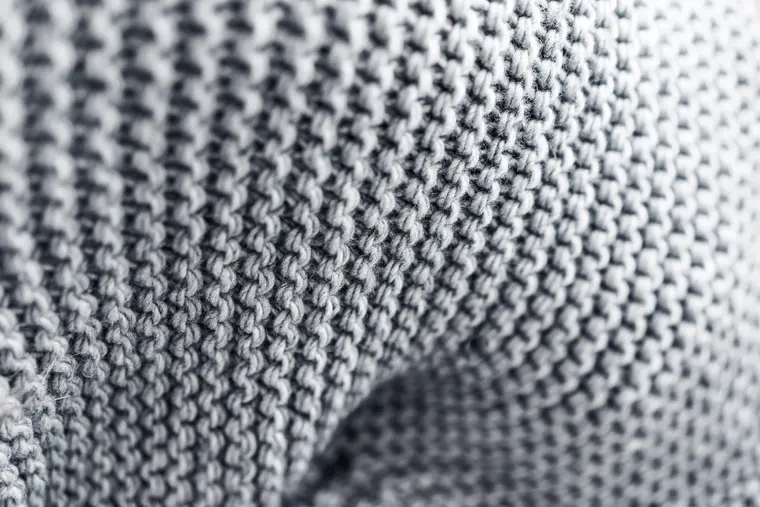
The swatch answers the yarn and hand-feel question: whether this fibre at this gauge feels like the garment the brand is trying to sell, and whether the shade holds in the stitch the design needs. It takes one knitting pass and changes nothing else, which is why it belongs before a fit sample rather than beside it.
The swatch round is also where stitch structure is settled. A cable, a rib, a jacquard or a float pattern changes the fabric weight and the yield, and changing structure after a fit sample usually means knitting the body again. Ask the structural question twice at swatch stage; it is the least costly place in the process to be uncertain.
Fit samples: proving the shape
A fit sample answers whether the garment sits on a body the way the drawing said it would: shoulder position, body width, sleeve pitch, neckline depth and hem length. It has to be made in the intended fabric at the intended gauge, because a fit sample in a substitute yarn answers a question nobody asked.
One sample in one size is enough for this step. Measure it against the spec sheet, put it on a fit model, and write the corrections as measurements with target values rather than as adjectives. Those corrections are what the size set will be graded from, so the clarity of the fit comment decides the quality of the grade.
Fit models vary, and one model’s shoulder line is not a standard. If the brand has its own fit model or a measurement chart from a previous season, send it with the request, because a correction is only useful when it is measured against a body the brand recognises.
Size sets: proving the grade
A size set answers whether the grade holds. A medium that fits well is not evidence that the extra large will, and the failures show up as an armhole that tightens, a neckline that drops or a body that shortens across the range. The set is usually the smallest size, a middle size and the largest, measured flat against the same spec sheet.
This is the sample buyers are most often tempted to skip, and it is the one that catches a grade running narrow in the shoulder before the error is multiplied by a bulk order. A size set is also the only place where a grade rule can be checked against a real garment rather than against arithmetic.
Pre-production samples: proving repetition
The pre-production sample answers the last question: can the factory make the approved garment again, in bulk, from the actual bulk fabric, trims and labels. It should be produced under production conditions rather than in the sample room, because the bulk is inspected at AQL 2.5 against this sample and nothing else.
Signing it closes the development. After that point a change is a production change, with the calendar consequences that follow, so the buyers who get the cleanest result from this stage are the ones who have already settled every earlier question.
The check on arrival is short: measurements against the graded spec, workmanship at the edges and the closures, and labels and trims exactly as ordered. Anything that differs from the approved fit sample is a question for the factory before the bulk run books its slot.
| Sample | Question it answers | Input needed | Sign-off output | If skipped |
|---|---|---|---|---|
| Swatch | Hand-feel, structure and shade | Yarn, gauge and stitch direction | Approved swatch card | Structure changed after the fit sample |
| Fit sample | Shape on the body | Spec sheet, technical drawing, intended fabric | Written correction list | Corrections guessed at bulk |
| Size set | Grade across sizes | Approved fit sample and grade rules | Graded spec and size set approval | Grade error multiplied across the order |
| Pre-production | Repetition of the approved garment | Bulk fabric, trims, labels and signed fit | Pre-production sign-off | Bulk inspected against an unproven standard |

What each sample needs as input
Inputs differ, and sending the wrong one is the most common reason a round is wasted. A swatch needs a yarn, a gauge and a stitch direction. A fit sample needs a spec sheet with measurements, a technical drawing and the intended fabric. A size set needs the approved fit sample plus the grade rules. A pre-production sample needs bulk fabric, trims, labels and the signed fit.
Each of those inputs is a document or a physical item, and each takes time to prepare. The sequence only saves calendar time if the inputs arrive with the request rather than after it, which is why the input list belongs in the first email rather than in the third.
Where sample rounds go wrong
Failures cluster in three places, and each one traces back to a sample that was asked to carry more than its purpose.
| Symptom | Where it starts | Fix on the next round |
|---|---|---|
| Fit right in the sample, wrong in bulk | Fit approved without a size set | Grade the fit and approve the small and large sizes |
| Shade approved, bulk shade differs | Swatch approved on a different yarn or stitch | Approve the shade on the bulk yarn and structure |
| Sample fine, bulk edge fails inspection | Pre-production sample made in the sample room | Run the pre-production sample on production machines |
None of these is a factory failure in the ordinary sense. Each is a missing sample in the sequence, and the sequence is the part that protects the calendar. When the defect appears at inspection, the cost of the missing round has already been paid twice: once in the delay and once in the remake.
Signing off without a full validation
A sign-off is not a claim that the garment is perfect. It is a record that the sample answered the question it was built for and that the next step can begin. Written that way, each approval takes minutes: a swatch is approved on hand-feel and structure, a fit sample on measurements and corrections, a size set on the grade, a pre-production sample on materials and workmanship.
The published timetable supports that reading. Sampling runs 7–12 days after fabric and tech pack approval, and bulk production typically 20–35 days after sample approval. Both assume the sequence is followed once. When a single round is used to answer two questions, one of them comes back unanswered and the window is spent twice. Fuller examples of that cycle appear in the case studies.
FAQ
Do we need a fit sample in every size?
No. One size proves the shape, and the size set then proves the grade at the smallest and largest sizes. Making a fit sample in every size repeats the same question and delays the answer.
Can the pre-production sample be skipped if the fit sample was approved?
No. The fit sample proves the shape, not that bulk fabric, trims and labels reproduce it. The bulk is inspected at AQL 2.5 against the pre-production sample, so skipping it leaves the order without a standard.
What usually causes a second sample round?
A structure change after the fit sample, or a grade correction that the size set was never asked to catch. Both are avoidable when the input for each stage arrives with the request rather than after it.
Who should sign off the size set?
Whoever owns the fit, usually the buyer or the brand’s technical lead. The signature records that the grade was checked; it is not a judgement about the design.
If the sequence is unclear, send the style and the stage you are at to the sampling team, and the services overview sets out what each stage is expected to produce.
Sources: Intertek on textile testing methods, OEKO-TEX Standard 100 on restricted substances, Better Work on labour compliance, Higg on environmental assessment, and EU Regulation 1007/2011 on fibre names and labelling.
Working on a knitwear project?
Let’s talk yarn, gauge and timing.
Send a reference or tech pack and we will come back with a practical development route.