
The item that decides whether a private label garment feels considered is not the hangtag. It is the small label at the back of the neck, which the wearer touches before reading anything, and the care label that ends up cut out with scissors because it scratches. Brand budgets go to the logo; the wearer meets the labels first.
That is the counter-intuitive part of private label development. A private label apparel branding checklist is mostly a list of small physical objects, and a well-made garment can still fail on one of them: a neckline that itches, a tag edge that shows at a seam, a polybag warning nobody read.
Private label apparel branding checklist: the short answer
A private label apparel branding checklist covers five groups: neck labels, care and content labels, hangtags, retail packaging, and the approval files behind them. Each group needs a size, a position, an artwork file and a sign-off. The garment cannot ship until all five are approved in the same revision.
The trade-offs in each group are worth settling early, because most private label delays come from choices made late rather than from the factory.
The piece the wearer touches first
Run a hand along the inside of a neckline and the difference is immediate. A woven label with softened edges sits flat; a stiff printed label curls at the corner after a few washes; a heat transfer label disappears into the fabric or, if pressed too hard, leaves a shiny patch.
Wearers rarely complain in words. They cut the label out, and the garment loses its size, fibre content and brand in one motion. For a retailer that is a compliance problem as well as a comfort one.
So choose the label before the neckline is finalised. A woven label has a folded end and needs a seam allowance to sit in; a printed label needs a flat surface; a heat transfer needs a panel that takes heat without shine. Deciding after the sample is sewn means re-cutting the neckline.
Woven, printed or heat transfer: the trade-offs
| Decision | Woven label | Printed label | Heat transfer |
|---|---|---|---|
| How it is made | Woven on a loom with the artwork in the weave | Ink printed onto a satin or taffeta tape | Printed film pressed directly onto the fabric |
| Detail | Limited by loom resolution | Fine text and small logos | Fine detail, no label edge |
| Hand feel | Soft once the edges are softened | Can feel stiff against skin | Barely detectable when pressed well |
| Durability | Holds through repeated washing | Print can fade or crack | Can dull or lift with heat and abrasion |
| Setup | Loom setup per design | Artwork file only | Artwork file and pressing plate |
| Typical fit | Brands wanting a tactile neck label | Short runs and many variants | Minimal branding and lightweight knits |
None of the three is a default. A brand with one logo and a long production life will usually prefer woven; a brand running six colourways in small quantities will usually prefer printed, because the artwork changes without a loom setup.
Care and content labels: the compliance layer
Care labels carry legal weight. Fibre names are regulated in the market where the garment is sold, and the EU regulation on textile fibre names sets out which names may be used and how percentages are stated. In the United States, the Federal Trade Commission rules and CBP informed compliance publications cover the same ground differently.
Two decisions belong here. The first is language: a label for the EU may need several, and space is fixed, so the text has to be planned before the label is made. The second is the care instruction, which must match what the fabric can survive. A symbol set that permits a hot iron on a heat transfer print is an instruction to fail.
Symbols are their own system, and the destination market decides which applies. Confirm the set with the buyer’s compliance team rather than assuming a familiar one travels. The label also has to survive: one that fades after five washes no longer carries the information it was attached for.
Hangtags: what the swing tag has to carry
A hangtag is a marketing object with a compliance tail. It carries the brand, the style, sometimes the size and a barcode, and it is attached with a string, a plastic fastener or a safety pin depending on the retailer. Each attachment has a placement rule, and the wrong position is a chargeback waiting to happen.
Material is a real decision. Coated stock photographs well but does not accept a stamp or a handwritten price; uncoated kraft suits a natural brand and shows handling marks. If the tag carries a price, decide whether it is printed, stickered or left blank for the retailer.
Barcodes deserve an early check. The symbology, the quiet zone around the bars and the print quality all affect whether a store scanner reads the tag first time. Send the barcode file with the artwork, not at proof stage.
Retail packaging: polybags, cartons and the carton mark
Packaging is where a correct garment becomes an incorrect shipment. A polybag needs the right gauge, a suffocation warning where the market requires one, a size sticker and, for some retailers, a hang hole or euro slot. A carton needs a mark that matches the retailer’s specification: style, colour, size ratio, quantity, carton number and order reference.
The trade-offs are practical. Individual polybags protect a garment and add handling time; flat-packed cartons save space and crease a garment that should hang. Recycled content is a claim that needs paperwork, not a phrase on a sticker.
The carton mark is the least expensive place to prevent a receiving dispute. If the ratio inside the carton does not match the mark outside, the warehouse finds out before the buyer does. Agree the mark against the routing guide, then check the first carton before the run finishes.
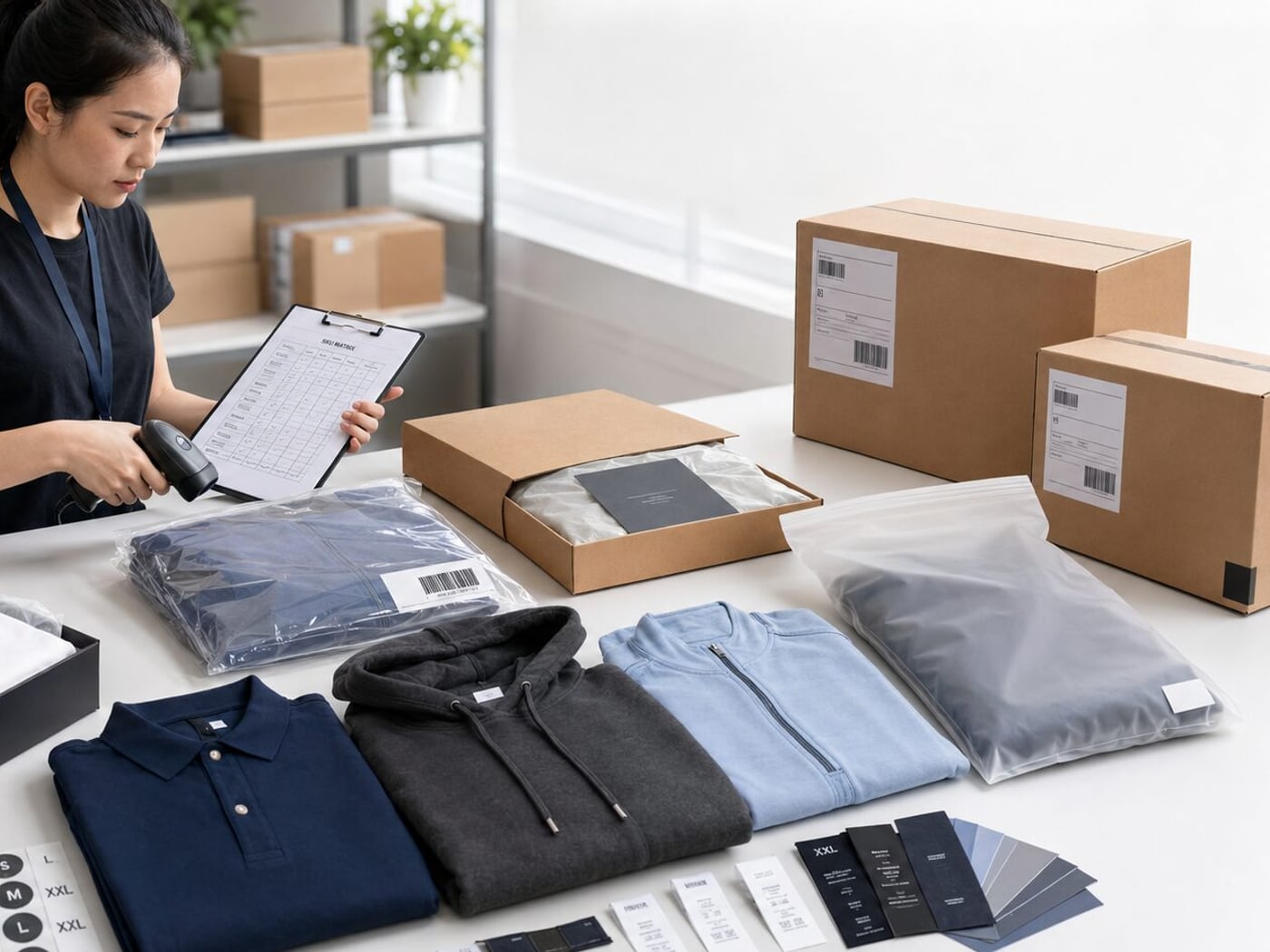
The checklist, item by item
Written as a working document, the list is short. Each line needs an owner, a size, a position and a date, or it becomes an email thread.
| Item | What to confirm | Who signs off |
|---|---|---|
| Neck label | Type, size, fold, position, artwork, colour | Brand, with a sewn sample approved |
| Care and content label | Fibre names, percentages, languages, symbols, placement | Brand compliance, against destination rules |
| Hangtag | Size, stock, finish, barcode, attachment and position | Brand and retailer, per routing guide |
| Polybag | Gauge, warning text, size sticker, hang hole | Brand, with one packed garment approved |
| Carton | Mark content, ratio, count, carton numbering | Brand and forwarder |
Add an artwork revision column if your team works across seasons. Most private label errors are not design errors; they are a season-two file applied to a season-one label.
Approving artwork: files, sizes and positions
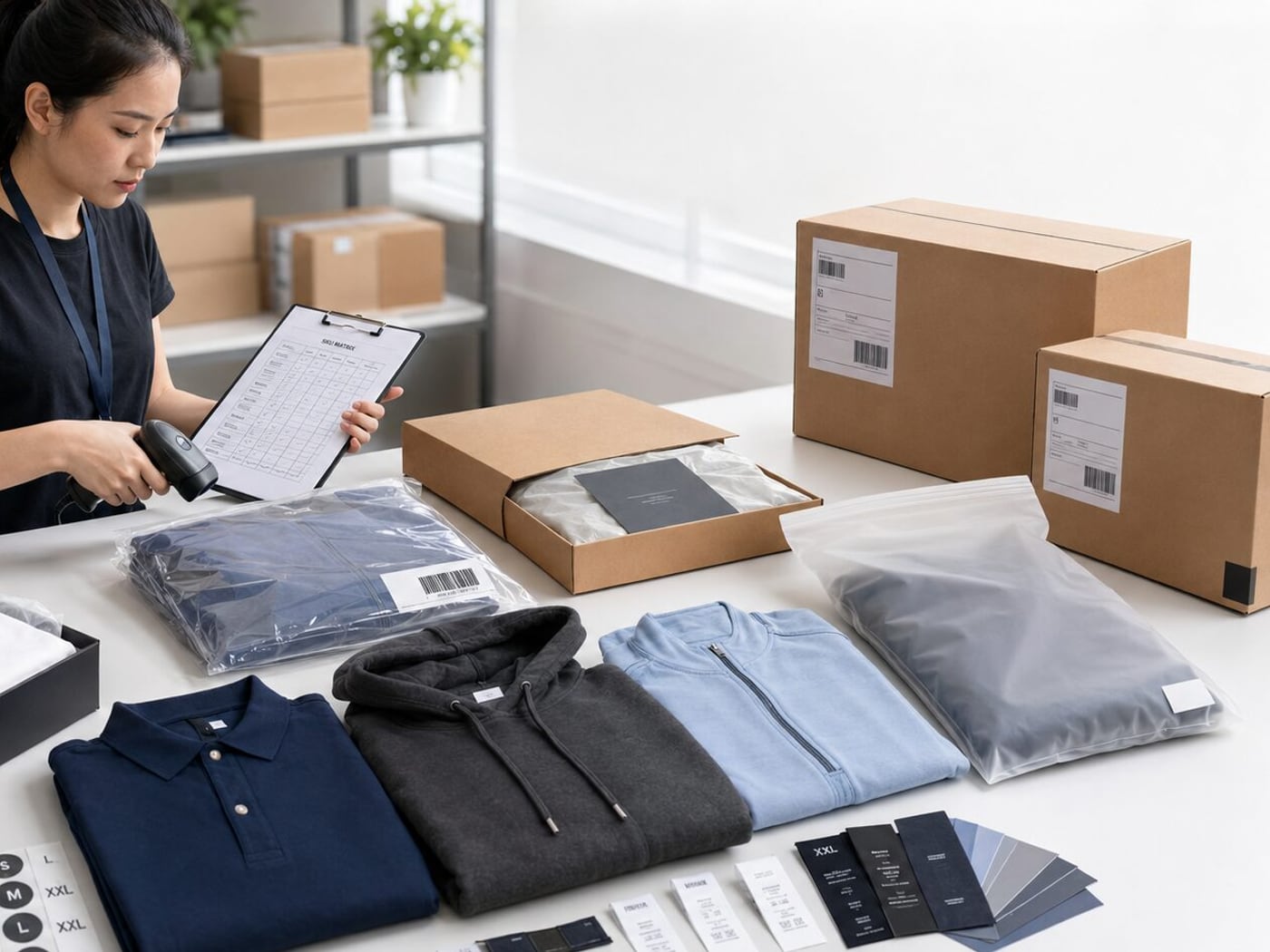
Approve on a physical sample, not a screen. A woven proof shows the weave, a printed proof the ink on the tape, a carton proof the print on the board. Each substrate changes how the artwork reads, and a logo that is crisp in a PDF can lose its counters at label scale.
Send vector artwork with fonts converted, state the finished size and position in millimetres, and name the colour references. Where a brand colour must match across label, tag and carton, accept that three substrates will not match exactly, and decide which sets the reference.
Claims that need a document behind them
Labels attract claims. Recycled content, organic fibre, a certification mark, a country of origin: each needs a document before the artwork is approved. A mill can supply OEKO-TEX Standard 100, GRS or RWS yarns by requirement with traceability documents where available, and that is not the same as a finished garment carrying a certification mark.
The safe sequence is document first, artwork second. Ask for the certificate scope and the holder name, check that the scope covers the material being used, then put the mark on the label. The care label development notes cover the same principle for fibre and care text.
FAQ
Which label type feels softest against the skin?
A softened woven label sits flattest, and a well-pressed heat transfer is barely detectable. Printed satin labels are the most likely to feel stiff, especially at the cut edge. Judge all three on a washed garment rather than on a swatch.
Can fibre content appear in more than one language?
Yes, and the market you sell into decides which languages are required. Plan the text before the label is made, because a woven label cannot gain a line after the loom setup, and a small printed label has a fixed area.
What has to be on a carton mark?
Usually style, colour, size ratio, quantity, carton number and the order reference, plus any retailer-specific fields in its routing guide. Confirm the exact layout with the buyer and the forwarder before the first carton is printed.
Who approves the branding files?
The brand approves artwork and colour; the retailer approves anything on its routing guide; the factory confirms what can be produced and where it sits. One written approval per item, on a physical proof, closes the loop.
Closing the branding file before production
A private label program is a stack of small physical decisions. Once each item has a size, a position, a proof and a signature, the factory can pack to it and a reorder can repeat it without another round of emails.
Send the label, tag and packaging artwork with the tech pack. Our private label knitwear manufacturing page sets out how branding is handled through sampling and bulk, the hangtag development notes cover stock and attachment, and the retail carton specifications cover the mark. Sampling is 7–12 days after fabric and tech pack approval, with bulk typically 20–35 days after sample approval.
Sources: EU Regulation 1007/2011 on textile fibre names, US CBP informed compliance publications, OEKO-TEX Standard 100, Better Work, Intertek and Higg.
Working on a knitwear project?
Let’s talk yarn, gauge and timing.
Send a reference or tech pack and we will come back with a practical development route.


