
The top that gaped was not too fine. It was knitted at an ordinary gauge and photographed well; it failed when the wearer raised an arm to a shelf and the armhole opened, and again when she sat down and the neckline dropped. A post-mortem on a fine gauge knit top development usually finds the same three faults, and none of them is the gauge.
That is the counter-intuitive part. Fineness makes a knit less opaque, but coverage, neckline position and armhole depth are decisions about fit, density and pattern, and each can be corrected without changing the gauge at all. What usually needs changing is the reference the pattern was borrowed from.
The sample that passed and the top that gaped
What follows is a reconstruction of a common development rather than one client’s story, because the sequence repeats often enough to be recognisable. A brand starts from a woven blouse that sold well. The knit sample copies its neckline width and its armhole depth, and on a hanger the result looks correct.
The pattern was graded from the woven block, so both numbers carried values that suited a fabric with no stretch. Knit fabric moves in ways a woven does not, and a pattern that ignores that movement reads as a fit error at the first wear rather than at the fitting, which is why the complaint arrives from a customer instead of from the sample room.
What the retrospective found
Three faults, in order of damage. First, coverage had been judged on a hanger in a studio, where nothing stretches the fabric and nothing is behind it. Second, the neckline had been measured flat across the front, not at the strap line where a wearer actually sees it. Third, the armhole had been copied from the blouse, with a depth and a curve designed for a fabric that does not give.
Each fault is cheap to find on a body and expensive to find in a return. None of them requires a new yarn, a new gauge or a new factory, which is the useful part of the retrospective: the fix is in the checking, not in the material.
Fine gauge knit top development: the checks that prevent it
Fine gauge knit top development needs three checks before a sample is approved: coverage against the light on a body rather than a hanger, a neckline measured at the shoulder and the strap line, and an armhole tested with the arm raised. The gauge is rarely the problem; the borrowed fit is.
The checks take an afternoon and a fitting model, and they replace a sample round. Write them into the approval sheet so the next style inherits them, because a check that lives in someone’s memory is a check that gets skipped when the calendar tightens.

Coverage is a parameter, not a thickness
Opacity depends on stitch density, yarn count, colour and how much the fabric is stretched over the body. Two tops at the same gauge can differ visibly under a doorway light, because one is knitted tighter and one is worn with more negative ease. A pale colour shows more than a dark one at identical density.
Test it the way a customer will: on a body, in daylight, with a light behind the wearer, and in the size that will be worn rather than the sample size. Then decide the fix. A denser stitch, a slightly heavier yarn, a darker colour, a double layer at the front, or a lining are all valid answers, and each one costs something different.
Neckline: width, depth and the strap line
Neckline width is measured across the front at the strap, not at the widest point of the opening, because the strap is what holds the garment on the shoulder. If the strap sits outboard of the shoulder bone, it will slide when the wearer moves; if it sits inboard, the neckline reads narrower than the drawing.
Depth is the second number, and it interacts with the band. A ribbed neckband pulls the opening in and sits closer to the body; a plain turned edge stays where it is sewn. For a fine-gauge top, the band tension matters more than the band width, and the strap line should be specified against the undergarment the market actually wears.
Armhole: depth, ease and the gaping check
An armhole gapes because of depth and ease, not because of size. Cut too deep, the underarm loses contact with the body and the opening stands away when the arm lifts. Cut too shallow, the top rides up and pulls across the chest when the arm comes down. The curve between those two failures is narrow in a fine gauge, because the fabric offers less resistance.
Test it on a body in four positions: arms down, arms raised to shoulder height, one arm across the chest, and seated. Photograph the underarm at each position. A gap that appears in only one position is a pattern adjustment; a gap that appears in all four is a size or block problem.
What the second development changed
The rebuild rarely touches the yarn. It changes the pattern, the approval sheet and the way the sample is judged, which is why the second development is usually faster than the first despite arriving later in the calendar.
| Check | What to measure | Pass criteria |
|---|---|---|
| Coverage | Opacity on a body in daylight, with a light behind | No lining or undergarment visible at the strap or chest |
| Neckline width | Across the front at the strap, and centre-front depth | Strap lands on the shoulder bone, not the arm |
| Strap line | Distance from neck edge to shoulder point | Matches the intended undergarment line |
| Armhole depth | Underarm to shoulder seam, plus ease at the pit | No gap with the arm raised to shoulder height |
| Body length | Centre front and centre back from the high point | Covers the waistband when seated |
| Rib recovery | Stretched width, then recovery after a wash | Returns within the agreed tolerance |
Two rows earn their place more than the others. Armhole depth is the one most often copied from a woven reference, and coverage is the one most often judged in the wrong conditions. Fix those two and the remaining checks become routine.
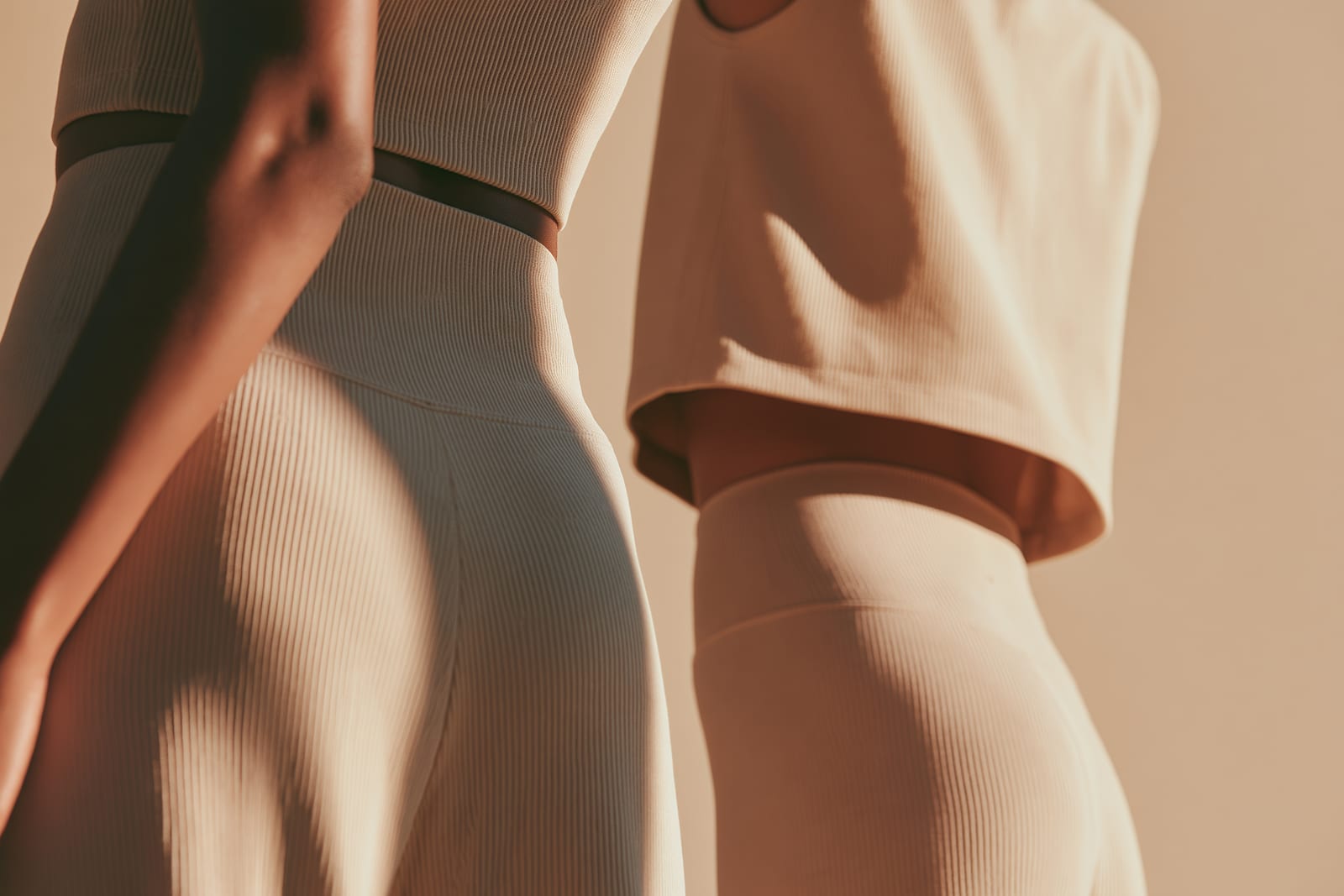
The logic carries across a range. A women’s knit top programme and a ribbed knit top ask the same questions about coverage and strap line, and a knit co-ord set adds one more: whether the top and the bottom meet when the wearer moves, which is a length decision rather than a gauge decision.
Density, gauge and the number behind opacity
Gauge counts needles per inch; density counts stitches per centimetre. The two usually move together, but they are not the same measurement, and opacity follows density more closely than gauge. A 14-gauge top knitted tight can cover better than a 16-gauge top knitted loose, even though the second one is finer.
So ask for courses and wales per centimetre, or for a minimum density on the finished fabric, and check it on the swatch rather than on the gauge label. On the ribbed tops the density also decides how much the garment pulls in at the strap, which is why rib and jersey need separate coverage tests rather than one approval.
What to bring to the sample round
Bring the reference garment, the undergarment the market wears, and a fitting model in the middle size. Bring the target opacity, described in a way a factory can test: a photograph under daylight, a lining decision, or a swatch held against a light. Bring the armhole and neckline numbers you intend to approve, not the ones inherited from the blouse.
Horssle Knit samples in 7–12 days after fabric and tech pack approval and runs bulk in typically 20–35 days after sample approval, with inspection to AQL 2.5. For a fine-gauge top, the sample round should include the four armhole positions and one wash, because the top has to survive both before the size grading is signed off.
FAQ
Can a fine-gauge top be opaque enough for workwear?
Yes, with density, colour and a construction decision. A tighter stitch, a darker shade or a double layer at the front will do it. What will not do it is a heavier gauge alone, because weight and opacity are different properties.
Does a finer gauge ladder more easily?
Not necessarily. Laddering depends on stitch density and yarn twist more than on gauge, and a tightly knitted fine gauge resists runs better than a loose mid-gauge. Ask for the density, not just the gauge number.
Why does the armhole gape when I lift my arm?
Because the armhole is too deep for the fabric and the ease. A knit needs a shallower, closer armhole than a woven garment. Test it with the arm raised before approving the pattern, not after the bulk arrives.
Is a higher gauge number finer or heavier?
Finer. Gauge counts needles per inch, so 16-gauge is finer than 12-gauge and knits a thinner fabric from a finer yarn. Heavier knits usually sit at a lower number, with a thicker yarn and a longer loop.
Sources: OEKO-TEX Standard 100, EU Regulation 1007/2011 on textile fibre names, Intertek textile testing, Higg facility indexing, The Woolmark Company on fibre specification, and US CBP informed compliance.
Working on a knitwear project?
Let’s talk yarn, gauge and timing.
Send a reference or tech pack and we will come back with a practical development route.


