
Two scarves come off the same cone of yarn in the same week. One hangs straight from the shoulder with a clean edge and a fringe that sits even. The other curls along both long edges, measures shorter than the drawing, and has a fringe that pulls the corners out of shape. The yarn was not the problem. The specification was a rectangle with a length and a width, and a scarf is not a rectangle. It is an edge, a hanging behaviour and a weight.
That gap is why custom knit scarf specifications take a sample round to settle rather than a line on a purchase order. A buyer who writes the four fields below gets a scarf that behaves; a buyer who writes two numbers gets a sample review that turns into a design argument.
Custom knit scarf specifications: the short answer
A custom knit scarf specification needs four fields: finished length including fringe, relaxed width, the edge finish on all four sides, and the finished weight. Add the yarn, gauge and stitch. Those fields decide how the scarf hangs, whether it curls, and what it costs to make.
The rest of this page is the reasoning behind each one, and the trade-offs between the edge finishes that make the biggest visible difference.
Length, and what the number includes
A scarf length is measured flat, relaxed, end to end. The question that causes most disputes is whether the fringe is inside that number. State it in the spec: finished length including fringe, or body length excluding fringe. Both are workable; a spec that leaves the question open is not.
Rib contracts, and a scarf knitted in a deep rib will measure shorter off the machine than it does after blocking. The spec should say whether the number is the blocked length or the as-knitted length, because the two differ by enough to fail a check. Blocking also evens the stitches, which is why a scarf usually looks better after it than before.
Length is a use question before it is a technical one. A scarf worn wrapped once over a coat needs enough length to stay put; one worn loose and long is a different product with a different weight and a different price. Decide the wearing style, then write the length that serves it.
Width, relaxation and the curl problem
Width is measured across the scarf, relaxed, at more than one point, because a knitted rectangle can vary along its length. A scarf measured while hanging will read longer and narrower than the same scarf measured flat, and a scarf left on a hanger for a week will keep some of that distortion.
Curl is the visible symptom of a stitch choice. Stockinette, which is smooth on the face and purled on the back, curls at any free edge because the two faces pull differently. Rib, garter and most textured stitches do not. The edge finish is how a designer either controls the curl or uses it deliberately.
Edge finishing: the trade-offs
Every edge finish buys stability with something: yarn, labour, softness or time. The table compares the routes we are asked for most often.
| Edge finish | What it does | Where it fails | What to specify |
|---|---|---|---|
| Rib end | Draws the end in and holds shape | Can look narrow beside a wide body | Rib depth, needle size, whether it is blended |
| Garter border | Flat, stable edge on all four sides | Adds width and yarn to every edge | Border width in stitches and rows |
| Rolled edge | Deliberate curl used as the design | Uncontrolled roll after washing | Which edges roll, and how far |
| Folded hem | Clean, firm finish that resists stretch | Bulk at the end and extra make-up time | Fold depth, seam type, finish inside |
| Crochet border | Decorative, stabilises a soft edge | Hand labour and variable density | Stitch, hook size, colour |
The rolled edge is the one to discuss explicitly, because it is either a design decision or a defect depending on what was written. A scarf that curls a little at the long edges after a wash is behaving normally for stockinette. A scarf that was specified as flat and curls is a rejected sample.
Fringe: length, count and how it is fixed
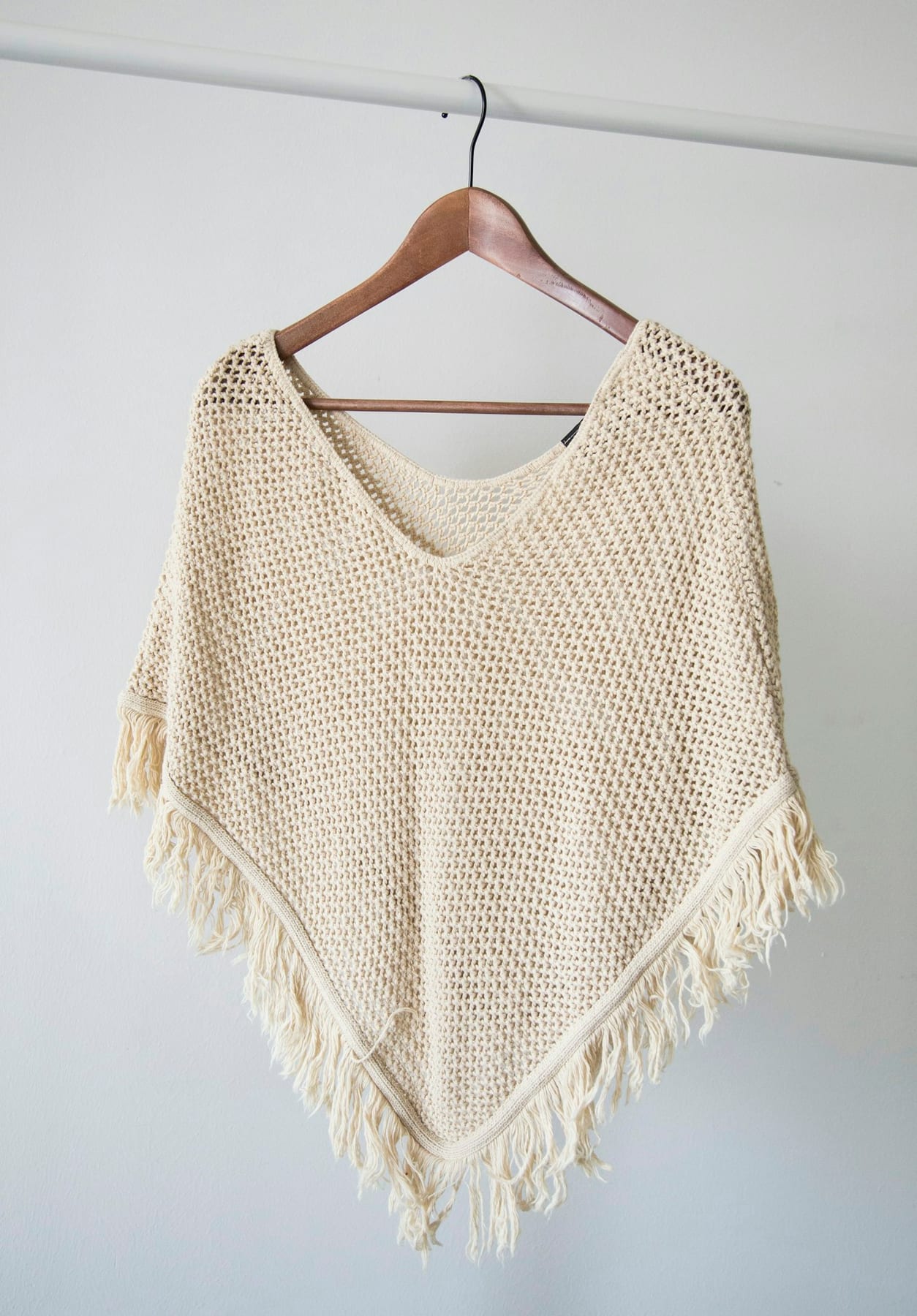
Fringe is a specification of its own: cut length, number of strands per bundle, spacing between bundles, and the method that holds it. A knotted fringe is secure and can pull the edge; a twisted fringe is softer and slower to make; a sewn fringe is the most controlled and the most expensive in labour.
Three details get missed. Whether the fringe is cut from the same yarn as the body, which decides whether it matches after washing. Whether the fringe is included in the finished length. And how the fringe behaves when the scarf is worn, because a long fringe on a soft yarn tangles and a short fringe on a firm yarn stands out.
Weight belongs here too. Fringe consumes yarn and adds handling, so a scarf with a generous fringe carries more yarn than the same body without it, and that difference belongs in the costing conversation rather than in a surprise on the invoice.
Weight and drape
Finished weight in grams is the field that connects the scarf to its price and to its behaviour. Two scarves can share a length and a width and still differ in weight because the gauge and stitch differ, and weight is what decides whether the scarf sits close to the neck or stands away from it.
A heavier scarf in the same yarn reads denser and warmer, and it will pull on the shoulders in a way a lighter one does not. For a merino accessories programme, the weight target is often the difference between a scarf that feels substantial and one that feels thin, even when both use the same fibre.
What to write in a scarf specification
This is the sheet we can sample from without a call.
| Field | What to write | How it is checked |
|---|---|---|
| Finished length | Blocked, flat, including or excluding fringe | Tape end to end, relaxed |
| Relaxed width | Measured at two points, flat | Tape across, no stretch |
| Gauge and stitch | Needles per inch, stitch structure, border plan | Swatch and sample |
| Finished weight | Grams per scarf, with a tolerance | Scale, per piece |
| Edge finish | Named finish for each of the four edges | Sample review against the drawing |
| Fringe | Cut length, strands per bundle, spacing, method | Count and measure on the sample |
| Blocking state | Blocked or as-knitted dimensions | Measure before and after blocking |
| Care | Wash method the sample was tested to | Wash test and re-measure |
Testing a scarf the way it is worn
A flat measurement is a starting point, not a verdict. The useful test is the wearing test: wrap it, knot it, tuck it into a coat collar, and leave it hanging for a day. Those four actions find the problems that a table cannot: a fringe that pulls the corner, a width that creeps, an edge that rolls further than the drawing.
Then wash it. A scarf is a high-friction accessory, and the points that pill first are the ones that rub against a collar and a bag strap. Washing the sample and re-measuring catches shrinkage and a changed handle while the pattern is still open, which is the whole point of sampling. Our scarf programme runs the same sequence for a matching beanie or a heavier throw, because the three products share a yarn and a colour and differ mainly in size and edge treatment.
Where scarf programmes lose a sample
Four failures repeat. A length that does not say whether fringe is included. A width measured on a hanger rather than flat. A stockinette body specified as a flat edge. And a fringe that is cut, counted and knotted by eye without a written spec, so the second sample does not match the first.
Each is fixed on the sheet rather than in the sample room. A written edge plan, a stated blocking state and a fringe specification turn a design argument into a check, and a check is what makes a reorder repeat. The same discipline runs through the loungewear pieces that share the accessory yarn, where a soft edge has to survive a wash without losing its shape.

FAQ
Should the finished length include the fringe?
Either is workable if it is written down. Most programmes specify the finished length including fringe, because that is what the customer sees. State the choice on the sheet and measure to the same point on every sample.
How do we stop a stockinette scarf curling?
Change the edge, not the yarn. A rib end, a garter border or a folded hem holds a flat edge; a rolled edge is a design decision that should be named in the spec. Blocking helps, and it does not remove the tendency.
How much fringe should a scarf have?
Decide the cut length, the strands per bundle and the spacing, then the fringe follows. The number of bundles is driven by the width and the spacing rather than by a rule, and the fringe should be cut from the same yarn as the body to match after washing.
Do scarves need their own measurement sheet?
Yes. A scarf is measured flat and relaxed, with a blocking state and a fringe definition that a garment sheet has no field for. Borrowing a knitwear sheet is how a length gets measured to a different point on two samples.
Sources: The Woolmark Company, OEKO-TEX Standard 100, Intertek, EU Regulation 1007/2011, Higg and Control Union.
Working on a knitwear project?
Let’s talk yarn, gauge and timing.
Send a reference or tech pack and we will come back with a practical development route.

