
Three tests decide whether a ribbed dress covers: standing, seated and stretched. Most programmes run the first and skip the other two, which is why a sample can look correct on a mannequin and still be returned by a customer who sat down in daylight.
Opacity is not a single property of a fabric. It is a property of a fabric in a pose, under a light, over a body. That makes it testable, and it makes it specifyable, provided the test conditions are written down rather than assumed.
Ribbed bodycon knit dress opacity: the short answer
Ribbed bodycon knit dress opacity is decided by three things: stitch density, yarn and colour, and the amount of stretch at the hip and seat. Test the dress standing, seated and stretched, against a light background, and record each zone. A knit that passes standing can still show through when seated.
Those three conditions are not equally weighted. Seated and stretched is where a bodycon dress actually fails, and it is the condition most sample reviews never create.
Three poses, one dress
A sample came back from a fit session with two notes. The first said the dress was fine standing. The second said it was transparent across the thigh when the model sat down. Both were true, and the supplier had every reason to feel misjudged: the dress had been photographed on a standing mannequin, in a studio, against a dark wall.
The fix was not a heavier yarn. It was a specification that named the poses, the background and the light, so the next sample could be judged against something reproducible.
Why rib opens when it stretches
A rib alternates knit and purl columns, which is what lets it stretch and recover. When the fabric is pulled horizontally, the columns separate and the spaces between them widen. The more the garment has to stretch to fit the body, the wider those spaces become, and the more the surface behind them shows.
Stitch density is the first lever. A denser rib has less space to open, and it recovers better after wearing. Rib depth is the second. A deep rib stretches further but opens more per unit of stretch, so the same yarn at a different rib can behave like a different fabric across the hip.
Recovery matters as much as stretch. A rib that opens when seated and closes when standing will pass a wearer’s test; one that stays open leaves a dress that looks stretched by mid-afternoon. Record whether the sample recovered after the seated test, not only whether it covered during it.
Colour and yarn change the answer
The same knit in ivory and in black are not the same product. A pale colour reflects more light and shows the shadow of the body behind it sooner; a dark colour absorbs light and hides more. This is why a style that works in one colourway can fail in another, and why a range that spans both needs either a denser construction or a lining plan for the pale end.
Yarn plays its part. A fine yarn at a loose gauge has more open space than a heavier yarn at a tight gauge, and a yarn with a soft, hairy surface scatters light in a way that reads as coverage even when the fabric is thin. The effect is real, and it is not a substitute for density: hairiness helps at a distance and fails in daylight.
Setting the test conditions
Write the conditions into the sample review, so two people judging the same dress reach the same conclusion.
| Condition | How to set it | What it reveals |
|---|---|---|
| Standing | Full length, arms relaxed, light behind the model | Baseline coverage at bust and waist |
| Seated | On a hard chair, both feet down, back straight | Thigh and seat coverage under compression |
| Arms raised | Both arms overhead, held for a moment | Ride-up at the hem and gape at the armhole |
| Deep knee bend | Squat, hold, stand | Recovery at the seat and knee |
| Backlit | A window or lamp behind the model | The worst case a customer will meet |
The backlit test is the one that settles arguments, because it removes the studio’s forgiving light. If the dress passes backlit and seated, it will pass a shop floor.
Use one model and two judges, and run the poses in the same order each time. A dress judged after the model has been standing in a warm room for twenty minutes is not the same fabric as one tested cold, and a small routine removes that variable at the cost of an afternoon. Write the routine down, so the next sample is judged by the same method.
The coverage checklist by zone
Coverage is not uniform across a dress, so the record should not be either. Check each zone and note the pose that failed it.
| Zone | Why it opens | What to check | What usually fixes it |
|---|---|---|---|
| Bust | Rib stretches over the fullest point | Coverage standing and with arms raised | Denser stitch, or a second layer |
| Waist | Least stretch, so rarely the problem | Seam placement and any waist shaping | Nothing, unless a seam pulls |
| Hip | Highest stretch in the garment | Coverage seated and backlit | Denser rib, or a bonded panel |
| Seat | Compression and seam stress together | Seam strength and shadow through the seam | Seam position, stitch density |
| Thigh | Stretch plus the light behind a seated body | Coverage seated, front and side | Weight, lining, or a longer hem |
| Hem | Ride-up rather than transparency | Hem position after arms raised | Length, hem finish, rib direction |
A dress that fails one zone is a specification problem in that zone, not a failed style. Recording the zone is what lets the next sample fix one thing rather than everything.
Lining, panels and denser knits
There are four ways to buy coverage, and they trade differently. A denser knit changes the whole garment, including its drape. A bonded second layer adds coverage where it is needed and stiffens the area it covers. A separate lining adds a layer without changing the outer surface, at the cost of another component and another fit decision. A second panel, placed where the stretch is highest, is the lightest intervention and the hardest to make invisible.
The choice depends on the range. A sweater dress in a heavier gauge may need none of them. A ribbed top built on the same yarn may need a denser stitch instead, because the stretch is spread over less fabric. A dress that is part of a co-ord set has one more constraint: the two pieces have to look like the same fabric, so a lined skirt and an unlined top will read differently in daylight even when the colour matches.
What to record at approval
Record the pose, the zone, the light and the result, then photograph the dress in each condition. Keep the approved dress as the physical reference, because the next sample will be compared to it rather than to a note.
Then wash it. A ribbed bodycon dress is worn close to the body and washed often, and a knit that relaxes after the first wash will open where it did not before. Re-run the seated test on the washed sample and compare the zone notes. If the washed dress is the one that will be sold, it is the one that should be approved.
Where bodycon programmes get caught
Four places. The seam at the seat, which shows through as a shadow before the fabric does. The hem, which rides up when the dress is worn rather than when it is pinned on a mannequin. The armhole, which gapes when the arms are raised. And the pale colourway in a range that was developed on a dark one.
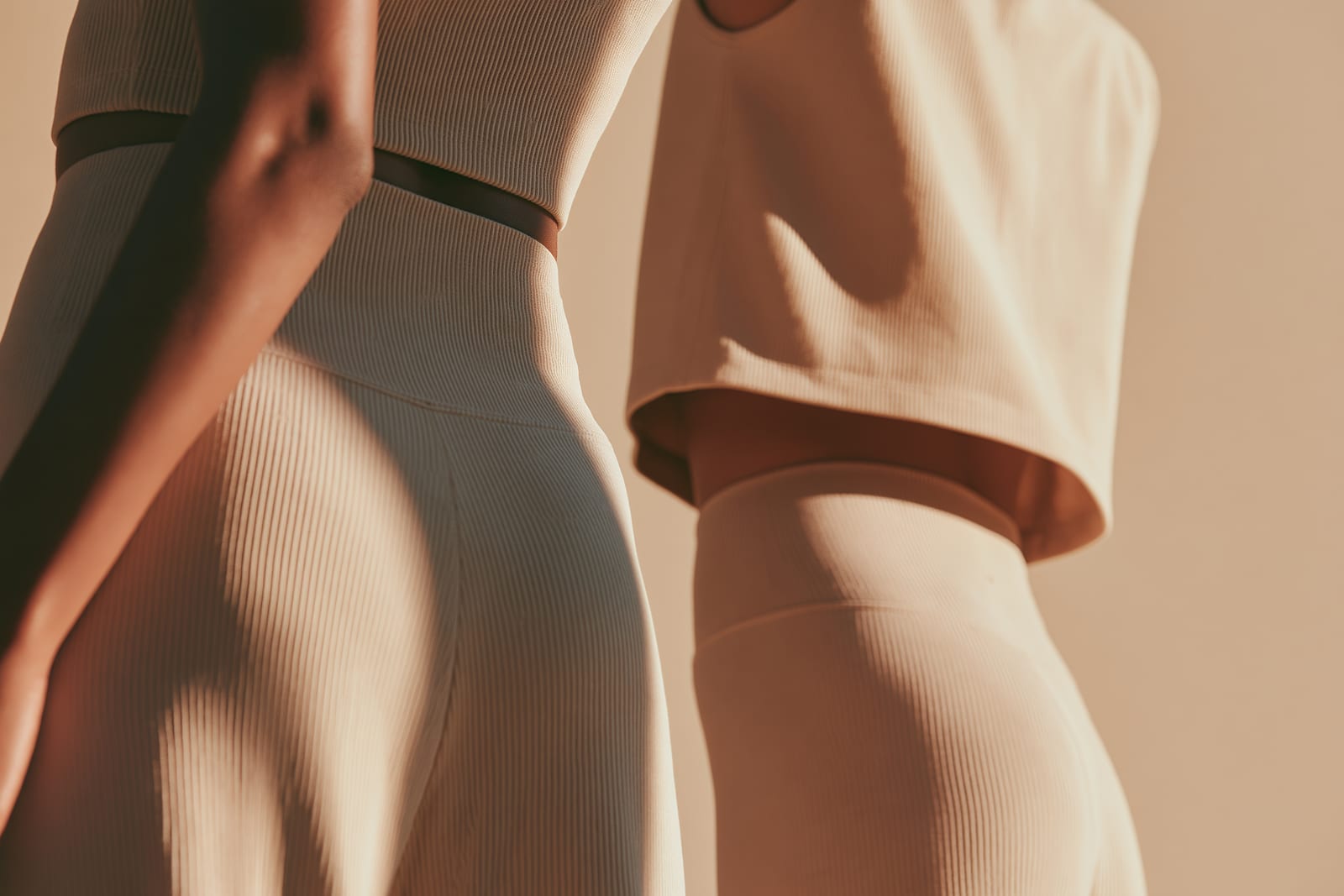
Each is caught by the same habit: judge the dress in the poses it will be worn in, against the light a customer will meet. The bodycon dress programme runs the seated and backlit tests as part of sample review, and the same conditions are used for the knit tops that share the stitch.

FAQ
Is a heavier knit always more opaque?
No. Weight helps, but density and recovery matter more under stretch. A heavier loose rib can open further than a lighter dense one, and a pale colour will show through either.
Should we line every bodycon dress?
Only where the tests fail. A lining adds a component, a fit decision and a cost, and a dense enough rib may need none. Test first, then line the zones that fail rather than the whole garment.
Can we judge opacity from photographs?
Only if the photographs were taken under the agreed conditions, with the same pose, background and light. A studio photograph against a dark wall will pass a dress that fails in a shop doorway.
What if the dress passes when washed but fails when worn?
Then the test conditions were wrong, not the dress. Add the pose or the light that produced the failure to the review, and re-test with the washed sample before the next bulk run.
Sources: OEKO-TEX Standard 100, EU Regulation 1007/2011, Intertek, Higg, The Woolmark Company and US CBP.
Working on a knitwear project?
Let’s talk yarn, gauge and timing.
Send a reference or tech pack and we will come back with a practical development route.

