
Two polos, same piqué body, same placket, same buttons. One collar is a knitted rib strip; the other is cut from the body fabric and folded. On a hanger the difference is a few millimetres of height and a slightly softer line. After laundering, compare the shape of both collars. Knit structure, interlining and assembly can all change how much a collar curls or recovers.
Last modified: November 23, 2026
Rib knit vs self fabric polo collar is a question that usually arrives late in development, when the body is approved and the collar is treated as trim. It is better asked early, because the answer changes the silhouette, the shade risk and the fabric consumption of the whole order.
Rib-knit vs self-fabric polo collars after laundering
A rib-knit collar is a separate knitted strip with stretch and recovery; a self-fabric collar is cut from the body cloth, folded and stitched. The rib holds its stand and returns after washing, while the self-fabric gives a softer line that relaxes with wear and gradually loses its edge.
That is the trade in one sentence: definition against softness. Everything else in the comparison follows from it, including how the collar is sampled, how the shade is matched and what the collar does to the fabric order.
What each collar is, in construction terms
A rib-knit collar is knitted as a flat strip on a rib machine, usually in a yarn that matches the body, then attached to the neckline with a seam that allows the strip to stretch over the head. The rib structure gives it elasticity in one direction, which is why it can grip the neck without a fastener.
A self-fabric collar is cut on the bias or crosswise from the body cloth, folded double, and attached in the same way. It has the body’s own hand-feel and shade, and it has the body’s own stretch, which on a piqué is modest. That is the source of both its softness and its weakness.
| Attribute | Rib-knit collar | Self-fabric collar |
|---|---|---|
| Construction | Separate knitted rib strip, attached | Cut from body cloth, folded and stitched |
| Stretch and recovery | High, returns to shape | Low, relaxes with wear |
| Silhouette | Defined stand and roll | Softer, flatter line |
| Shade | Knitted separately, shade risk | Same fabric, shade matches |
| Fabric consumption | Extra yarn and a knitting step | Extra body fabric and more making up |
| After washing | Holds shape, may tighten slightly | Edge softens and can roll |
| Hand-feel | Firmer at the neck | Softer, closer to the body cloth |
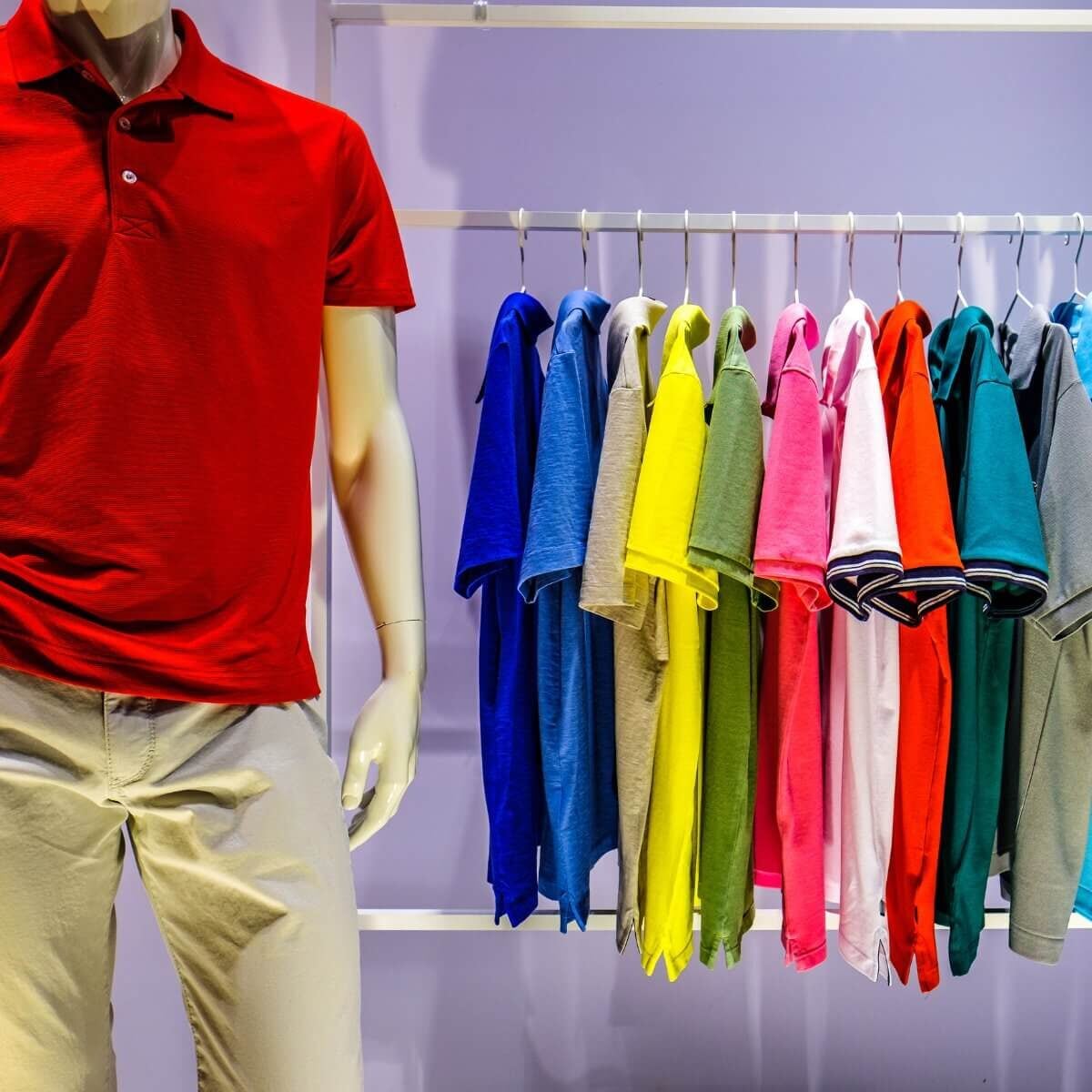
Silhouette: stand, roll and height
The rib collar stands. Its structure allows a taller band without collapse, which is why it appears on uniform and golf polos where the collar has to hold a shape for a working day. Height is a separate decision: a taller rib reads formal, a shorter one reads sporty, and both are available in the same yarn.
The self-fabric collar lies down. It can be cut taller and folded to create a roll, and the roll is softer because the cloth has body but little elasticity. On a heavier piqué the result reads relaxed and slightly retro; on a light jersey it can read limp, especially after a wash.
Neither is more correct. The mistake is choosing a self-fabric collar for a silhouette that needs a stand, or a rib collar for a garment whose whole appeal is softness at the neck, and discovering the mismatch at the fitting rather than at the sketch.
The placket and the collar are one visual unit, and the collar choice changes the placket by reflex. A rib collar pulls the front edges slightly together when fastened, which is why the placket on a ribbed polo is often cut a little wider. A self-fabric collar lies flatter and shows any gap between the front edges, so the placket has to be plumb and the button spacing even. Get that balance wrong and the collar is blamed for a placket fault.
Recovery: the property that decides the second season
Recovery is what a collar does after it is stretched and released. Rib returns because its structure stores the stretch; self-fabric does not, because the fabric was never built to. The practical consequence is a collar that opens up at the front after a few months of wear, which is the complaint that arrives long after the order has been paid for.
Test recovery on the sample rather than reading about it. Stretch the neckline over a form, release it, and measure or photograph the opening; then wash the sample and repeat. Record any loss of stand against the agreed care cycle and approved collar shape.
How to identify a self-fabric collar and check it after washing
Match the collar face to the body swatch before calling it self fabric. A self-fabric collar uses the shirt’s body fabric for the collar itself; a rib-knit collar uses a separately knitted component. Matching colour alone does not identify the construction. If the polo body is piqué, inspect the repeat on the outer collar and confirm the fabric reference on the cut list. Record any separate undercollar or interlining by name so the supplier cannot interpret “self fabric” as a complete specification for all layers.
| Inspection point | How to compare the samples |
|---|---|
| Collar points | Button the polo to the agreed setting. Place it flat and photograph both tips. Check whether either point has lifted, twisted, curled or ended in a different position relative to the placket. |
| Back collar and roll | Compare the centre-back height and fold against photographs of the approved piece taken from the same angle. Use the same time after drying for both samples. |
| Body-to-collar junction | Follow the seam towards both shoulders. Note any puckering or distortion and record which layers the sample uses so the mill can isolate the cause. |
Keep an unwashed reference and repeat the measurement points after the agreed care cycle. If rubbing, pressing or steaming is part of preparation, make that step explicit so the comparison can be repeated. The BSI record for appearance after laundering describes formal evaluation of garment and seam appearance. Apply the buyer’s own approved reference when deciding whether a particular collar shape is acceptable.
Shade matching: the risk that hides in the self-fabric option
The self-fabric collar carries no shade risk at all, because it is the body fabric. That is a real advantage on a deep colour or a heathered yarn, where a small component in a different yarn lot shows as a band around the neck.
The rib collar is knitted separately, sometimes in a different yarn lot, and sometimes by a different machine. The shade has to be matched to the body, which means a lab dip for the collar yarn rather than a promise that it will be close. On pale colours the mismatch is invisible; on navy, black and deep green it is the first thing a buyer sees.
That asymmetry explains why some buyers specify rib for the shape and accept the shade work, while others specify self-fabric for the colour control and accept the softer line. Both are defensible once the trade is visible.
Cost drivers, without the price tag
Cost does not decide this choice on its own, but it explains the quotes. A rib collar adds a knitting step, a separate yarn and a seam; a self-fabric collar adds fabric consumption and more making-up time, because a folded and stitched collar takes longer at the machine than a strip that is attached in one pass.
Which one lands cheaper depends on the fabric and the quantity. On an expensive body cloth, cutting a collar from the same fabric costs more in material than knitting a strip from a cheaper yarn; on a low-cost piqué the difference narrows and the making-up time starts to dominate.
Retrospective: what a collar change teaches
The pattern that repeats across collar programmes is that the change is always judged too early. A collar looks right on a hanger, is approved after a fitting, and only reveals its behaviour after a wash and a month of wear, which is exactly when the bulk has shipped.
The retrospective lesson is to add one step to the sampling round: wash the collar sample and photograph it beside an unwashed one. That single comparison turns a subjective argument about “holding its shape” into a picture both sides can read, and it usually settles the rib versus self-fabric question in favour of whichever option the garment actually needs.
Where collar samples fail
Three failures account for most collar rejections. The first is a neckline that is too tight or too loose because the collar length was copied from another style rather than measured against the neck opening. The second is a collar that stands too tall for the placket, so the front edges meet unevenly when the top button is closed.
The third is shade. A rib collar knitted from a different lot can look correct under the sample-room light and wrong in daylight, which is why the shade check belongs next to a window rather than under a lamp. The golf polo styles make this visible fastest, because the collar is the part a player sees in the mirror at address.
Questions about polo collar construction and approval
Which collar lasts longer?
The rib collar usually holds its shape longer, because its structure recovers. A self-fabric collar can outlast it in appearance if the fabric is firm and the fold is well constructed, so the answer depends on the cloth.
Can a self-fabric collar be given more stand?
Yes, with a taller cut, a firmer interlining or a double fold. Each adds making-up time and some stiffness, and the result is still softer than a rib at the same height.
Does the collar have to match the cuff?
Not strictly, but the two are usually specified together. A rib collar with a self-fabric cuff is a common combination, and it works as long as the contrast is deliberate rather than accidental.
What should we check on the collar sample?
The neck opening against the head, the stand height against the placket, the shade in daylight, and the shape after a wash. Four checks, one sample, and the decision is made with evidence.
If the collar is still open, send the body fabric, the target silhouette and the quantity to the polo shirt team and ask for both collars on one sample so the comparison is made on the same body.
Sources: OEKO-TEX Standard 100 on restricted substances, EU Regulation 1007/2011 on fibre names and labelling, Intertek on textile testing, Higg on environmental assessment, and US CBP informed compliance on import documentation.
Working on a knitwear project?
Let’s talk yarn, gauge and timing.
Send a reference or tech pack and we will come back with a practical development route.

