
Twenty-four is the number that decides the shape of a care label project in Europe: the official languages of the European Union. No single label carries all of them, but a range sold into several member states can easily need four or five, and the text still has to fit the same small piece of tape.
A multilingual care label workflow is therefore a version-control problem before it is a translation problem. The text, the symbols, the market and the style all move independently, and the label that reaches the sewing room is the one that was approved last, not necessarily the one that was correct.
Multilingual care label workflow: the short answer
A multilingual care label workflow needs four things: a market matrix that maps each destination to the languages and rules it requires, one label artwork per market and style, a review step with the buyer’s compliance team, and a sewing instruction that matches the label to the garment and the carton. Without the matrix, every order restarts the same conversation.
The sections below take the matrix, the label itself, the sewing position and the version record in turn.
One label, several markets
The first decision is whether to print separate labels per market or one label that serves several. Separate labels cost a setup each and simplify everything else: the text is short, the type is legible and a change in one market does not touch the others.
A combined label saves setups and costs legibility. Four languages of care text on a 20 mm label forces small type, and small type at production speed is where misprints appear. The trade-off is real, and it should be decided per range rather than per order.
A third option is a base label with a market-specific over-label. That works well for a distributor holding stock for several countries, provided the over-label position does not cover the fibre content and the adhesive survives the wash.
| Option | Text capacity | Change cost | Typical fit |
|---|---|---|---|
| Single-market label | Full, legible type | One artwork per market | Ranges sold mainly in one country |
| Combined multi-market label | Limited, small type | One artwork change affects all markets | Core styles sold across a customs union |
| Base label plus over-label | Base text plus a market panel | Over-label only | Distributors holding mixed stock |
| Printed satin label | Fine detail, many languages | Artwork file only | Short runs and frequent text changes |
Printed satin appears in the table because it changes the trade-off: fine text holds up better than on a woven label, where the loom limits the character height. A woven label reads beautifully and cannot carry four languages at a small size.
Building the market matrix
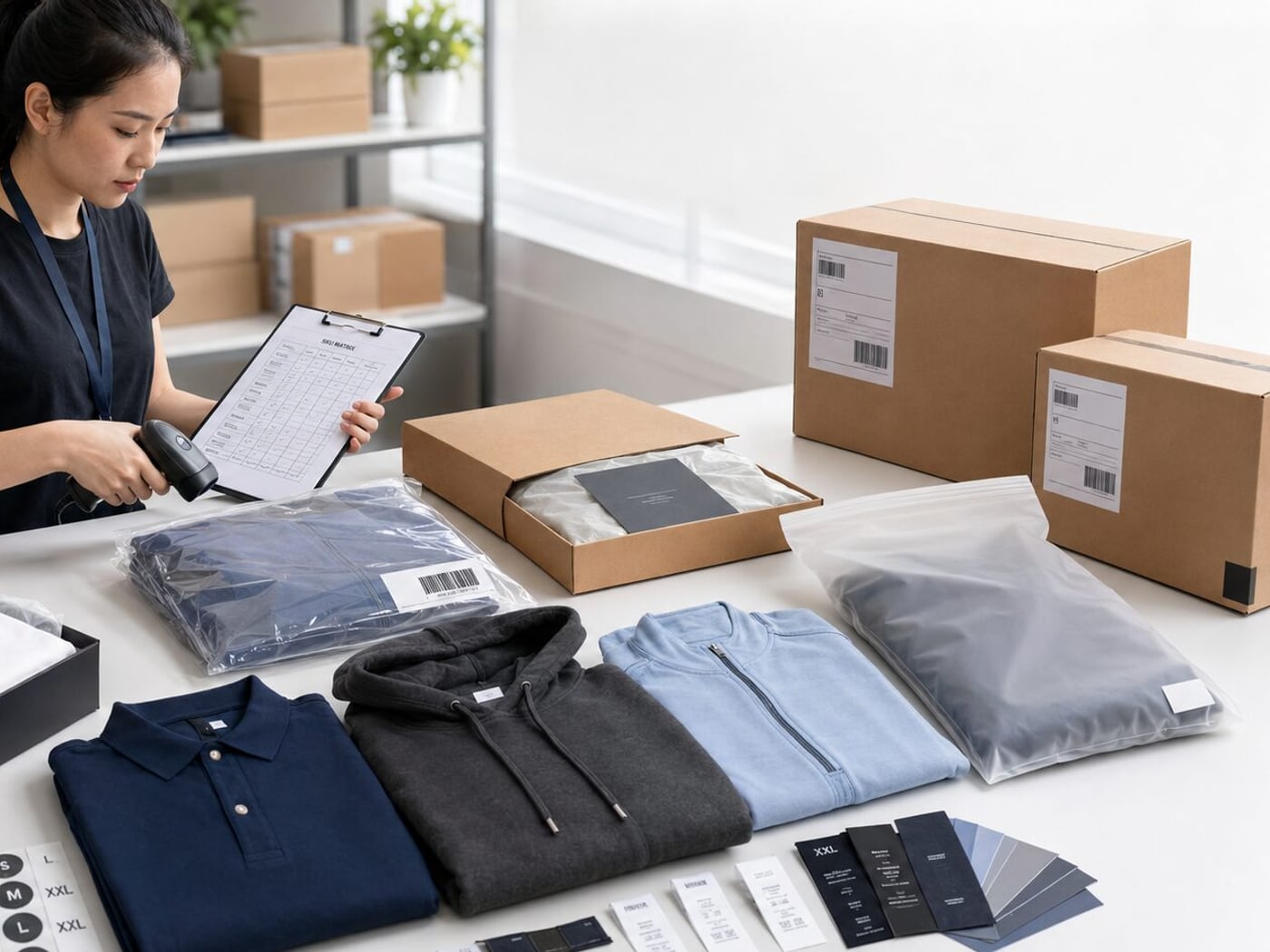
The matrix is a table with markets down the side and decisions across the top: languages required, fibre names permitted, care symbol set, size marking, importer details and any warning text. Fill it once, with the compliance team, and reuse it for every style.
Language requirements are set by the destination, not by the brand’s preference, and they can differ within a single market. Where a country has more than one official language, the label may need both, and the buyer’s own standard may add a third for retail reasons.
Fibre names are a separate column because the permitted names are regulated. The EU regulation on textile fibre names sets out which names may be used and how percentages are stated, and the US rules cover the same ground differently. A label translated correctly but using an unpermitted fibre name is still non-compliant.
Symbols, text and what each must say
Care symbols and care text do different jobs. Symbols travel across languages; text carries the legal fibre content and any warning. A label usually needs both, and the symbol set has to be one the destination recognises rather than one the design team finds clear.
Translation is a compliance step, not a courtesy. Machine translation of care terminology produces instructions that are grammatically correct and technically wrong, and a wrong care instruction creates the failure it was meant to prevent. Use a translator who works with textile terminology, then have the buyer’s compliance team confirm the legal wording.
Warnings and importer details belong in the matrix too. Where a market requires a warning, its exact wording is usually prescribed, so it cannot be paraphrased into a shorter phrase to fit the label. If the text does not fit, the label has to grow or the layout has to change.
Symbol systems differ by market as well. A symbol set that reads cleanly in one region may be unfamiliar in another, and some retailers add their own. Confirm the set with the buyer rather than assuming a familiar one travels, and check that each symbol is legible at the size the label allows.
Sewing position and label size
Position is part of the specification. A care label is usually sewn into a side seam or the back neck, and the position has to be consistent across the range so a store can find it. Where two labels are used, the order in the seam matters as much as the content.
Size follows from the text. Work out the character count per language, choose the label width that holds it at a legible height, then confirm the seam allowance can take that width. A 40 mm label in a 10 mm seam allowance is a specification that will be changed at the machine.
Where the label is long, consider a folded format with the text on two faces. It carries more without shrinking the type, and it is a standard option at most label makers.
Version control across styles and seasons
Name every artwork by market, style and revision, and keep the revision date inside the file. The most common multilingual failure is a correct label applied to the wrong style because two files looked alike in a folder.
Record which revision was sewn into which order. When a market changes a requirement mid-season, the record shows which shipments carry the old text and which carry the new, and that is the difference between a controlled change and a recall conversation.
Packing by market
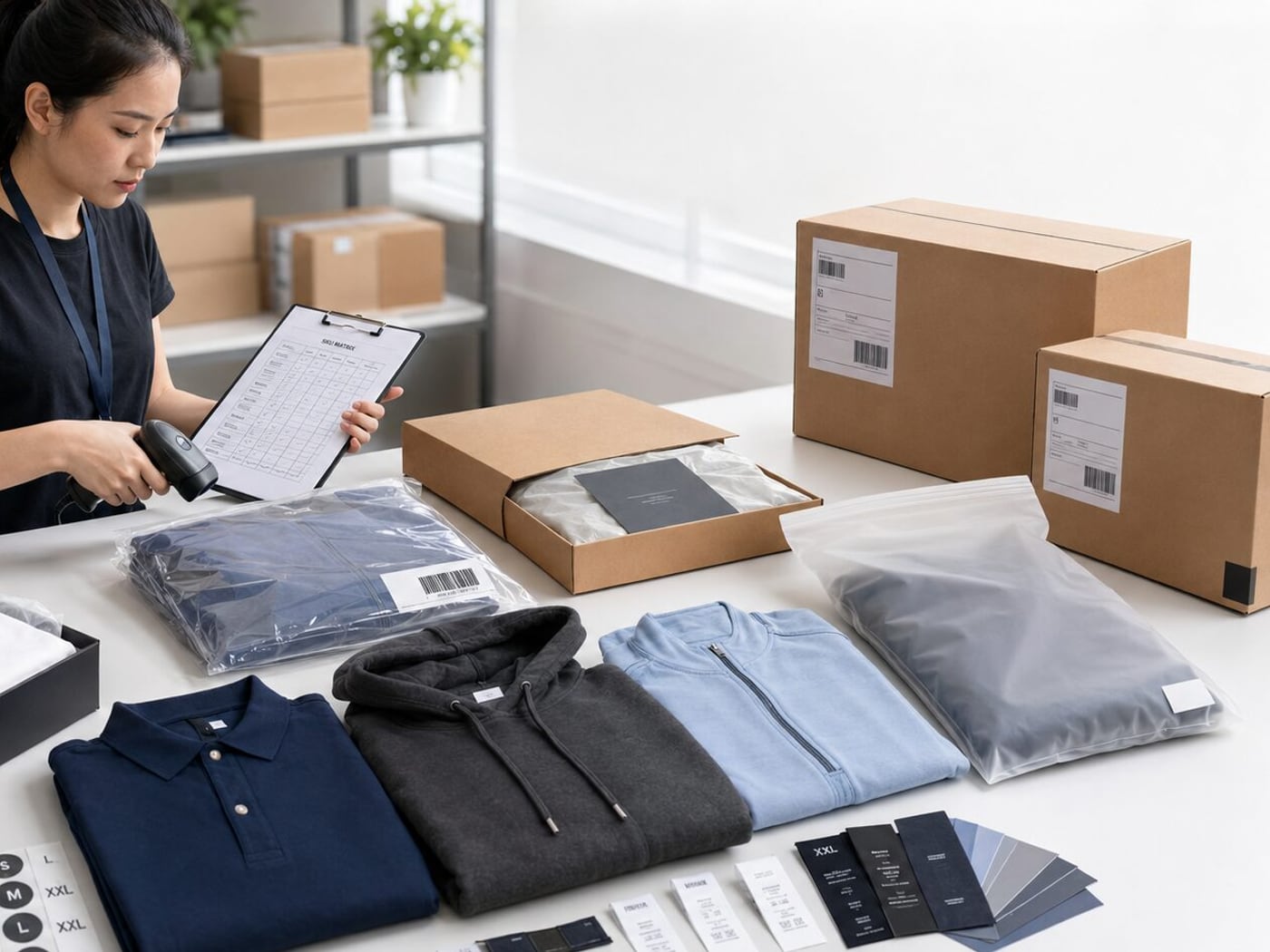
A label is only correct if the right carton reaches the right market. Where one style ships to three countries, separate the cartons by market at packing and mark the destination on the outside, because the label inside is invisible at the dock.
Mixed-market cartons are the usual source of a wrong-label shipment: three language versions in one box, split later by the distributor. If that is the plan, agree in advance which label each unit carries and how the cartons are identified, or the split happens without a record.
Where the workflow usually breaks
Four breaks account for most problems: a label approved for one market and packed for another, a translation updated without the artwork, a symbol set assumed rather than confirmed, and a label whose size was set before the text was final.
Each has the same fix: put the decision in the matrix, put the revision on the file, and check the packed carton against the market it is destined for. None of that requires new tooling, only a sequence that is followed.
Keep a photograph of the sewn label in the order file. When a query arrives about a specific shipment, the photograph settles which revision was used faster than any spreadsheet.
FAQ
How many languages can fit on one care label?
It depends on the label width, the type size and how much text is required. Three or four short care phrases fit on a standard label; full legal wording in five languages usually needs a wider label, a folded format or separate labels per market.
Can we use symbols instead of translated text?
Symbols reduce the text but rarely replace it. Fibre content and any prescribed warnings still have to be stated in the required language. Symbols and text usually appear together, with the symbols carrying the wash instructions.
Who approves the translated text?
The brand owns the wording and the buyer’s compliance team confirms it against the destination rules. The factory confirms that the text fits the label and reproduces cleanly. One approval per market, in writing, with the revision recorded.
What happens if a market changes its requirement mid-season?
Issue a new revision, record the effective date and identify which orders carry the old label. Where stock is already packed, the choice is between re-labelling and shipping to a market where the old text remains valid. Both need a written decision.
Building the label file once
The matrix takes an afternoon and saves a conversation on every order after it. Start with the markets you actually sell into, add the languages and rules for each, and keep the label artworks named by market and revision.
Send the matrix with the tech pack. Our private label knitwear manufacturing page covers how labels are approved through sampling, the hangtag development notes cover the tag that sits beside the label, and retail carton specifications cover how markets are separated at packing. Sampling is 7–12 days after fabric and tech pack approval.
Review the matrix at the start of each season. Rules change, markets are added, and a matrix that was right two years ago is a quiet source of errors.
Sources: EU Regulation 1007/2011 on textile fibre names, US CBP informed compliance publications, OEKO-TEX Standard 100, Better Work, Intertek and Higg.
Working on a knitwear project?
Let’s talk yarn, gauge and timing.
Send a reference or tech pack and we will come back with a practical development route.

