
Two cotton cardigans can weigh the same and hang differently. One falls straight from the shoulder like a shirt, the other stands away from the body like a light jacket. Both are cotton, both may use the same yarn count, and the difference between them is the structure: the way the loops are knitted decides how the fabric behaves under its own weight.
Last updated: November 24, 2026
What Does Cotton Cardigan Fabric Structure Decide?
Cotton cardigan fabric structure decides how the garment drapes, how much it weighs in the hand and how it holds its shape at the front edge. Rib, half-cardigan and jacquard structures use the same cotton differently, so the structure, not the fibre alone, sets the season the cardigan belongs to.
That is why a brief that specifies cotton without specifying structure tends to sample in the wrong direction. Cotton is a fibre with a wide range of behaviours depending on how it is spun and knitted, and the cardigan is unusually sensitive to the choice because it is worn open, hangs from the shoulders and is judged at the front edge.
Two Cardigans, One Fibre, Different Jobs
Picture a spring cardigan worn over a shirt and a winter cardigan worn over a knit. The first needs to fall straight, hold a narrow front band and stay light enough to carry in a bag. The second needs to stand away from the body, hold a wide band and keep its shape when it is pulled on over a sleeve.
Both can be cotton. The spring garment is usually a flat structure with a fine gauge and a lighter yarn; the winter garment is a rib or a cable with more bulk per square centimetre. Put them side by side and the weight difference is obvious, but the structural difference explains most of it.
Structure, Not Fibre, Sets the Season
Rib is the elastic structure. It pulls in across the width, clings at the hem and the cuffs, and gives a cardigan that follows the body. On a summer weight it makes a neat, fitted layer; on a heavier yarn it makes a garment that holds its shape without a lining.
Half-cardigan is the flat one. The face is smooth with a faint vertical texture, the fabric falls rather than clings, and the front edge stays straight if the band is knitted at the right tension. A cotton half-cardigan is the closest thing to a shirt in knitwear, which is why it suits spring ranges and layering pieces.
Textured structures, cables and links-links patterns add bulk without adding much weight per stitch, because they trap air in the fabric. They also stiffen the drape, which is useful for a coat-style cardigan and wrong for anything meant to hang softly.
| Structure | Surface | How it hangs | Suits |
|---|---|---|---|
| Half-cardigan | Smooth with faint vertical texture | Falls straight and holds a narrow band | Spring button-through cardigans |
| Rib | Pronounced vertical lines, elastic | Clings and pulls in at hem and cuff | Fitted cardigans and layering knits |
| Links-links | Textured, small-scale pattern | Softer and bulkier, less recovery | Relaxed, statement pieces |
| Cable panel | Raised ropes and crosses | Stands away from the body | Winter cardigans with weight |
The table is a starting point rather than a rule. A rib knitted on a fine gauge behaves closer to a flat structure than a chunky rib does, and a cable on a light cotton reads as decoration rather than warmth. The gauge and the yarn count sit on top of the structure and change all four rows.
Where the Weight Actually Sits
Garment weight is a product of yarn count, gauge and structure together. A heavier yarn at a coarse gauge with a dense structure produces a cardigan that feels substantial and drops quickly at the hem. The same yarn at a fine gauge gives a lighter fabric that holds its shape differently and presses flatter.
Weight is also distributed unevenly. A cardigan carries more fabric at the front bands, the hem and the cuffs, and those are the places where a heavy structure shows first: the hem sags, the band curls or the buttonholes stretch. Balance is about keeping the weight where the structure can carry it.
Season positioning follows from that. A spring cardigan in cotton is usually light, flat and slightly loose. A winter cardigan in cotton is heavier, textured and cut closer to the body so it can sit under a coat. The same fibre serves both; the structure and the weight decide which one the buyer is actually ordering.
Comparing Swatches Without Fooling Yourself
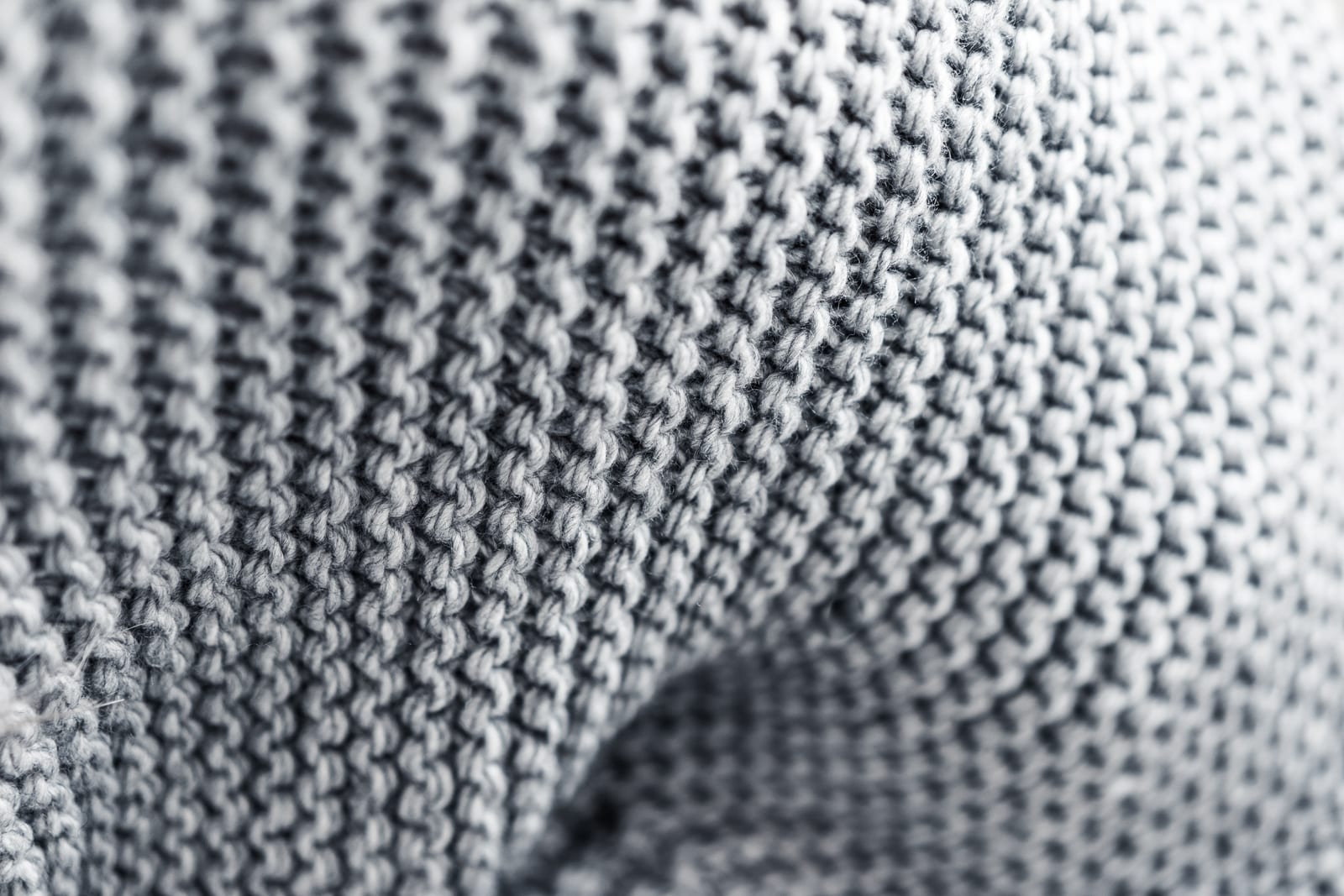
Swatches are the right tool, provided they are compared fairly. Knit both candidates on the same machine at the same gauge, wash them the same way, and hang them from the same point for the same time. A swatch held in the hand tells you about surface; a swatch hung for a day tells you about drape.
Then measure. Length before and after hanging gives a hang-growth figure that predicts what the finished cardigan will do at the hem. Width before and after a gentle stretch gives an idea of recovery. Neither number is a guarantee, but together they separate a structure that will hold its shape from one that will grow in the wardrobe.
Compare at the same colour, too. Cotton takes dye differently across structures because the surface reflects light differently, and two whites in different structures can look like two different qualities on a rail even when the yarn is identical.
Keep the swatches after the decision. A structure approved in one season is often revisited the next, and a physical swatch with the hang measurements written on the back answers questions that a photograph cannot.
Build a material and stitch record for the cotton cardigan
Start the fabric sheet with separate fields for fibre content, yarn reference, and knit structure. “Cotton rib” leaves two questions open: whether the yarn is all cotton or a blend, and which rib was approved. If the body and opening are different, give each its own line. Link both lines to the swatch labels so a replacement yarn or a change at the band can be traced during sampling.
- Body: Record the stitch name and the yarn reference. Photograph the face and reverse, then hang the finished swatch as it will hang on the garment. Note whether it falls straight, twists, or draws in. Keep the approved swatch with the style number and the direction in which it was knitted marked.
- Front and hem: Ask for a sample with the proposed closure fitted to the actual opening. Photograph it buttoned and open, both before and after washing. If the opening waves, check how the band is attached and where it starts to pull. If only the hem grows, record that separately before requesting a change to the body stitch.
- Care: Mark the points you will measure and write the intended wash and drying route on the record. Compare width and length after the same care process. AATCC TM135 covers dimensional change in fabric after home laundering. Use a garment method when the finished piece is what you need to approve. Once the choice depends on buttons, bands, or seam weight, check the sewn or linked sample as well as the swatch.
If two structures meet the brief, keep both swatch codes in the sample history and write what decided the approval: a flatter opening, better recovery, or how the hem hangs. For a shaped sleeve, add the shoulder and armhole measurements to the fit sheet. This gives the next order a fabric reference and a fit reference that can be checked independently.
Front Edges and Button Tension
The front edge is where a cardigan is judged. A band that is knitted too loosely curls away from the body; one that is too tight pulls the front and opens the buttonholes. The band structure should match the body, and on a button-through cardigan the band tension is often the difference between a garment that hangs straight and one that gapes between buttons.
Zip-front styles trade that problem for another. A zip has no give, so the front edge has to be stable before the zip is attached, or the tape will wave. If the range is moving between closures, the body structure may need to change too, not just the opening.
Bulk, Inspection and Reorder
Once a structure is approved, the commercial sequence is fixed. Minimum order is 300 pcs per style. Sampling runs 7–12 days after fabric and specification approval, and bulk production typically runs 20–35 days after sample approval. Inspection is carried out to AQL 2.5 unless the buyer’s own plan replaces it.
That sequence is the same for any structure, which is why a custom cotton cardigan programme can be planned around the calendar rather than around the fabric. What changes between structures is the sample round, not the commercial steps: a rib and a flat cardigan can share a delivery window, and usually cannot share a pattern.
Keep the approved swatch with the measurement sheet. Structure is easier to copy than yarn, and a reorder that matches the swatch in structure but not in yarn will show at the hem within a month. A cotton programme is also worth keeping separate from a merino cardigan programme in the development file, because the two behave differently at the front edge and the tolerances do not transfer.
The same applies when the range widens to a zip-front cardigan or a heavier winter style. Each opening and each weight needs its own sample, and the structure that worked at one weight is not automatically right at another.
Questions about cotton cardigan structure and sampling
Is a heavier cotton cardigan always warmer?
Not always. Warmth comes from trapped air as much as from weight, so a textured structure can feel warmer than a flat one at the same weight. A dense flat cotton can also feel cooler because it conducts heat away rather than holding a layer of air.
Can cotton hold a cable structure well?
Yes, though cotton has less natural elasticity than wool, so a cable in cotton tends to read crisper and hold its shape rather than relax into the pattern. It also makes the cardigan heavier at the same gauge, which suits a winter style better than a spring one.
Why does the front edge curl on some samples?
Usually because the band tension does not match the body. A band knitted looser than the body curls outward; one knitted tighter pulls the front and distorts the button spacing. The fix is a band re-knit rather than a change of fibre.
What is the minimum order and lead time?
Minimum order is 300 pcs per style. Sampling takes 7–12 days after fabric and specification approval, and bulk production typically takes 20–35 days after sample approval, with inspection to AQL 2.5 unless the buyer’s plan replaces it.
Sources: The Woolmark Company, OEKO-TEX Standard 100, Intertek testing, EU Regulation 1007/2011, Higg, Control Union certification.
Working on a knitwear project?
Let’s talk yarn, gauge and timing.
Send a reference or tech pack and we will come back with a practical development route.

