
The shirt looked right on the hanger and wrong on the customer. A linen-blend tee in a relaxed fit, sampled in a small size, washed once at home, and returned as “too short and too see-through”. The blend was the one the buyer had asked for, and the sample had passed every measurement on the sheet. What the sheet had never recorded was the state the measurements were taken in, or the wash the shirt was about to meet.
That is the pattern with linen blend t shirt development: the fibre behaves differently in the hand, on the body and in the wash, and a process that checks only one of those states will approve garments that fail the other two.
Linen blend t shirt development: the short answer
Linen blend t shirt development starts with three decisions: the fibre ratio, the knit structure and the wash the garment will be sold with. The ratio sets drape and texture, the structure sets opacity and stretch, and the wash sets the final dimensions. Confirm all three on a sample rather than on a swatch.
Everything else follows from those three, including the size the garment should be sampled in and the state it should be measured in.
What is in the blend, and why the ratio matters
A blend is a set of trade-offs expressed as a percentage. Linen brings texture, drape and a dry hand; cotton brings body, softness and better dimensional stability. Move the ratio and you move all of those at once, which is why a “linen blend” without a percentage is not a specification.
Ask for the exact split, the yarn count and the knitting structure. A jersey, a slub jersey and a pique built from the same blend behave differently, and the slub is often what gives a linen tee its character: an uneven yarn with thick and thin places that reads as texture rather than as a fault.
Does linen drape better than cotton?
It drapes differently rather than better. Linen is stiff in the hank and softens with washing, so a linen-blend tee often has more movement at the hem and less body at the shoulder than an all-cotton version. That movement is why the blend is chosen for a relaxed silhouette and why it can look shapeless on a fitted one.
The hand also changes with the blend and with the finish. A washed linen blend feels softer from the first wear; an unwashed one feels crisp and softens over time. Which one the range needs is a design decision, and it belongs in the brief rather than in the finish bath.
The silhouette compounds it. A relaxed tee in a linen blend drapes at the hem and reads as deliberate; a fitted tee in the same blend stretches across the chest and loses the texture that made the fibre worth choosing. Fit and fibre are decided together rather than one after the other.
How much can it show through?
Opacity follows the same rules as any knit: stitch density, yarn thickness and colour. Linen blends add a variable because a slub yarn has thin places by design, and a thin place is where light passes first. It also depends on the colour, because a pale linen blend shows a shadow sooner than a darker one.
Judge it on a garment rather than a swatch, over the base layer the customer will wear, in daylight and with the light behind. A white linen tee can be entirely correct for a beachwear layer and entirely wrong for an office uniform, and only the brief knows which one is being made. Record the pass with the conditions attached, so the next order is compared with a standard rather than an impression.
What happens after a wash?
Linen blends move in the first wash. The linen content can shrink and the cotton can relax, and the combination can change the length more than the width or the reverse. A single wash test on a swatch will show some of it; a wash test on the finished garment in the size that will be sold will show the rest.
The state matters before the wash too. A knit measured flat and relaxed will read differently from one hung on a rail for a day, and a tee that is sold on a hanger should be measured after hanging. Record the state with the number, or the measurement cannot be repeated.
Comparing the routes
The table compares the fibre directions a tee can take, at the level of behaviour rather than of price.
| Route | Drape | Opacity | Dimensional stability | Suits |
|---|---|---|---|---|
| All cotton | Body and shape | Depends on density | Settles after the first wash | Structured and uniform tees |
| Linen blend | Movement at the hem | Lower where the yarn slubs | Moves in the first wash | Relaxed and textured tees |
| All linen | Strong drape, crisp hand | Variable | Moves most | Loose, warm-weather shapes |
The all-linen column is included because buyers ask for it and then discover the maintenance it brings. A blend exists to take the edge off exactly those properties.
How to check a linen-blend sample
Check the garment in the size that will sell most, not in a small sample. Linen blends drape differently across a size range, and the small size will always look tidier than the large one.
Measure the tee flat and relaxed, then hang it for a day and measure again. Wash it as the care label instructs, dry it as the label instructs, and measure a third time. Photograph it at each stage, on the same hanger and in the same light.
Then check the details that a textured fabric affects: the neck rib, which can ripple if the body moves more than the rib; the shoulder seams, which can creep on a drapey knit; and any print or embroidery, which sits on an uneven surface. A print on a slub jersey needs a slightly different approach from a print on a smooth cotton, which is why the same artwork can look sharper on one blank than another.
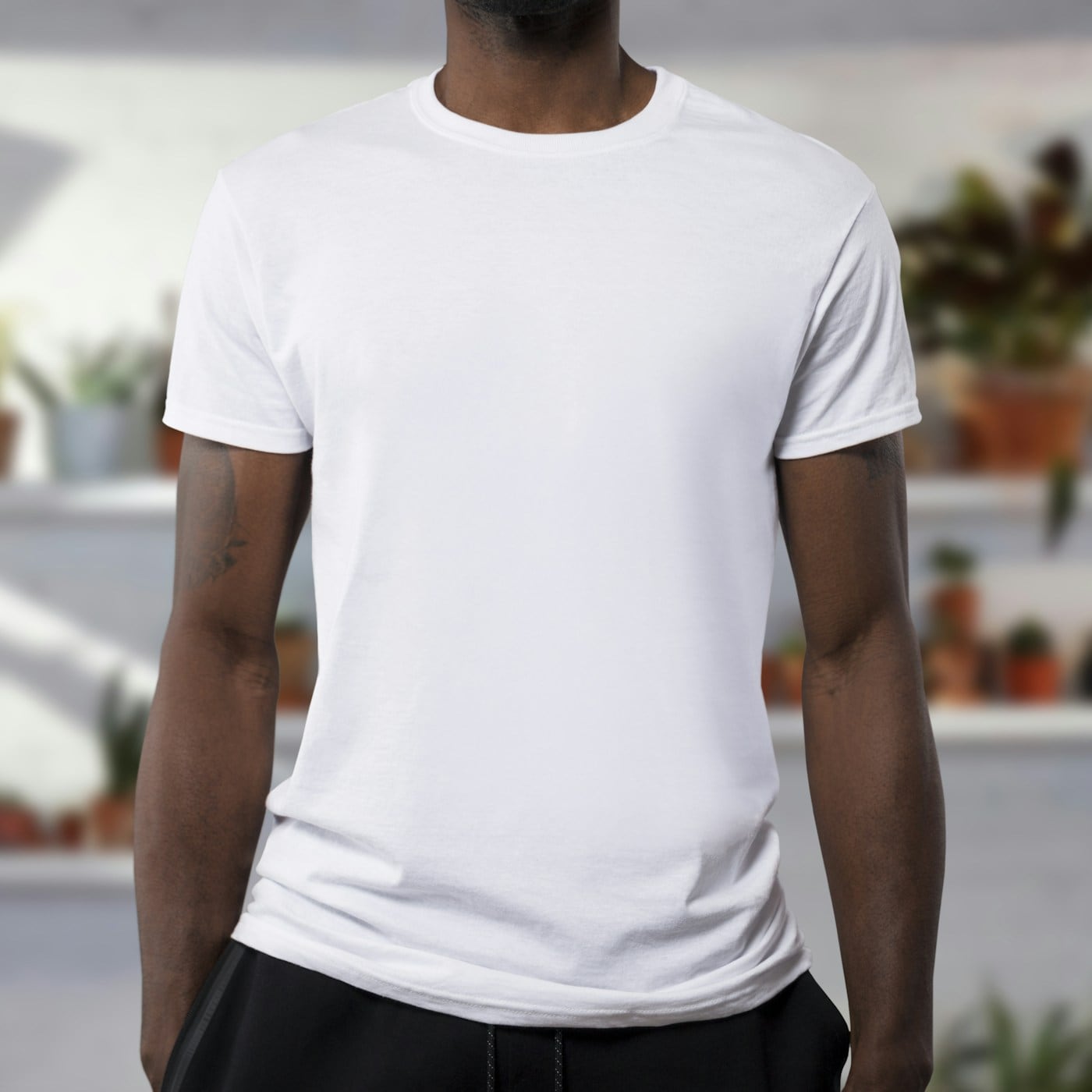
An oversized cut is where the difference shows most. A oversized tee hangs from the shoulder, so the linen content does the drape work across a larger panel, and a small change in the ratio reads as a change in the silhouette rather than in the hand.
What to put in the brief
State the fibre split, the yarn and the knit structure, the colour, the designed opacity and the wash the garment will be sold with. Then add the state the measurements are taken in, and the size used for the sample.
That last field is the one that prevents the return at the top of this page. A small sample in a relaxed linen blend will pass a length check that the middle size fails, and the middle size is the one most customers buy.
It also helps to say why the blend is needed. Our t-shirt programme covers cotton, blends and heavier weights, and a brief that explains the texture or the drape it is chasing gets a more useful recommendation than one that names a fibre and stops.
Where linen-blend tees go wrong
Three failures repeat. A sample in the wrong size, approved for a range where the larger sizes behave differently. A wash test on a swatch rather than the garment, so the length change is discovered by a customer. And an opacity judgement on a hanger, over a white wall rather than over a body.
Each is avoided by testing the finished garment in the state it will be sold and worn. A cotton tee programme is a useful comparison, because cotton settles where linen keeps moving, and the difference tells you which measurements need the wider tolerance.
FAQ
What linen percentage should a tee use?
Enough to give the texture and drape the design needs, and not so much that the garment loses the stability it needs in wear. The percentage is a design decision, and the sample should be tested at the ratio you intend to buy.
Will a linen-blend tee shrink?
It can move in the first wash, more in length than in width in many cases. Test the finished garment rather than a swatch, and set the care label to the wash the test used.
Is a linen blend more transparent than cotton?
It can be, because a slub yarn creates thin places. Judge it on the garment, over the intended base layer, in daylight. The colour makes as much difference as the fibre.
Should the sample be washed before approval?
Yes. A linen blend is a different garment after its first wash, and the measurement that matters to the customer is the one after that wash rather than the one in the sample room.
Sources: OEKO-TEX Standard 100, EU Regulation 1007/2011, Intertek, Higg, US CBP and The Woolmark Company.
Working on a knitwear project?
Let’s talk yarn, gauge and timing.
Send a reference or tech pack and we will come back with a practical development route.


