
The email said “we are a knitwear manufacturer with 20 years of experience”. The signature had a Gmail address, the PDF catalogue had no factory photos, and the quote came back 22% below the other three. Two months later the samples arrived from a different address, knitted by a subcontractor nobody had met. None of that was visible at the point of contact — which is exactly the problem with how most brands find a factory.
There are five realistic routes to a knitwear manufacturer, and each one hides a different failure. The route matters less than knowing what it hides.
The five routes, and what each one hides
| Route | What it is good at | What it hides | Tell-tale sign |
|---|---|---|---|
| Trade shows | Seeing samples and people in one place | Sales presence is not production capacity; many exhibitors are trading companies | They cannot show a machine or a sample room on video |
| B2B platforms | Volume of options, quick quotes | Who actually knits the garment; listings are often resold | Every product photo looks like a stock catalogue |
| Referrals | Pre-vetted by someone who ordered | Fit between their product and yours; a great hoodie factory may be a poor sweater factory | “They can do anything” without a gauge range |
| Sourcing agents | Local language, factory vetting, coordination | Which factory is used, and who holds the relationship | Agent will not name the factory before an order |
| Cold outreach | Direct contact, no intermediary | Almost everything until you ask | Fast quote, no technical questions asked |
None of these is disqualifying. A trading company can be the right partner for a small order, and an agent can save a first-time buyer months. What matters is knowing which one you are talking to, because the price, the lead time and the accountability all differ.
The first call: five questions that separate factory from intermediary
You do not need a factory audit to learn a lot. These five questions take ten minutes and are hard to answer plausibly without the underlying reality.
- Which gauge range do you knit in-house? A real knitwear factory names a range (for example 3–16G) and knows which structures it avoids.
- Can you show me the sample room on a video call? Not a photo set — a live walk with the person who runs it.
- Who knits the panels: your floor or a partner? Subcontracting is normal; concealing it is not.
- What was the last style you declined, and why? A factory that never declines is either small or not telling you.
- Which customer references can you share for a similar product? Similar product, not similar price.
Our sweater manufacturing page states the gauge band and the sample process we run, which is the level of specificity to expect from anyone you shortlist.
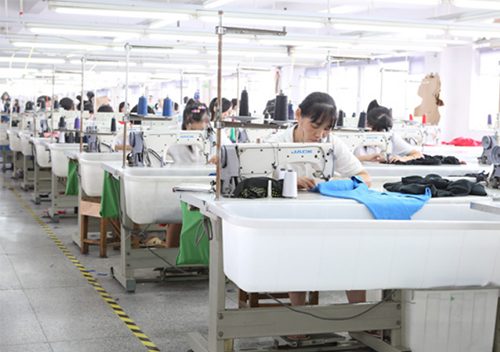
What the quote is hiding
Price differences of 15–25% between quotes for the same tech pack are normal. They usually come from four places, and only one of them is margin.
- Yarn. A cheaper count or a different mill; sometimes a stock shade instead of a dyed one.
- Gauge and machine time. A coarser gauge is faster; a finer gauge costs more per piece.
- Trims and labels. “Standard labels” in one quote and specified labels in another are not the same product.
- Who is actually producing. A trading company adds a layer; a subcontractor may add another.
Ask for the quote broken down by yarn, knitting, making, trims and packing. A supplier who cannot break it down is pricing a guess.
Three signals at sample stage that should stop you
- They do not ask for your measurement state. A factory that measures a knitted panel without asking whether it was washed or pressed will produce a garment that fits differently from the one you approved.
- The sample arrives with no documentation. No measurement sheet, no yarn reference, no notes on what changed. That is how a reorder drifts.
- Every question is answered with “yes, no problem”. Real factories push back on gauge, structure and timing. A supplier that agrees to everything is either not reading the pack or not planning to follow it.
Payment and capacity before you commit
Two numbers decide whether the relationship survives: the deposit and the capacity slot. The deposit is commercial and negotiable; the slot is physical and is not. Ask what else is running in the same weeks as your order, and what happens if your yarn arrives late.
| Question | Good answer sounds like | Warning sign |
|---|---|---|
| Deposit and balance | A stated split with a named inspection trigger | “Whatever you prefer” — no process |
| Capacity in your window | A named slot and a stated conflict rule | “We can always fit it in” |
| Yarn lead time | A range by yarn type, with stock vs dyed distinction | One number for all yarns |
| Late yarn | A documented re-plan, not a promise | “It will be fine” |
At Horssle the published starting minimum is 300 pieces per style, sampling runs 7–12 days after yarn and tech pack approval, and bulk runs 20–35 days after sample approval. Those are the numbers to compare against whatever a new supplier quotes you.
Small order or large order: different routes
Under 300 pieces, the realistic routes are a factory that already stocks the yarn, a capsule program such as our low-MOQ knitwear capsule, or a domestic manufacturer charging more per piece. Above 1,000 pieces, agents and direct factory relationships start to pay for themselves. The mistake is using a large-order route for a small order and being surprised by the minimum, or using a small-batch route for a program that needed a proper production slot.
What to send on first contact
A short message with five things gets a useful reply: product type and reference image, target quantity, target market, delivery window, and whether you have a tech pack. Factories quote faster when they can see whether the request is inside their capability, and you learn more from a considered “we do not do that gauge” than from a cheerful “yes”.
FAQ
How do I know if a supplier is a factory or a trading company?
Ask for the gauge range, a live video of the sample room, and who knits the panels. Then check whether the company name on the quote matches the name on the invoice and the export documents.
Is it cheaper to go direct to a factory?
Usually, but not always. An agent or trading company can be cheaper for small orders because they consolidate yarn and capacity. Compare the landed cost, not the unit price.
How many suppliers should I contact?
Three to five is enough to see the market. More than that and you will spend the time on quotes instead of on the one conversation that matters.
Sources: WCO HS nomenclature and ICC Incoterms 2020 for the commercial terms you will be asked to choose.
If you are shortlisting factories now, send the reference and the quantity. We will answer with what we can and cannot do at that gauge, which is more useful than a brochure.
Working on a knitwear project?
Let’s talk yarn, gauge and timing.
Send a reference or tech pack and we will come back with a practical development route.


