
Three hundred pieces can fill a pallet or half a container, and the packing decision is what separates the two. Flat packing compresses a knit into a bag; hanger packing gives it a shoulder and a rail; size-assorted packing organises it for a warehouse that receives by size. Each changes the carton, the freight and the first thing the customer sees.
The apparel flat pack vs hanger pack choice is usually made late, by whoever is booking the freight, and that is where it goes wrong. Packing is a product decision as much as a logistics one, and it should be taken before the order is confirmed, when the carton specification and the label artwork can still move with it.
The three methods and what they are for
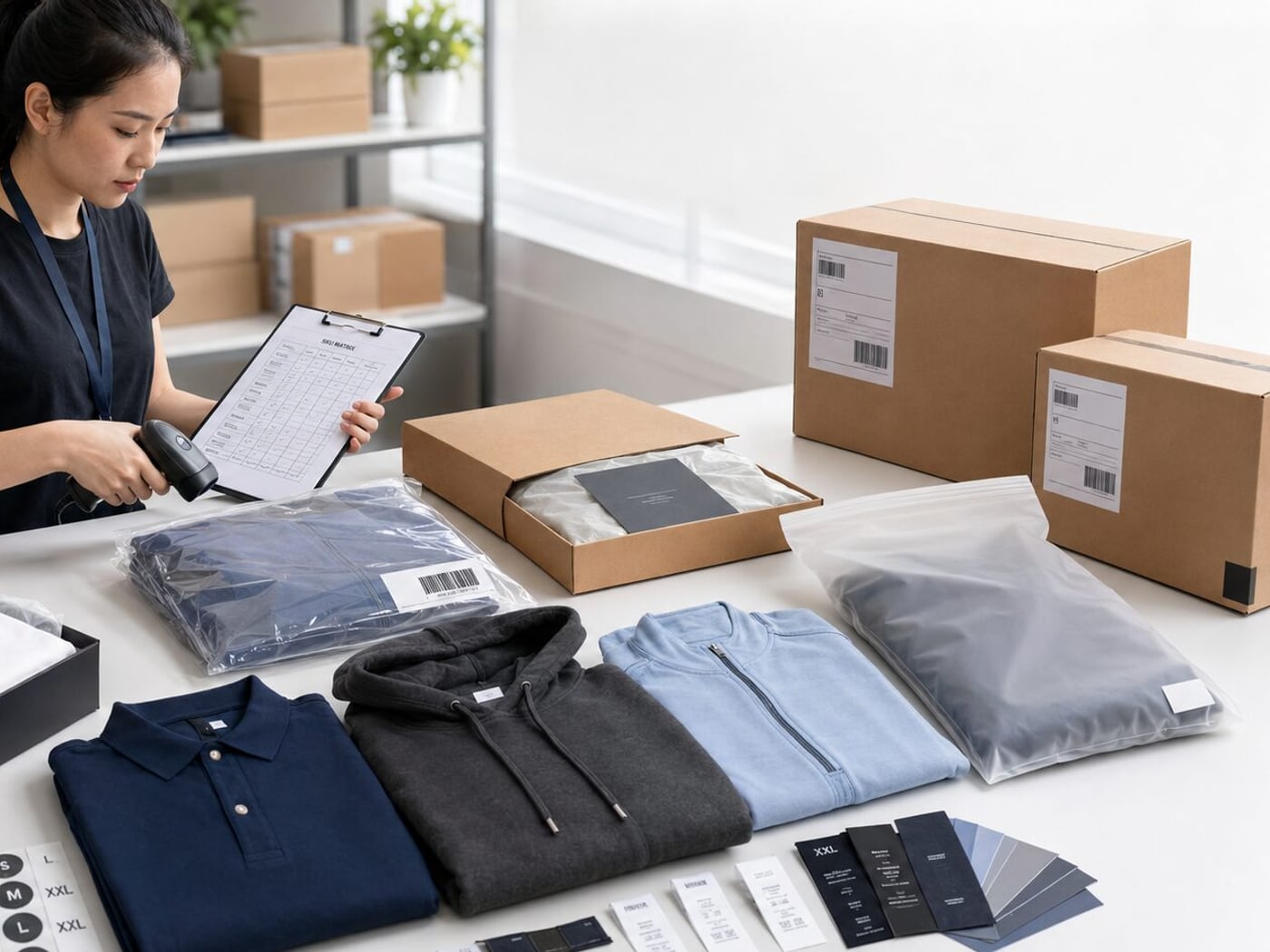
Flat pack is a garment folded to a fixed size, bagged and boxed. It suits e-commerce, wholesale and long storage, and it is the most space-efficient of the three. Hanger pack puts the garment on a hanger, usually with a polybag or a cover, in a carton designed to hold the rail; it suits a retail floor that goes straight to the fixture.
Size-assorted packing is a hybrid: garments are packed by size within a style, or pre-assorted by size across a range, so the receiving warehouse can allocate without opening every carton. It is a decision about the warehouse rather than about the garment, and it changes the carton count more than the carton type.
Apparel flat pack vs hanger pack: the decision
Apparel flat pack vs hanger pack comes down to where the garment is opened: flat pack suits e-commerce, wholesale and long storage; hanger pack suits a retail floor that goes straight to rail; size-assorted packing suits a warehouse that receives by size. Choose at order stage, because it changes carton, labels and freight.
If two channels are served from one order, split the packing at the order line rather than at the warehouse. A mixed carton satisfies neither channel and costs more to open.
| Method | Suits | Cube and creasing | Label and tag needs |
|---|---|---|---|
| Flat pack | E-commerce, wholesale, storage | Lowest cube, visible fold lines on knits | Size sticker on the bag, barcode |
| Hanger pack | Retail floor and concessions | Highest cube, shape preserved | Hangtag, hanger type, size marker |
| Size-assorted | Warehouse receiving by size | Moderate cube, more cartons | Carton marking by size, packing list |
Flat pack: creases, weight and cube
Knits crease along the fold, and a heavyweight fleece creases more than a fine jersey. A fold that sits in a carton for three weeks leaves a line that hangs out slowly, and a customer who opens a bagged hoodie sees the fold before they see the garment.
Ask for the fold to follow the garment’s structure: along a seam where possible, with tissue at the neckline and a board in the bag where the shape needs support. A fold that crosses a printed panel or an embroidery will show first at the decoration, so plan the fold around the artwork. Weight matters as well, because a carton has a limit and a heavy knit reaches it before the volume does.
Hanger pack: presentation and protection
A hanger costs cube, and cube is what a forwarder prices. The gain is presentation: the garment arrives on a rail without a fold, ready for the floor, and the shape of a shoulder or a collar survives. The loss is freight and, on a long route, the risk of a hanger pressing into a neighbour.
Specify the hanger type, the spacing and the carton rail, and say whether the hanger is intended to be reused on the retail floor or replaced at the store. A hanger that is replaced adds cost at both ends, and a hanger that is not designed for the garment adds a shoulder mark that the store cannot fix.
Size-assorted: the warehouse view
Size assortment is about the receiving end. A warehouse that allocates by size wants cartons that contain one size, or a defined ratio across sizes, so it can book stock without opening and re-packing. A store that displays by style wants the opposite.
Agree the ratio before the order is cut, because it changes the carton count and sometimes the minimum. A pack that mixes sizes inside a carton is cheaper to produce and more expensive to receive. Write the ratio into the purchase order, with the carton marking that matches it, so the warehouse and the factory are working from one number.
How labels and tags change the choice
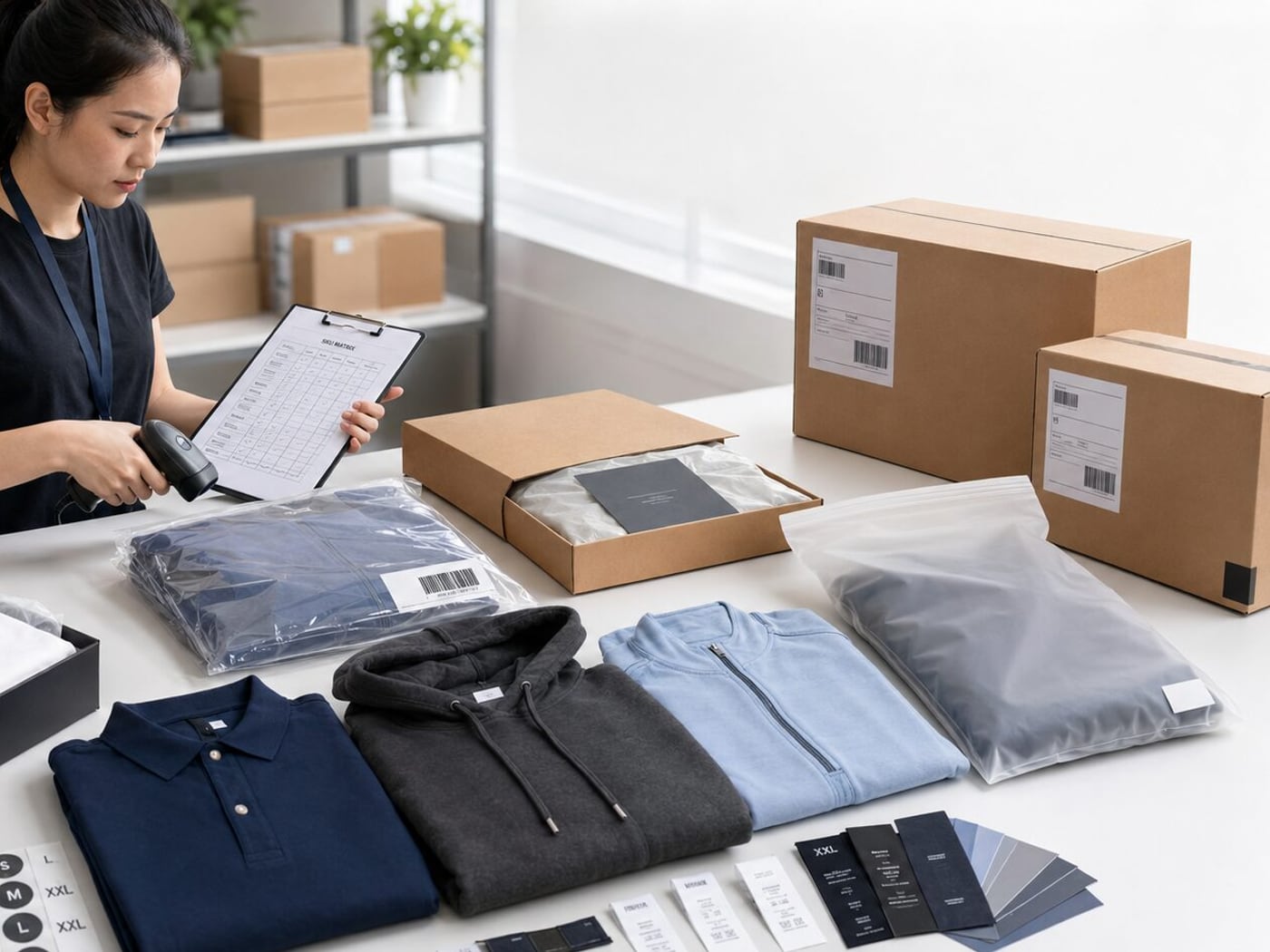
A flat-packed garment needs its size visible on the outside, so a size sticker on the bag and a barcode that scans through it. A hanger-packed garment needs a hangtag attached at the right point and a size marker the shopper can read on the rail. A size-assorted carton needs marking that survives a warehouse scanner.
The label set is part of the same decision. A woven label at the back neck and a care label in the side seam are fixed before packing, but their position and visibility change with the fold. A care label that ends up inside the fold is a care label the customer never reads. Set the label positions against the packing method, and check them on the packed sample rather than on the flat garment.
Packing for knitwear specifically
A knit behaves differently in a carton from a woven shirt. It has stretch, so a fold can sit in the same place and mark the surface; it has weight, so a stack compresses the garment at the bottom; and it has a shoulder, which a hanger can stretch if the hanger is the wrong shape or the garment is heavy.
Hanging a heavy knit on a thin hanger puts the whole weight on two points and leaves a peak at the shoulder that no steamer removes. If a hanger is required, specify a broad shoulder and, for heavier garments, a support under the body. Flat packing avoids the peak and adds the fold, and the choice is really a choice about which mark is easier to remove.
Cost of packing: materials and labour
Packing carries its own cost lines: the bag, the tissue, the board, the carton, the hanger and the labour per piece. Some of those scale with volume and some with handling, and the labour line is the one that surprises buyers, because a hanger-packed order takes more minutes per garment than a flat-packed one.
The freight line moves in the opposite direction. A flat-packed carton carries more pieces for the same cube, so the unit freight is lower even when the packing materials cost more. Comparing the two on packing cost alone misses the half of the calculation that arrives on the freight invoice.
The decision path
- Name the channel. Retail floor, e-commerce, wholesale or a mix, and where the carton is opened.
- Choose the method for each channel and split the order if the channels differ.
- Fix the fold or the hanger, and specify tissue, board and bag where the shape needs support.
- Specify the carton: dimensions, weight limit, marking and the number of garments.
- Place the labels so they stay visible after the fold, and confirm the size marker.
- Approve a packed sample in the actual carton, opened the way the customer opens it.
The path is short, and each step closes a question the next one depends on. Step six is the one that pays for itself. Horssle Knit samples in 7–12 days after fabric and tech pack approval and runs bulk in typically 20–35 days after sample approval, with inspection to AQL 2.5, and a packed sample approved before bulk is cheaper than a re-pack at the warehouse.
FAQ
Does hanger packing cost more in freight?
Usually yes, because a hanger needs cube and the carton is designed around a rail. The trade is presentation and speed at the retail end, which can be worth more than the freight on a seasonal launch.
Will flat-packed knits arrive creased?
They can, especially heavier weights. The fold position, tissue at the neckline and a short hang after unpacking reduce it. Approve a packed sample that has spent a week in the carton, not one packed the same morning.
What is size-assorted packing?
Packing by size or by an agreed size ratio, so the receiver can allocate stock without opening every carton. It is a warehouse decision and it should be agreed before the order is cut.
Can one order be packed two ways?
Yes, and it usually should be when the order serves a shop and an online store. Split it at the order line so each carton has one specification, one label set and one packing list.
Sources: EU Regulation 1007/2011 on textile fibre names, US CBP informed compliance, OEKO-TEX Standard 100, Better Work on labour compliance, Intertek textile testing, and Higg facility indexing.
Working on a knitwear project?
Let’s talk yarn, gauge and timing.
Send a reference or tech pack and we will come back with a practical development route.

