
Three numbers decide a polybag: the folded length, the folded width and the folded depth. Everything else, from the film thickness to the closure and the warning text, follows from those three. A programme that starts with the bag rather than with the fold usually ends up re-bagging in a warehouse, which is the most expensive place to discover a specification error.
Those three numbers cascade into the carton, which is why apparel polybag packing specifications are usually written backwards from the fold rather than forwards from a catalogue. A bag that is slightly too large reduces the garments per carton, and a carton count that changes late in the season changes freight, storage and the retail delivery plan with it.
What Do Apparel Polybag Packing Specifications Need to Cover?
Apparel polybag packing specifications fix the folded garment dimensions, the bag size and film thickness, the closure type, the warning and recycling marks, and where the label sits. Those five decisions have to agree with the carton and with the market’s packaging rules, so they belong in the brief before packing samples are made.
Most buyers hand over a folded sample and a photograph of a bag. That is a start, not a specification. The useful version states the fold method, the finished fold dimensions per size, the bag’s internal dimensions, the film gauge, the closure, and the marks that have to be printed or applied.
Start With the Fold, Not the Bag
Fold first, because the fold is what the customer sees when the parcel is opened and what the retailer sees on the shelf. A flat fold with the front panel showing, a half fold that halves the width, or a hang-ready fold for a rail all produce different dimensions, and a range that mixes them will need several bag sizes.
Then decide whether the fold is consistent across the size range. A small and an extra large folded the same way produce different rectangles, so either the bag is sized for the largest or the range uses two bag sizes. Both are workable; the expensive option is discovering the mismatch when the first cartons are packed.
Bag Size: Length, Width and the Gusset
A bag needs enough room for the folded garment to slide in without strain, and not so much that the garment moves in transit. Strain at the seams and the corners is the usual cause of a split bag on arrival; movement is the usual cause of a creased front panel and a crushed hangtag.
Depth is the dimension buyers forget. A folded sweatshirt is not flat, and a bag with no gusset compresses it into a shape that shows on the shelf. Where the garment has bulk, a gusseted bag keeps the fold square and protects the print, at the cost of carton volume.
A bag sampled empty proves very little. Fill it with the folded garment, seal it, and drop it once from waist height: a bag that splits at the corner will split inside a carton, and the fault will appear at the customer rather than at the packing line.
Thickness: What It Protects and What It Costs
Film thickness is quoted in microns, and it sets how much handling the bag survives: thinner film saves material and carton weight but tears at the corners, thicker film protects and costs more per unit and per carton. For most programmes the right answer sits where the bag survives the journey without carrying more plastic than the product needs.
Recycled content claims belong here too. A bag described as recycled needs evidence that names the material and the percentage, and the mark printed on the film has to match what the supplier can document. A claim on a bag is a claim on the packaging, and packaging claims are checked by the same buyers who check the garment label.
Closures: Tape, Adhesive or None
The closure is the first thing the customer touches and the last thing the packer thinks about. It also decides how the bag behaves in a returns process, because a bag that cannot be reclosed neatly is a bag that gets replaced.
| Closure | How it works | Suits | Watch for |
|---|---|---|---|
| Self-adhesive strip | Peel-and-seal flap on the bag | Retail single units | Residue on the film; strip can fail in cold stores |
| Clear or branded tape | Applied by the packer after folding | Bulk and cost-sensitive programmes | Inconsistent placement; tape can cover printed marks |
| Open bag, heat-sealed | Sealed by machine at the packing line | Inner packaging inside a master carton | Not resealable; needs a tear notch |
| Drawstring or ribbon | Reusable closure | Gift sets and premium ranges | Hand labour; not machine-applicable at speed |
The comparison matters less than the consistency. A programme that specifies an adhesive strip and receives taped bags has a different product on the shelf, and the change is usually invisible until a customer complains about the tape residue.
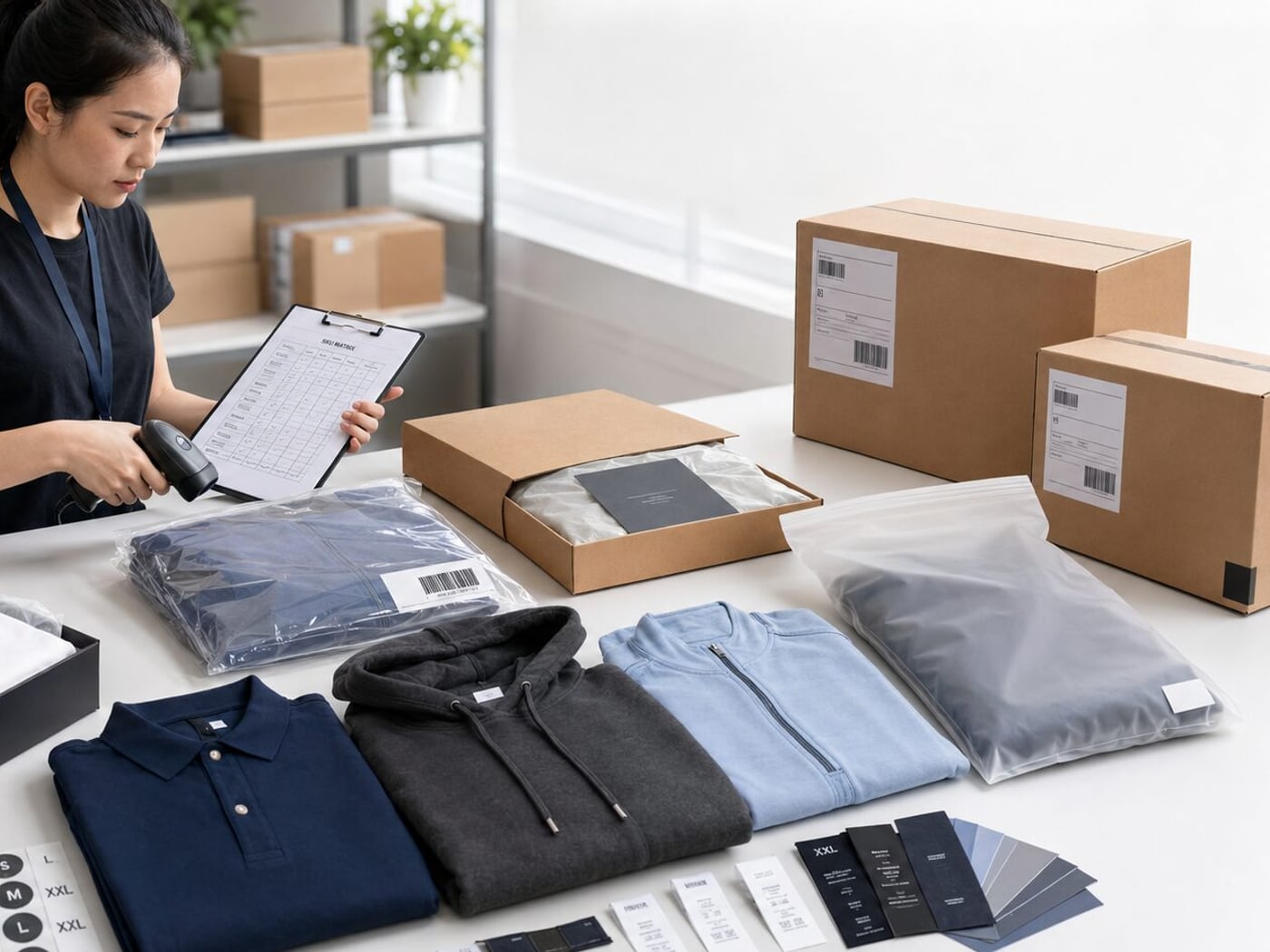
Consistency also has a documentation side. Name the closure, the tape width and the person responsible for applying it, then put a photo of the finished bag in the packing specification. A picture closes more arguments at the packing line than a paragraph does.
Marks, Warnings and Market Rules
Printed marks fall into three groups: the ones a retailer demands, the ones a market demands, and the ones a buyer wants for branding. A suffocation warning belongs to the second group in some markets and is required by some retailers regardless, so the text, its size and its position have to be confirmed for the destination rather than copied from a previous order.
Recycling marks are the same story. Resin codes and disposal instructions differ between markets and change as packaging rules are revised, so the mark on the film has to be checked against the current requirement for the country the goods are sold in. This is one of the few areas where a last-minute check is worth the delay.
Care labelling is separate from packaging but travels in the same bag, and the two are approved together in practice. A custom care label that states a fibre composition the test report does not support is a bigger problem than a bag that is 5 mm too wide.
Labels, Barcodes and What Ships Inside
Inside the bag, the label set decides what the customer reads first. A woven label at the neck, a hangtag on the arm and a size sticker on the film are three different components with three different approval routes, and each has a placement that the packing sample should prove.
Barcodes and price stickers need a defined position so that a scanner can read them through the film without opening the bag. A custom woven label and a custom hangtag are usually approved before the bag is specified, which is the wrong order: the hangtag’s size decides where it can sit without folding.
Packing Samples, Bulk and Inspection
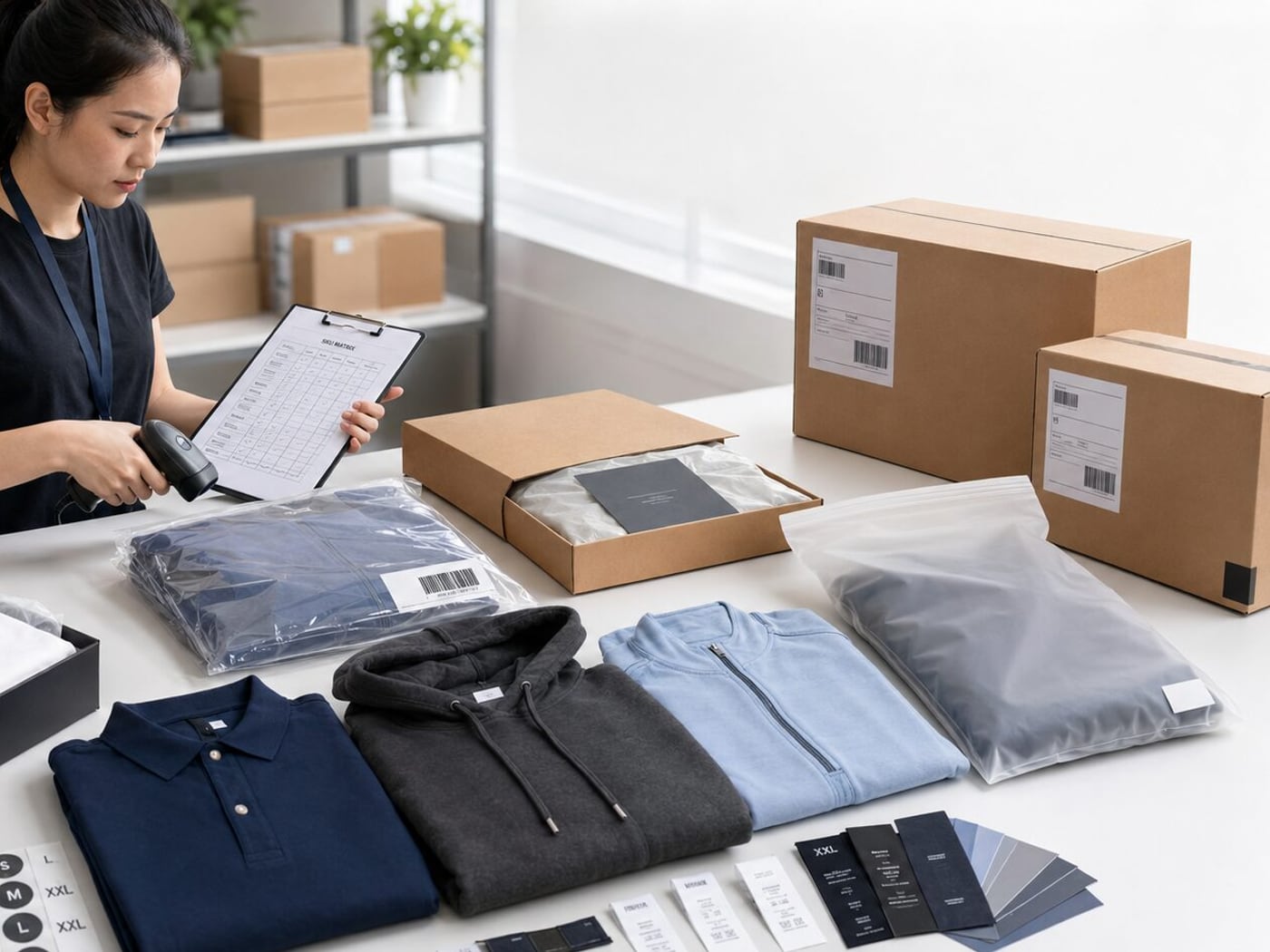
Ask for a packing sample before bulk: the garment folded, bagged, labelled and packed into a carton, with the carton marked as it will ship. Photograph it, measure it, and keep it. Minimum order is 300 pcs per style. Sampling runs 7–12 days after fabric and specification approval, and bulk production typically runs 20–35 days after sample approval. Inspection is carried out to AQL 2.5 unless the buyer’s own plan replaces it.
The packing sample is also where the carton count is fixed. Bags per carton, cartons per pallet and the carton dimensions all follow from the bag, and a bag specification that changes after the carton is booked will change the freight calculation with it.
FAQ
What size polybag should a folded T-shirt use?
There is no universal size. Measure the folded T-shirt’s length, width and depth with the fold you intend to use, then add a small allowance so the garment slides in without strain. State those dimensions in the brief rather than naming a bag size, because a bag size means different things to different suppliers.
How thick should the film be?
Thick enough to survive the journey and the handling at the other end, and no thicker than the programme needs. The right figure depends on the garment’s weight, the carton configuration and the retailer’s requirements, so ask for a packing sample and test it rather than choosing a gauge from a catalogue.
Are suffocation warnings always required?
Not in every market, but they are required in some and demanded by some retailers regardless of law. Confirm the requirement for the destination and for the retailer before the film is printed, because the warning has a specified format and position that cannot be added later without reprinting.
What is the minimum order and lead time?
Minimum order is 300 pcs per style. Sampling takes 7–12 days after fabric and specification approval, and bulk production typically takes 20–35 days after sample approval, with inspection to AQL 2.5 unless the buyer’s plan replaces it.
Sources: EU Regulation 1007/2011, US CBP informed compliance, OEKO-TEX Standard 100, Better Work, Intertek testing, Higg.
Working on a knitwear project?
Let’s talk yarn, gauge and timing.
Send a reference or tech pack and we will come back with a practical development route.

