
Three colours, five sizes, one style: fifteen SKUs, fifteen barcode values, fifteen label variants and one carton that has to be received correctly at the other end. Most warehouse receiving errors begin here rather than at the scanner, because the scanner only reports what the mapping told it to print.
Apparel SKU barcode label mapping is the document that turns that list into something a packing line can follow: a matrix tying style, colour, size, barcode value and label template together, with a scan test that proves the mapping before a carton is sealed.
Apparel SKU barcode label mapping: the matrix behind the sticker
Apparel SKU barcode label mapping is the document that ties each style, colour and size to its own barcode value, label template and sticker position, so a warehouse can receive a carton without checking it by eye. It is built once and tested by scanning every variant.
That matrix is the reason a mapping project is worth an afternoon. The sticker itself is trivial; the agreement about which number belongs on which garment, and who is allowed to change it, is what prevents a season of receiving disputes.
Counting SKUs before counting labels
The count drives everything else. A 300-piece order in three colours and five sizes carries fifteen SKUs, each with its own barcode value, and each value has to appear on the sticker, in the data file and on the carton documentation in the same form.
Two printing routes follow from that count. Pre-printed stickers need one roll or one sheet per SKU, which suits a small number of variants and a packing line without a printer. Variable-data printing needs one template and a data file, which suits many variants and keeps the human-readable text and the barcode in step because both come from the same record.
Either route works. What does not work is mixing them mid-order, because the numbering will drift between the rolls and the data file, and the drift is invisible until a carton is opened in a warehouse.
The four fields on every label
A label carries four things, and each is owned by someone different: the style, the colour, the size and the barcode value. The first three belong to the brand’s own code logic; the fourth is usually a separate number that a retailer or a standards body has issued.
| Field | What it holds | Who supplies it | How it is checked |
|---|---|---|---|
| Style code | The internal style identifier | Brand | Against the tech pack header |
| Colour code | Shade name and code, not just the name | Brand | Against the approved lab dip |
| Size code | The size as it appears on the size label | Brand, with factory confirmation | Against the size label on the garment |
| Barcode value | The scannable number, with its check digit | Brand or retailer | By scanning, never by reading |
The size field is where the two label systems meet. A size sticker that says M has to agree with the woven or printed size label sewn inside the garment, and with the size column in the packing list. Three documents, one word, and a mismatch on any of them is a return.
Template, size and the quiet zone
A barcode needs clear space around it: the quiet zone. It needs a minimum bar width for the scanner that will read it, and it needs contrast between the bars and the background. All three are lost when a label template is squeezed onto a small area of a polybag, and the loss shows up as a scan failure at the warehouse rather than at packing.
The practical rule is to design the sticker at the size it will be printed, place the barcode at the width the printer can hold, and check it with the scanner the warehouse actually uses. A label that scans on a phone app and fails on a handheld reader is a label that was never tested properly. Test the template on the printer that will run the order, too, because thermal transfer and laser output differ where a barcode is smallest.
Placement matters as much as size. A sticker applied over a fold, a seam or the curve of a bag distorts the bars. Keep it flat, keep it clear of the bag seam, and put a photograph of the correct placement in the packing instructions so a new operator applies it the same way.
Who owns the number, and who prints it
The barcode numbers belong to the brand, or to the retailer that issued them. A factory prints and applies what it is given; it does not create a number for a style, and a supplier that offers to assign barcodes is offering something that will not scan correctly in the retailer’s system.
That division should be written down. The brand supplies the values in a data file with a version and a date, the factory confirms the file it has received, and any subsequent change comes with a new version rather than a verbal instruction. Retailer routing guides usually state the label format, the placement and the data required, and they change between accounts, so the guide for the destination should be on the table while the template is built.
The scan test before packing
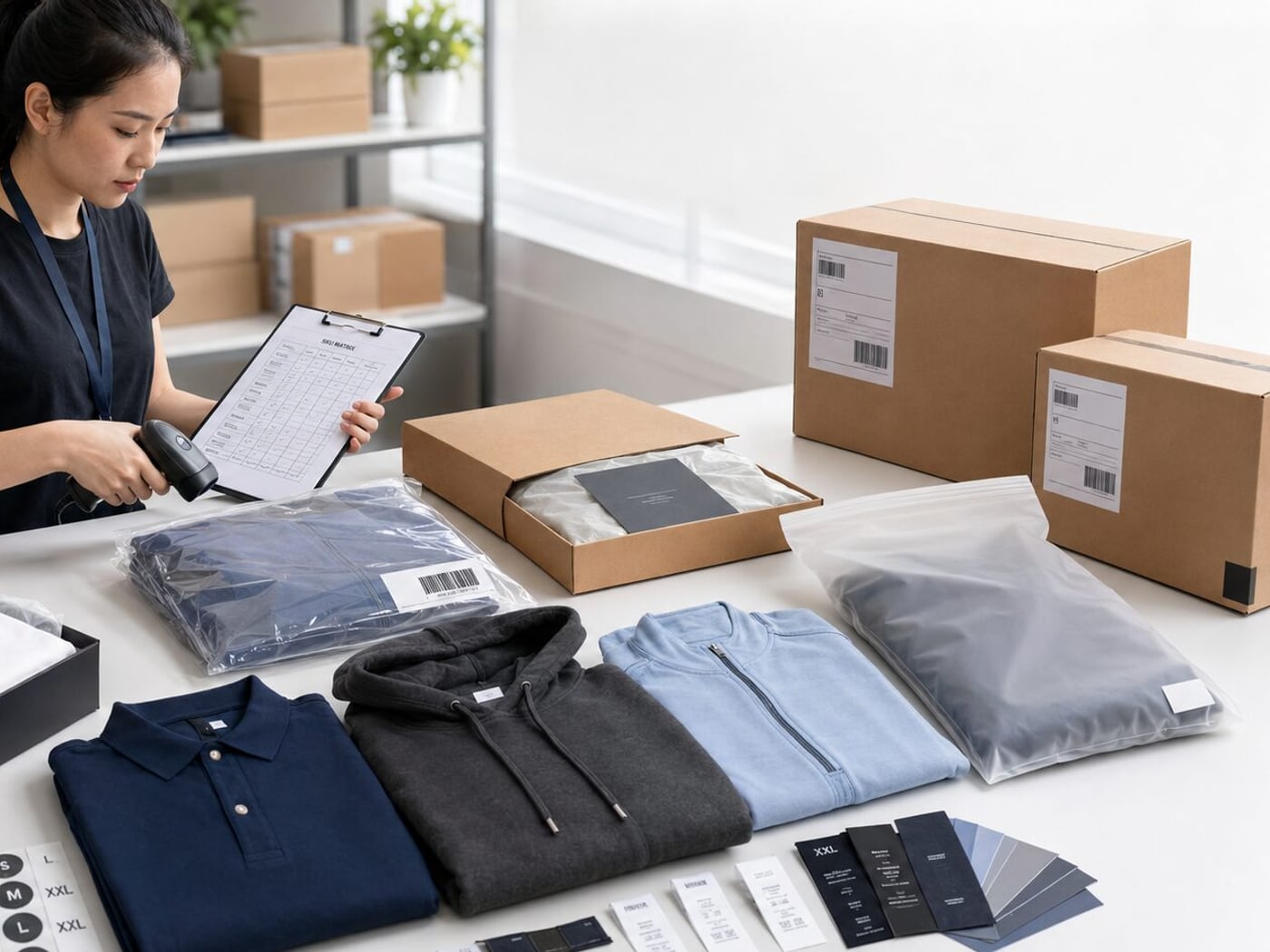
The scan test is short and it is not optional. Scan one example of every variant, at packing, with the scanner the warehouse uses, and confirm three things: that the number read matches the data file, that the human-readable text matches the number, and that the sticker is in the agreed position on the bag.
Keep the result as a signed line in the packing record rather than a memory of a conversation. When a receiving error is reported later, the scan log answers the first question in minutes: whether the wrong sticker was applied, or the right sticker was applied to the wrong garment.
The carton is the last place the mapping is tested. A carton label carrying the same numbers as the bag stickers, and a packing list that matches both, is what lets a warehouse receive the shipment as a single line rather than opening every bag to find out what is inside. When those three disagree, the bags are opened regardless of the scan test, and the packing time is lost twice.
Where mapping fails
The failures repeat, and they are cheap to prevent with a check at the right moment.
| Failure | Cause | Check before packing |
|---|---|---|
| Wrong size sticker on a garment | Two rolls or two data records open at once | Scan one of each size against its record |
| Same barcode on two colours | Value copied from the previous style line | Count unique values against the SKU count |
| Barcode will not scan | Label shrunk, quiet zone cropped or bars distorted by a fold | Scan on the packed bag, not on the sheet |
| Human-readable text disagrees with the bars | Two data sources, or a template edited by hand | Compare both fields on every variant |
| Sticker covers the bag seam | Placement never specified | Use the placement photograph in the packing instructions |
Putting it in the order pack
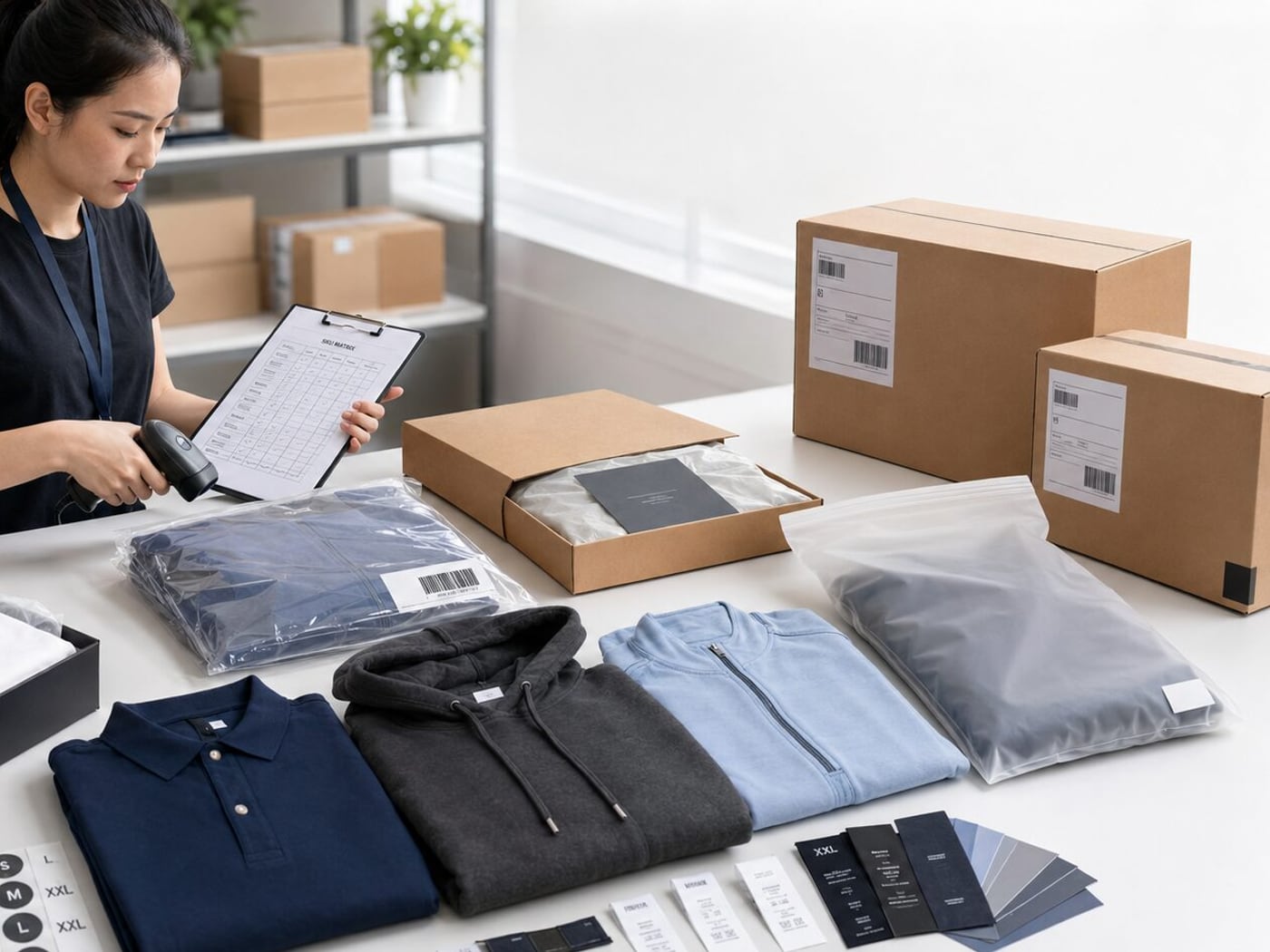
The order pack should carry four things: the SKU matrix, the label template with its dimensions, the data file with a version and date, and the scan log from the sample packing. Add the sticker placement photograph, and the retailer’s routing guide if one exists.
Those four documents make the order repeatable by someone who was not in the room. They also make the label set auditable, which matters when a woven label or a care label changes in the same season and the packing team has to know which combination is current.
If the matrix is the part still missing, send the SKU list and the destination retailer’s routing guide to the barcode label team and ask for the template to be checked against a test scan before the packing run.
FAQ
Can the factory assign our barcode numbers?
No. The numbers belong to the brand or the retailer that issued them, and a factory that invents a value is printing something that will not scan in the destination system. The factory prints and applies what it is given.
Do we need a separate label for every size?
Not necessarily. Variable-data printing uses one template and a data file, so the size changes with the record rather than with the roll. Pre-printed stickers do need one per SKU.
Where should the sticker sit on the bag?
Flat, clear of the seam, and in the same place on every bag. The retailer’s routing guide may specify it; if not, agree a position and photograph it for the packing instructions.
What if the barcode changes mid-season?
Version the matrix and the data file, set a changeover date, and re-run the scan test. A change without a date leaves two valid numbers in circulation and returns follow.
Sources: EU Regulation 1007/2011 on fibre names and labelling, US CBP informed compliance on import documentation, OEKO-TEX Standard 100 on restricted substances, Intertek on textile testing, and Better Work on labour compliance.
Working on a knitwear project?
Let’s talk yarn, gauge and timing.
Send a reference or tech pack and we will come back with a practical development route.

