
A cardigan generally costs more to develop than a sweater knitted from the same yarn, and the difference does not sit in the sleeves. It sits in the opening down the front. That is the first thing a custom cardigan development guide should say, and it is usually the last thing a brief mentions.
Last modified: November 23, 2026
Wearers notice that opening before anything else. A placket that ripples, a top button that pulls, a front edge that swings away from the body: each one reads as poor quality even when the yarn is good. Development cost follows the same geography, because the front is where the fitting, the interlining and the re-sampling happen.
A custom cardigan development guide starts at the front
A custom cardigan development guide should start with the front, because that is where the cost and the fit risk concentrate. Two front panels, a closure, an interlining and a placket must meet, hold their line and stay aligned after washing. Everything else follows from that decision.
What follows is the order in which the front builds cost: the panel, the edge finish, the closure, the drape, the pocket, and the sampling rounds that test them. None of these is expensive in isolation. Together they decide whether the garment is a cardigan that closes properly or a sweater with a gap in it.
Reading the front as a cost centre
Cost accumulates in a fixed order: yarn, knitting time, front panels, closure, finishing, sampling rounds. Yarn is the line buyers ask about first and rarely the one that moves. A heavier yarn lifts the yarn line once; a front that will not sit flat lifts every line after it, because the garment is knitted again, fitted again and graded again.
That order matters when a quotation arrives. A supplier pricing from a flat sketch will cost a placket as a strip of fabric. A supplier pricing from a sample knows whether that strip needed interlining, a different knitting tension, or a hand-finished edge that holds its shape through a wash.
There is a practical test for this, and it costs one sample. Ask for the front to be knitted in the intended yarn, washed and pressed before approval. If the edge stays straight and the placket lies flat, the construction is resolved. If it waves, no amount of finishing will keep it flat in bulk.
Front construction sets the cost base
Three constructions cover most cardigan development: a button-through placket, a zip front, and an open front with no closure. They are not interchangeable at sampling stage, and their cost drivers diverge long before a unit price appears.
| Front construction | Front panels | Closure | Interlining | Fitting rounds | Main wash risk | Cost pressure |
|---|---|---|---|---|---|---|
| Button-through placket | Two fronts plus separate placket | Buttons and buttonholes | Usually required | Most | Placket alignment | Highest |
| Zip front | Two fronts plus tape | Zip and puller | Required along the tape | More | Tape and panel shrinkage | High |
| Open front | Two fronts, no closure | None | None | Fewest | Edge curl at the front | Lowest |
Read the table as pressure rather than price. An open front removes the closure and the interlining, and lets the fronts be knitted as part of the body; it also removes the structure that holds the front in place, so the yarn and the tension have to do that work instead. A soft yarn in an open front will curl, and no pressing will train it permanently.
The zip front trades buttonholes for a tape and a zip. That is fast to attach and unforgiving to align: the tape shrinks at its own rate, and a front that measures correct on the table can wave once the zip is sewn in.

Placket, band or facing: three ways to finish the edge
A placket is a separate strip attached to the front edge. A band is knitted on as a continuation of the front. A facing is a turned-back strip on the inside that never shows. The three look almost identical in a photograph and behave very differently after a wash.
The band is the fastest to knit and the least stable, because any variation in yarn tension runs straight down the edge as a wave. A separate placket costs more in making up and can be interlined, stabilised and pressed, which is why it appears on button-through cardigans made in soft yarns. A facing hides the structure and keeps the front visually plain, at the cost of an extra layer inside.
Whichever route you choose, the edge has to be specified the same way on every size. A band width that grades as a percentage will look correct on a medium and thin on an extra small, and the difference shows most at the neck, where the edge is shortest.
Closures carry hidden cost
Buttons, zips and snaps do not cost the same to install, and the hardware is only part of it. The closure dictates the placket width, the interlining, the buttonhole method and the amount of handling the front edge needs.
| Closure | Placket build | Interlining | Alignment risk | Repair at retail | Wearer experience |
|---|---|---|---|---|---|
| Buttons | Separate placket or band | Usually required | Moderate, shows after washing | Button can be replaced | Adjustable, visible opening |
| Zip | Tape attached after knitting | Required along the tape | High at hem and neck | Zip replacement is a workshop job | Clean line, less adjustability |
| Snaps | Placket with reinforcement | Required at each snap | Moderate, pull concentrates | Snap can be replaced | Fast, but edges pull between snaps |
This explains a common surprise in sampling. Two cardigans in the same yarn, one with buttons and one with a zip, quote differently even when the panels are knitted from the same programme, because the making-up steps behind the closure are not the same.
Drape is a knitting decision, not a styling one
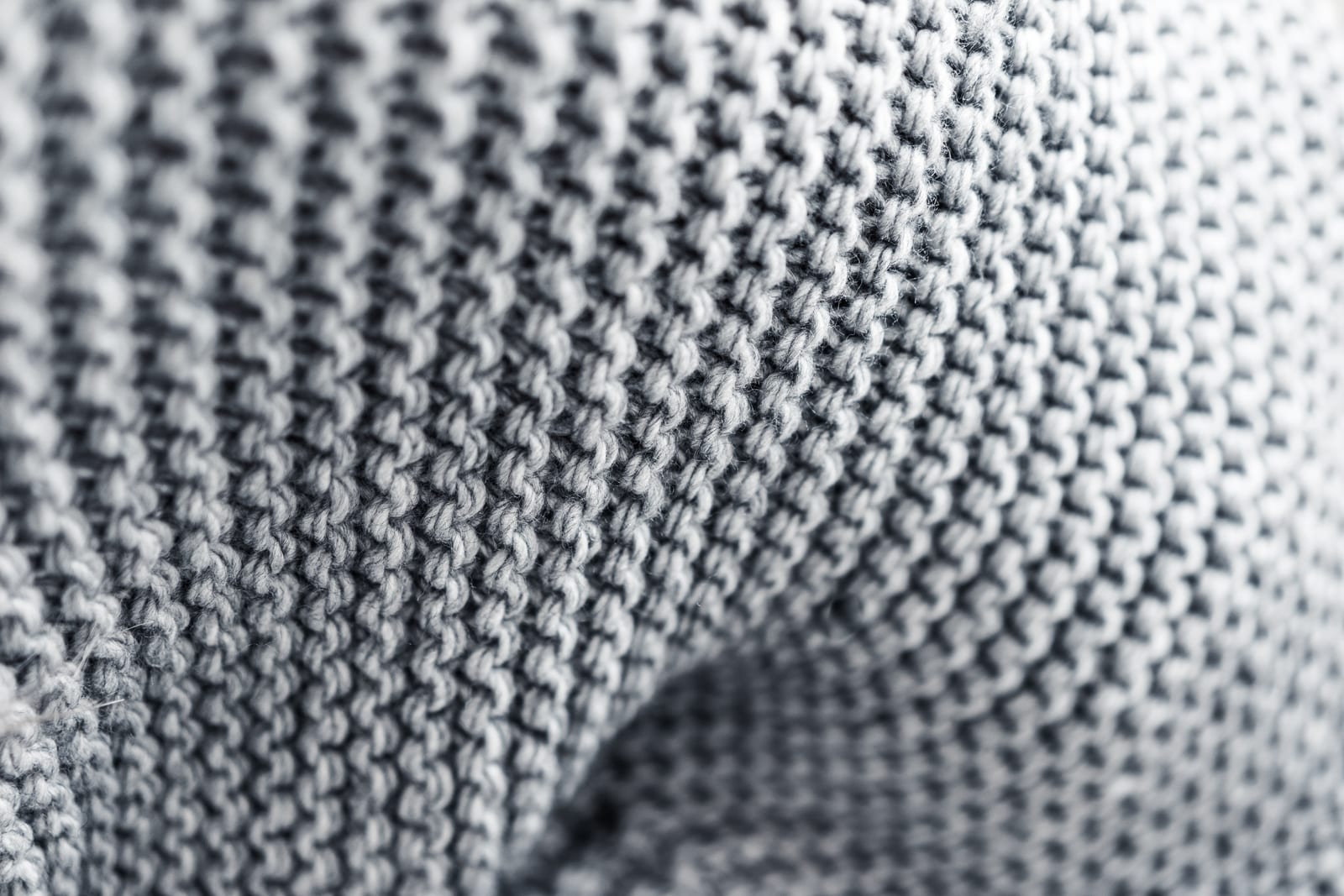
A cardigan hangs from the shoulders and closes at the front, which means its front panels carry a job a sweater’s front does not: they have to meet without pulling and hang without flaring. That behaviour is set by gauge, stitch structure and yarn, in that order, long before anyone chooses a button.
Firm yarns at a tighter gauge hold a straight front. Soft yarns at a looser gauge drape, then curl at the edge and gap between the closures. The usual compromise is a front panel knitted at a slightly tighter tension than the back, which costs knitting time and reads to the wearer as a cardigan that closes properly.
Pockets: the detail that changes the panel
A patch pocket is a piece sewn on. A welt is a slot worked into the fabric. An in-seam pocket sits in the side seam and needs a bag, which means extra panels and lining. Each adds a different amount of making-up time and each changes how the front hangs.
Pockets are also where cost negotiations usually land first, because they are visible and easy to remove. Dropping a welt pocket drops the making-up step. Dropping an in-seam pocket also drops the bag, the reinforcement and two seams, and on a soft yarn the front may hang better without them, which is the only sound argument for a pocket-free cardigan.
What to check on a cardigan front before signing off fit
Start with the cardigan open on the fit model. Mark the intended overlap, then fasten it without shifting the hem or pulling either front into position. If the distortion appears only after fastening, look at where the closure loads the front and whether the intended chest ease is still there. If it already hangs unevenly when open, lay the garment flat and compare the two panel edges before moving the buttons. Write down which condition produces the fault. A photograph of the cardigan buttoned shut cannot answer that question by itself.
- Band pulls into waves before fastening
- Compare the band length and front edge with the approved reference. Check where the ripples start and ask the sample room whether the band, attachment or finishing changed.
- Only the fastened front gaps or twists
- Mark the matching buttons and buttonholes on a flat garment, then check the marks against the overlap on the body. Isolate a misaligned closure from a garment that is tight through the chest before changing either.
- Front hem drops with pockets loaded
- Repeat the fitting with the intended pocket contents, then remove them and record whether the hem recovers. Review pocket support and panel stability with the sample maker.
Take matching open and closed photographs before and after the intended care cycle. Put the photographs next to the finished measurements and the closure specification in the fit comments. The BSI guide to assessing appearance after washing and drying includes damage to garment components among the features a formal assessment can cover.
Where sampling rounds multiply
Sampling runs 7–12 days after fabric and tech pack approval, and bulk production typically 20–35 days after sample approval. The windows are fixed; what varies is how often a buyer uses them. A front resolved at the first sample costs one round, and a closure changed after approval costs another.
Treat the sample as a test of the front rather than a photograph of a garment. Fasten it, hang it, wash it, press it, and look at the placket before approving anything. The bulk is inspected at AQL 2.5 against that approved sample, so a front approved in a hurry becomes the standard the whole order is measured by.
Questions about cardigan fronts and fit sampling
Is a cardigan not just a sweater with an opening down the front?
No. Two front panels, a closure and an interlining change the structure, the fitting and the sampling. A sweater pattern cannot simply be cut open, because the front panel tension, the grade and the making-up all change with it.
Can we drop the interlining to save cost?
On a firm yarn at a tight gauge, sometimes. On a soft merino or cashmere the omission shows as a rippled placket after the first wash, and that is not a repair a retailer can make. Decide it with a wash test on the sample.
Do we need a new sample if only the front changes?
Yes. A different front changes the panel width, the drape and often the grade, so treat it as a new development and book the sampling window for it rather than expecting the change to travel on the existing approval.
Does a heavier yarn make a better cardigan?
Not by itself. Weight helps a front hold its line, and it also pulls on the shoulders and uses more yarn. A tighter tension on a mid-weight yarn usually does more for the front than moving up a yarn count does.
If the front is still open, send the style, the closure and the target quantity to the cardigan manufacturing team and ask for a sampling suggestion before the yarn is booked. Comparisons are only worth making on the same yarn, the same gauge and the same front.
Sources: The Woolmark Company on wool fibre specification, OEKO-TEX Standard 100 on restricted substances, EU Regulation 1007/2011 on fibre names and labelling, Intertek on textile testing, and Control Union on certification scope.
Working on a knitwear project?
Let’s talk yarn, gauge and timing.
Send a reference or tech pack and we will come back with a practical development route.

