
The shirts arrived on the Thursday before a Saturday event, and the size split was wrong. Too many mediums, almost no smalls, no spares, and a box marked only with the style code, which meant somebody had to count four hundred shirts by hand on the Friday night.
None of that was a production failure. The order was made correctly and delivered on time. The failure was in the planning before the order: the sizes were collected without a measurement guide, the spares were not planned, and the packing was specified as a quantity rather than as a distribution. Event T-shirt order planning is mostly that: the decisions taken before the purchase order rather than at the venue.
Event T-shirt order planning: the short answer
Event T-shirt ordering is decided by three numbers: the size split, the spares you carry, and the way the shirts are packed. Collect sizes with a measurement guide, set the split before the order, pack by group rather than by size, and distribution on the day takes an hour rather than an afternoon.
The checklist below runs in the order the decisions have to be made, because each one constrains the next.
Collecting sizes that are worth collecting
A registration form that asks for a size returns a preference rather than a measurement, and preferences skew. People choose the size they wear in one favourite brand, or the size they intend to become, and the resulting curve is wider than the real population. Ask for chest measurement in centimetres alongside the size, and publish the size chart next to the field.
Where the form cannot be changed, add a line to the confirmation email: “check your size against the chart in the link”. The response rate is never complete, but even a partial correction improves the split and shows where the uncertainty sits.
Treat the returned data as a sample rather than a census. A form filled in by a third of the registrants shows the shape of the curve, and the rest usually follows it closely enough for an order. What the sample cannot show is the extremes, so check the smallest and largest sizes against the chart before the split is fixed.
Unisex, fitted and the chart that goes with them
Most event shirts are ordered on a unisex block, and most people convert their usual fitted size into a unisex size by guessing one down. That guess is the single largest source of exchange requests at an event, and it is corrected by publishing both charts side by side with a chest measurement rather than a letter.
Decide early whether the range includes a fitted option. Two blocks double the size curve, double the spares and complicate the packing, and the benefit is real only when a significant share of the audience asks for it.
Size letters are not standardised between suppliers either. A medium in one block is a large in another, and the chart that matters is the one printed for the blank being ordered rather than the one in a brand’s size guide. Put the chest measurements in the help text next to the field and most of the argument about letters disappears.
| Decision | What to do | What it prevents |
|---|---|---|
| Size collection | Ask for chest measurement with the size | A curve built on preference rather than body |
| Size chart | Publish unisex and fitted charts with measurements | Guessing one size down |
| Spares | Concentrate extras in the middle sizes | Exchanges with nothing to exchange |
| Packing | Pack by group, label every carton | Counting four hundred shirts by hand |
| Distribution | One desk per group, one spare box per desk | A queue that moves at the speed of one person |
The third row is an assumption rather than a rule: spares concentrate where the demand is, and the demand is in the middle of the curve. A handful of smalls and a handful of larges carry the exchanges at the edges.

Spares: how to size the assumption
Decide the spare quantity as a planning assumption and write it beside the order. The number depends on the audience: a conference with pre-registration needs fewer spares than a public event with walk-ups, and an event with a stage or a staff team needs a separate allowance for people who never registered.
Concentrate the spares where the curve is fat, and keep a small number of each extreme size. If the budget is tight, reduce the spare percentage before reducing the fabric weight, because an under-ordered size is visible on the day and a slightly thinner shirt is not.
Two other allowances are worth separating. Staff shirts are rarely in the registration data, and a crew or a volunteer team will ask for shirts on the day. Count them as their own line rather than burying them in the spare number, because they usually arrive as a block of one or two sizes.
Packing by group, not by size
The packing specification is where an event order differs from a retail order. Retail packs by size ratio; an event packs by who receives the shirt. If the shirts are distributed by team, by registration category or by bib number, the cartons should be packed that way and labelled with the group, the size breakdown and the count.
Give the factory a packing list with one line per carton. A carton labelled “team A, 40 pieces, S 6 / M 18 / L 12 / XL 4” can be opened at the desk and handed out; a carton labelled “40 pieces” has to be sorted first.
The packing list doubles as the receiving check. When the cartons arrive, the person holding it can confirm the counts per group in ten minutes and raise a missing carton before the desks open, rather than discovering it at the second queue.
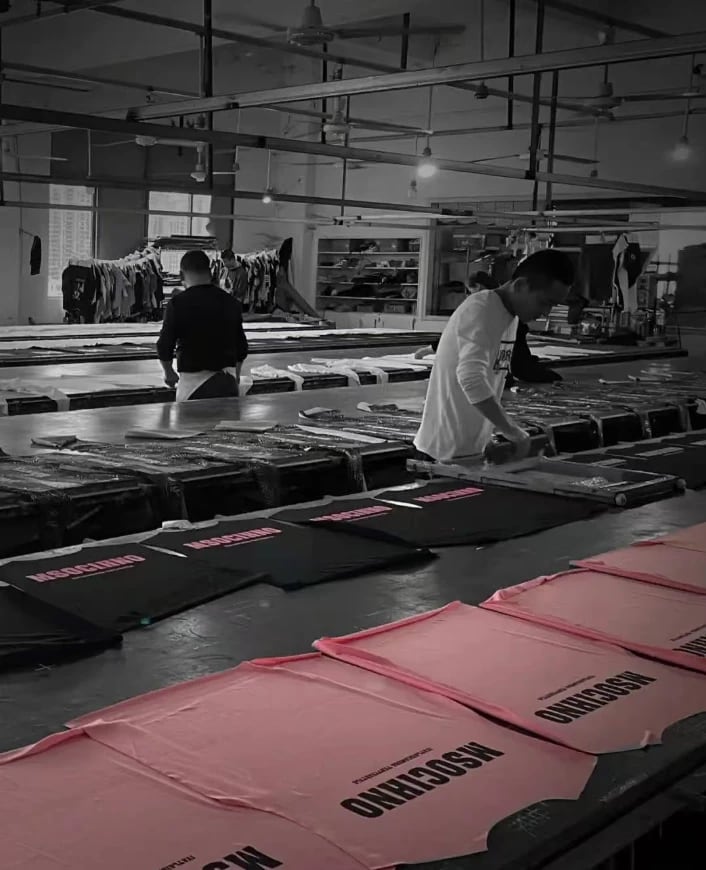
The distribution plan
Step one: assign one desk per group and put the labelled cartons behind each desk. Step two: keep a spare box at every desk, filled from the middle sizes. Step three: record exchanges rather than performing them silently, so the next event’s split improves. Step four: keep two cartons unopened until the end, for staff and for the late arrivals the registration list missed.
None of those steps costs money and all of them reduce the queue. An event that runs one queue for four hundred people takes an hour longer than an event that runs four, and the difference is decided in the packing list rather than on the day.
Tape the distribution plan inside the lid of each carton. The person at the desk does not need the whole order, only the sizes in that carton and the exchange rule, and the page inside the lid stays with the shirts when the paperwork does not.
What to send with the order
Send the artwork in the final size and colour separation, the size split with the spares marked separately, the packing list per carton, the delivery address and the date the goods must arrive rather than the date the event begins. Add the contact who will receive the delivery, because a container that arrives at a venue with nobody to sign for it is a problem no schedule survives. Confirm the delivery window as well: a loading bay that receives goods between certain hours is a constraint that belongs in the order rather than in a conversation after dispatch.
A custom oversized T-shirt used as an event shirt needs the size chart revised for the block, because an oversized cut shifts everyone down a size and the registration form will not know that.
What the order should not assume
It should not assume that the venue can store cartons, that the delivery will be accepted outside office hours or that the printer can add names after the order is placed. Names and numbers are a per-piece operation, and they change the packing from a carton count to a list.
The T-shirt range page covers the blanks and the constructions that most event orders use, and the event brief is the part that turns a blank into a distribution plan.
FAQ
How many spares should an event order carry?
Set it as an assumption based on the audience: more for walk-ups and staff, fewer for pre-registered conferences. Concentrate the spares in the middle sizes, because that is where the exchanges happen.
Should we ask for fitted and unisex sizes?
Only if the audience will use them. Two blocks double the curve, the spares and the packing complexity, and a single well-explained unisex chart usually serves an event better than two charts nobody reads.
Can names be added to the shirts?
They can, and they turn the packing into a per-person list rather than a carton count. Order the names as their own line item and allow time for the packing, because a named shirt has to reach the right person.
When should the order be placed?
Early enough that the goods arrive before the event with a margin for a delivery problem. Work back from the arrival date rather than the event date, and confirm the receiving contact before the shipment leaves.
Sources: OEKO-TEX Standard 100, EU Regulation 1007/2011, Intertek, Higg, US CBP and The Woolmark Company.
Working on a knitwear project?
Let’s talk yarn, gauge and timing.
Send a reference or tech pack and we will come back with a practical development route.


