
A listing goes dark on a Tuesday morning. The stock is already in a fulfilment centre outside Rotterdam, and the marketplace message is three lines long: product safety information incomplete. The brand spends the next ten days looking for an EU company willing to put its name and address on knitwear labels printed four months ago.
None of that is a product defect. It is an order-of-operations problem, and it is the usual way knitwear brands meet GPSR for the first time. The regulation, (EU) 2023/988, has applied since December 2024. Most of what it asks for is information you already hold, arranged in a sequence that most brands assemble backwards.
Who is the responsible person
Under GPSR, a product needs a responsible person established in the EU — a manufacturer, importer, authorised representative or fulfilment provider. That entity’s name, postal address and electronic contact must appear on the product or packaging and on the online listing. Without one, the product cannot be placed on the EU market.
The role is not a rubber stamp. It is the party an authority contacts, and the one expected to hold the technical documentation when something goes wrong.
Brands choose between three arrangements in practice: the EU importer of record, an authorised representative appointed in writing, or a fulfilment service provider where the arrangement genuinely covers the obligation.
Two tests tell you whether the appointment is real: can that entity receive a posted letter and answer it in the market’s language, and does it hold the batch records for the goods it is named on? An address that fails either test is decoration.
The text of Regulation (EU) 2023/988 is short enough to read in an afternoon, and it is the only version that counts when an authority quotes it back to you.
Traceability you must be able to produce
Traceability under GPSR means identifying the economic operators who supplied the product, and where relevant those it went to, for the period the regulation sets. For knitwear that lands on lot-level links from purchase through shipment.
A purchase order number is not batch traceability. When a complaint arrives about a pilling collar, the question is which yarn lot and which dye lot produced that carton, and the answer must come from records written at the time.
What to keep is unglamorous: order, yarn lot, dye-lot sheet, cutting ticket, packing list, shipment record. Four of those six pages come from the factory, which is why this belongs in the supplier conversation, not in a legal folder.
Product identification and batch marks
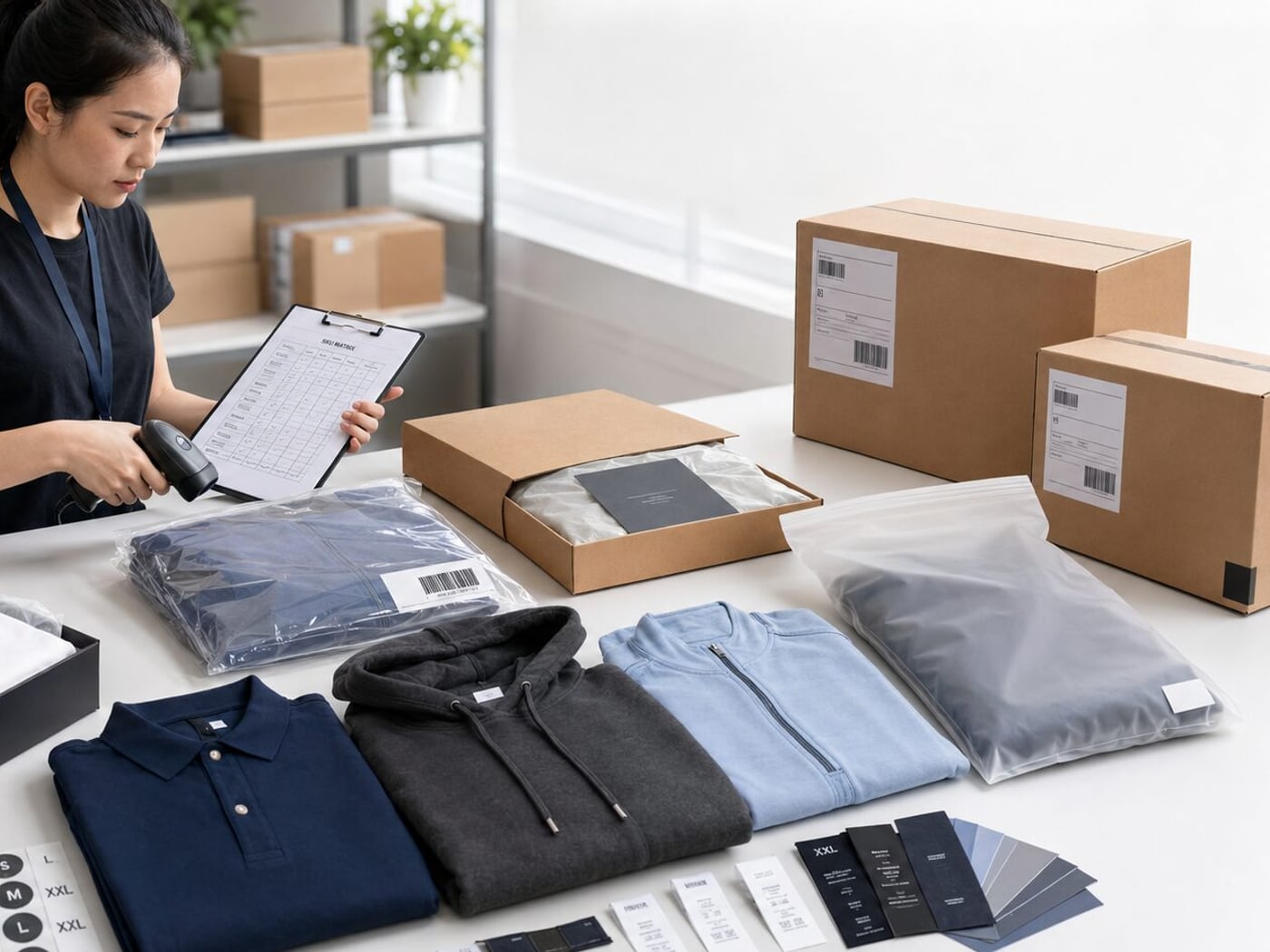
Every unit needs to be identifiable, and identification has to survive the laundry. Style code, colour code, size, and a batch reference are the minimum; the responsible person’s details are the addition GPSR makes visible.
- Woven or printed main label: brand, composition, origin and the responsible person where the label has room.
- Care label: care symbols per ISO 3758, style and batch code, fibre content per Regulation (EU) 1007/2011.
- Hangtag or polybag sticker: batch, size, and the contact block when the label cannot carry it.
- Carton mark: the same batch reference, so a warehouse can pick a recall lot without opening every box.
The batch code is the part brands skip and the part that makes later steps possible. Assign it at cutting rather than at packing. Print it on the care label, not on a removable sticker.
Warnings in the right language
Safety information has to be understandable to consumers in the member state where the product is sold. That usually means several language versions of one SKU, not one version for the EU.
Translation is where the factory should not decide. Warnings are short. Short text is where machine translation and improvised wording do the most damage. Fix a glossary per market once and let someone accountable for the claim review it. Lock it into the artwork file; the factory then prints what it is given.
A warning that nobody can read is not a warning at all.
If a warning exists for one market, assume the listing will be read in another: buyers cross borders to shop, and an authority does not check which warehouse sent the parcel.
Matching the online listing to the label
The listing is treated as part of the product information, so the two records have to agree. They diverge at predictable fields, usually because the listing was built by marketing from a spec sheet that changed twice.
| Field | On the label | On the listing | Common failure |
|---|---|---|---|
| Product identity | Style and colour code | Same codes, searchable | Listing shows a superseded colourway |
| Responsible person | Name and postal address | Same block, plus email | Listing offers a web form only |
| Composition | Fibre percentages | Identical wording | Listing rounds or reorders fibres |
| Care | Symbols | Same symbols, explained | Listing says machine wash, label says cool wash |
| Batch reference | Code on the care label | Visible in the listing data | Listing carries no batch at all |
| Warnings | Text in the market language | Same text, same language | Two translations of one warning |
The fix is procedural: whoever approves the label artwork also signs off the listing copy, and both carry a version number. Without that, the divergence is found by a customer or a regulator rather than by you.
A listing is a label with a URL, and the two must match.
Records to keep when a claim arrives
A claim arrives as a complaint, a marketplace notice or a request from a market surveillance authority. All three follow one pattern: identify the batch, count the units, say where they went, state what you did.
The incident file has four parts: batch reference; distribution list; technical evidence for the style; dated log of decisions. Keep it in one place per case, with the correspondence inside it.
Response speed is set by the authority and it is short. The file does not lengthen the window; it stops the window being spent assembling documents that should have existed since cutting.
What the factory supplies
A supplier owns a defined part of the evidence: whatever concerns what was physically made, the factory supplies; whatever is claimed about it, the brand owns. What we can put in your hands is listed on the factory page.
- Batch and lot records linking yarn, dye lot, cutting ticket and packed cartons.
- Fibre composition and care instructions per style, consistent with the approved artwork.
- Test reports and certificate numbers, including chemical screening such as OEKO-TEX where the buyer specifies it.
- Label and packaging proofs with placement and version control.
- A signed declaration per shipment referencing the specifications above.
A factory outside the EU cannot be your responsible person, or sign a declaration for your brand. If a supplier offers to “handle GPSR” without an EU entity behind it, that is a document service, not a compliance role.

What only the brand can do
Four decisions cannot be delegated, because they rest on knowledge the supplier does not have: who the responsible person is; what the listing says; what risk assessment the product carries; whether a recall is triggered.
The risk assessment is the one brands underestimate. A knit top may carry no mechanism and no chemical hazard at use. That is a defensible conclusion but it has to be written down and dated. Choosing not to warn is also a decision that needs a reason on file.
There is a direction of travel to plan for. EU work on digital product information under the ESPR framework points towards structured data attached to a digital record. That is easier to reach from clean field-level data than from a folder of PDFs.
A one-page handover file
Nine sections, one page, one version number per shipment. This is the document to hand to an EU importer at first delivery, and the one to open when a claim arrives.
| Section | Contents | Source |
|---|---|---|
| 1 Responsible person | Legal name, postal address, email, signed mandate | Brand |
| 2 Product identity | Style, colour, size range, product identifier | Brand |
| 3 Batch and traceability | Yarn lot, dye lot, cutting ticket, packing list | Factory |
| 4 Composition and care | Fibre percentages, care symbols, origin | Factory |
| 5 Test evidence | Report references, certificate numbers, dates | Factory |
| 6 Warnings and languages | Approved text per market, translator sign-off | Brand |
| 7 Listing record | URL, screenshot, date captured, version | Brand |
| 8 Distribution record | Which batch went to which market and customer | Brand |
| 9 Declaration | Signed statement referencing sections 1 to 8 | Brand and factory |
Two of the nine sections are entirely yours and two are entirely the supplier’s; the rest need both sides. That is a reasonable summary of where GPSR work actually sits, and it is why the shipment handover checklist we use covers sections 3 to 5 in more detail than the regulation itself does.
Before your first EU shipment, confirm two things: who the responsible person is, and which legal entity is the importer of record. If either is unresolved, send the destination markets plus the launch date through the contact page and we will tell you which sections we can populate from production records.
FAQ
Is GPSR only relevant to electronics and toys?
No. It covers consumer products generally, knitwear included, and the obligations scale with risk rather than with category.
Can our factory in China be the responsible person?
Only if it is established in the EU. A factory outside the EU can supply documents, but it cannot hold the role.
Does a CE mark solve this?
No. CE marking applies to product groups covered by specific legislation, and a knitted garment is not one of them.
We are a small brand. Are we exempt?
No. Size does not remove the requirement; it changes how much documentation an authority is likely to request.
Working on a knitwear project?
Let’s talk yarn, gauge and timing.
Send a reference or tech pack and we will come back with a practical development route.

