
The first pointelle sample looked correct on the table and wrong on the body. The eyelets were even, the pattern repeat lined up at the side seam, and then the model raised her arms: the front panel had opened into a ladder four stitches wide, running from the armhole to the hem. The structure had been knitted at a gauge that was too coarse for the yarn, and nothing in the sample review had asked it to stretch.
Pointelle is one of those structures that rewards a specific set of decisions and punishes everything else. It is not a surface effect added after knitting; the holes are part of the loop structure, which means the yarn, the gauge and the finishing all have to agree before the first panel is knitted.
What pointelle actually is
Pointelle is a knit structure in which stitches are transferred to create small eyelets in a planned pattern — diamonds, chevrons, a scattered scatter of single holes, or a fine vertical line running up a sleeve. The transfers interrupt the usual loop path, which is why the fabric is lighter and more open than jersey at the same gauge, and why it behaves differently under tension.
That difference is the whole story. A jersey panel recovers elastically; a pointelle panel recovers around a pattern of holes, and those holes are the weak points where a run can start.
Gauge and yarn: the pairing that decides everything
Pointelle is usually knitted in the finer half of the gauge range. On flat knitting machines the practical band is roughly 12 to 16 gauge; coarser than that and the eyelets become large, unstable openings rather than a surface pattern. The yarn has to match: smooth, reasonably high-twist, and fine enough that the transfer does not leave a slack loop.
| Structure | Typical gauge | Yarn direction | Where it fails |
|---|---|---|---|
| Fine allover pointelle | 14–16G | Fine count, smooth, high twist | Holes close up after washing; pattern reads as texture only |
| Scattered single eyelets | 12–14G | Medium count, even yarn | Individual holes vary in size across the panel |
| Pointelle stripes or panels | 12–14G | Medium count, low hairiness | Distortion at the boundary between plain and open zones |
| Pointelle with cable or rib | 7–12G | Woolen or worsted, moderate twist | Density mismatch; the cable blocks pull the eyelets out of line |
Hairy yarns — brushed wool, alpaca, some mohair blends — are the usual culprit when pointelle looks muddy. Fibre fills the eyelet, so the pattern reads as a soft texture rather than a hole, and the customer wonders why the sample looks nothing like the reference.
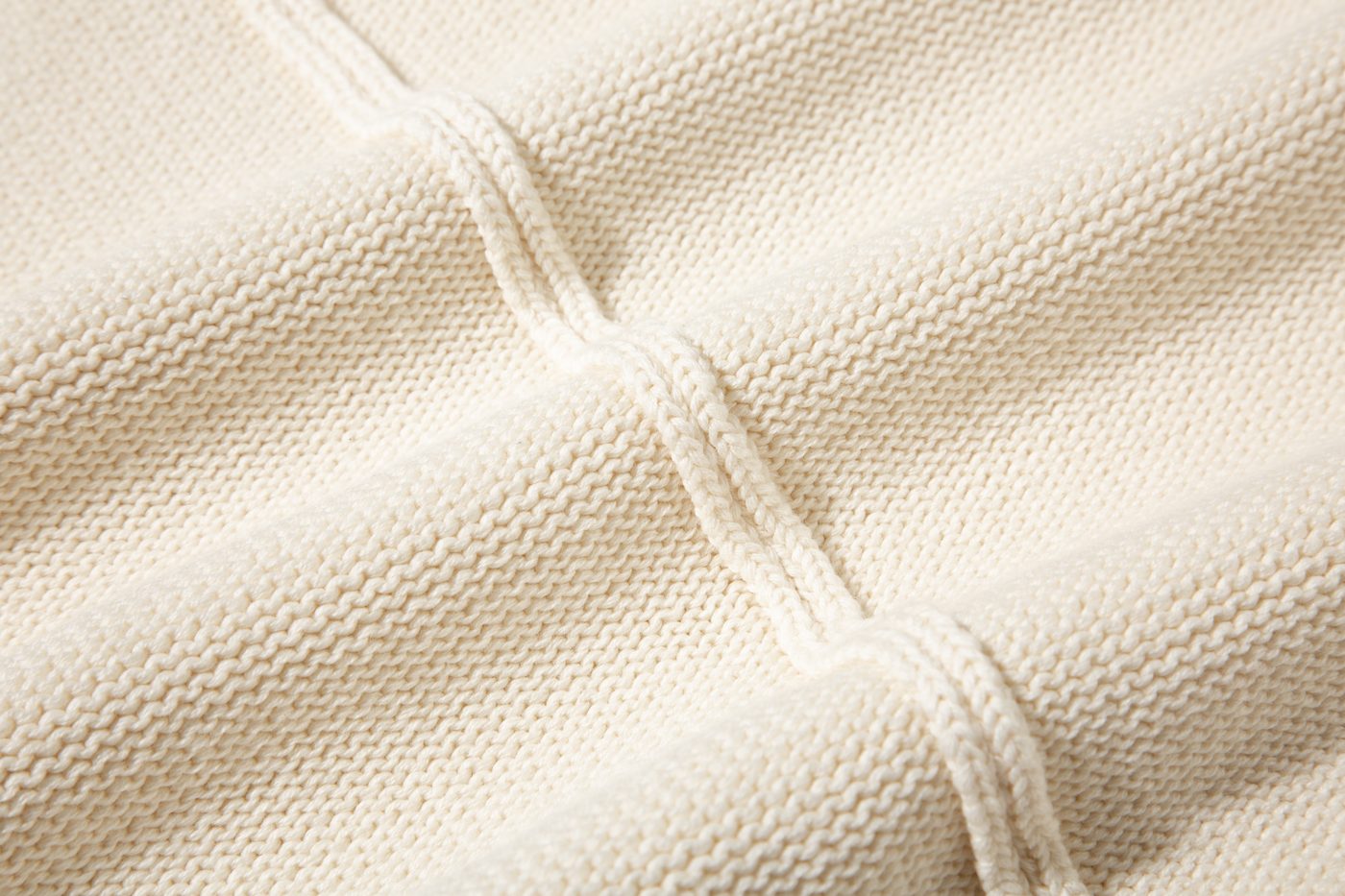
Why the panel distorts
Three mechanisms, and they are worth separating because each has a different fix.
- Transfer tension. Every transfer leaves a slightly different loop length. On a small panel the difference is invisible; across a full front it accumulates into a twist or a lean.
- Open-zone recovery. The eyelet band stretches more than the plain band beside it, so the seam line bows. This shows up after blocking, not before.
- Finishing. Wet finishing relaxes the structure and closes some of the openings. A panel that measured well dry can lose 20–30% of its visual openness after wash and press.
The practical consequence: pointelle cannot be approved on a dry, flat measurement alone. It has to be approved after the finishing route that bulk will use, and it has to be checked under stretch.
How to review a pointelle sample
- Measure the hole, not just the panel. Pick three points across the width and measure the eyelet opening. If the range is wider than about a millimetre on a fine gauge, the transfer tension is uneven.
- Stretch it. Hold the panel across the eyelet band at roughly 20% extension and look for a run starting at a transfer point. If one appears, the yarn or the gauge is wrong, and no amount of finishing will fix it.
- Wash it the way the care label says. Then re-measure length and width. Pointelle commonly grows in length and narrows in width after the first wash; the growth needs to be inside tolerance before bulk, not discovered by the customer.
- Check the seam. Link or seam a shoulder and look for “grin” — the eyelets opening along the seam line because the seam allowance is too narrow for the open structure.
- Photograph it on a body. Pointelle reads differently on a hanger. Most buyer complaints about “the pattern looks wrong” are actually about how the holes sit over the bust or the shoulder.
What it costs
Pointelle runs slower than jersey on the same machine. The transfers add cycles, the yarn break rate is higher, and the panel rejection rate is higher because a single dropped transfer ruins a panel. In practice that means a pointelle style carries a higher per-piece cost than a plain style at the same gauge and yarn, and the gap widens as the pattern gets denser.
Design decisions that keep the cost sane: keep the eyelet repeat narrow, avoid combining pointelle with a dense cable in the same panel, and do not place a pointelle zone across a seam that has to carry load.
What to tell the factory
A pointelle brief needs four things beyond the usual pack: the pattern graph (not a photo), the intended hole size in millimetres, the finishing route, and the stretch requirement at the seam. Without the graph the factory will interpret the pattern; without the hole size it will choose one; without the finishing route the sample will be approved in a state that bulk never reaches.
If the style is a fine-gauge merino or a cashmere blend, the material choice narrows the options further — our notes on merino sweater development cover how fibre fineness interacts with open structures, and the knitwear range overview shows which structures we run most often. For pointelle specifically, the atelier page lists the gauge band we develop with our knitting partners.
FAQ
Can pointelle be made on a circular machine?
Only in limited forms. True pointelle with planned transfers is a flat-knitting structure, because the machine has to move stitches between needles. Circular machines can produce eyelet-like effects with tuck or drop stitches, but the pattern control and the hole shape are different.
Does pointelle shrink or grow?
It usually grows in length and narrows in width after the first wash, because the open structure relaxes. The amount depends on yarn, gauge and finishing; approve the sample after the bulk finishing route and set the tolerance from that measurement.
Is pointelle suitable for a first knitwear order?
It is manageable if the pattern is simple and the yarn is smooth. It is a poor choice for a first order when the design also introduces a new yarn, a new fit block and a tight launch date, because the sample rounds tend to multiply.
Sources: ISO 8559-1 (size designation) and ISO 6330 (domestic washing and drying procedures).
If you have a pointelle reference, send the image plus the gauge and yarn you have in mind. We will tell you what the structure can hold at that gauge before a swatch is knitted.
Working on a knitwear project?
Let’s talk yarn, gauge and timing.
Send a reference or tech pack and we will come back with a practical development route.

