
The file arrived with a cover sheet headed certificate, and the buyer read it as a guarantee that the site had been approved. What it actually contained was an audit report from a different unit, three years old, with a scope that named a product category the buyer did not order. The supplier had not lied; it had sent the document it had.
That is the ordinary failure in social audit vs product testing apparel files, and it is not solved by asking for “certificates”. It is solved by knowing which of three kinds of evidence you are looking at, what each one proves, and what its scope and date actually cover.
Three kinds of evidence
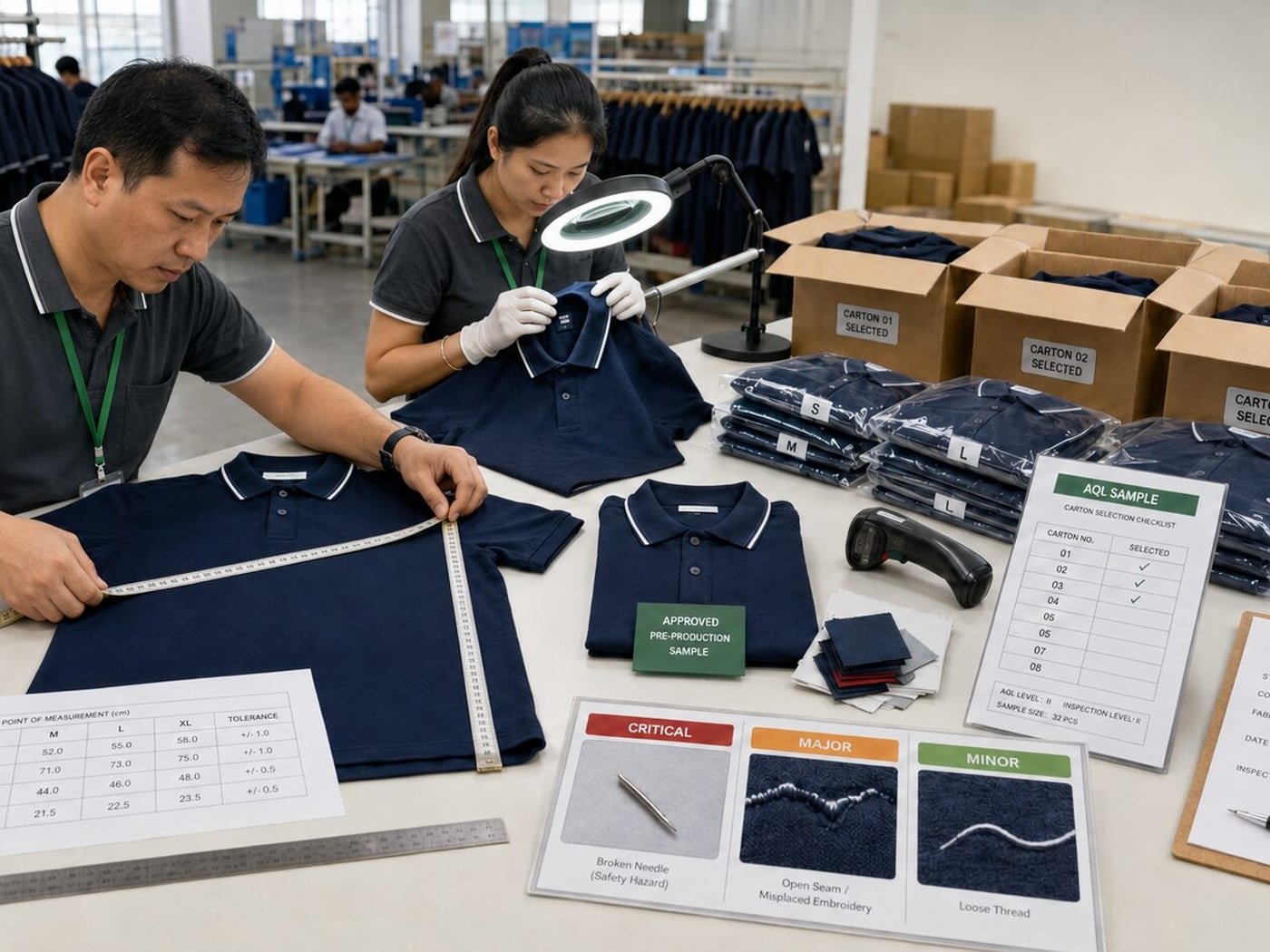
A social audit looks at how a site operates: hours, wages, health and safety, freedom of association, and the management systems around them. A product test report looks at what a material or garment does: colourfastness, shrinkage, pilling, fibre composition, restricted substances. A platform listing is neither; it is a database record that points to the other two.
Mixing them is the most common error in a supplier file. A social audit says nothing about whether a dye is banned; a test report says nothing about whether wages were paid. A buyer who needs both should ask for both, by name.
Social audit vs product testing apparel
Social audit information and product testing answer different questions: an audit looks at how a site operates, while a test report looks at what a material or garment does. An audit report names a site and a date; a test report names a sample, a method and a result. Neither substitutes for the other.
The practical test is simple: if the document does not name a specific site, or a specific sample, it is not evidence about your order. It may be useful background, but it cannot be filed as proof.
What each document actually is
An amfori BSCI audit produces a report and a rating for a site, against a set of social criteria, with an audit date and a validity period. Sedex is a platform where audit reports, including SMETA audits, are shared with customers; membership is not an audit finding, and a Sedex record is only as good as the report behind it.
A product test report comes from a laboratory and names the sample it tested, the method used and the result. It is specific to that sample, that colour and that date. A certificate, by contrast, is issued by a certification body for a defined scope, such as a management system or a product standard, and its scope statement is the part buyers read least and should read first.
| Document | What it proves | What it does not prove |
|---|---|---|
| Social audit report | Conditions at a named site on a date | Product safety, fibre content, colour |
| Platform record (Sedex) | That a report exists and is shared | Anything beyond the report it links to |
| Test report | Results for a named sample and method | Other colours, other lots, other styles |
| Certificate | Conformity within a stated scope | Products or sites outside that scope |
| Supplier declaration | The supplier’s stated position | Independent verification |
Scope, name and date
Three details decide whether a document applies to your order. The name: the legal entity and the site, not the trading name or the group. The scope: the products, processes or criteria covered. The date: the audit date, the test date and the validity period, which differ between documents and between schemes.
For a test report, add the sample description and the colour. A report for a navy pique does not cover the white pique in the same order, and a report from a previous season does not cover a new yarn. For an audit, add the audit type and whether it was announced, because the answer changes what the report can tell you.
What it costs to assemble
Compliance evidence is a cost line, and it behaves differently from the others. An audit is priced per site and per audit cycle, with the platform fee on top; a test programme is priced per sample, which means per style, per colour and per material; a certificate carries its own fee and its own surveillance cycle.
Those costs scale with variety rather than volume. One style in one colour needs one test set; ten styles in six colours can need far more than six, because each colour and each material is a sample. That is why a buyer who adds colours late pays twice: once for the test and once for the delay.
It also explains why suppliers push back on testing requests that arrive after production. A test on a finished lot can only report what was made; a test on a development sample can still change the order.
How to verify a file
Work through the document rather than around it. Check the issuing body, the site or sample name, the scope statement, the date and the result section. Then check it against the order: same site, same material, same colour, current cycle.
Where something does not match, ask a specific question rather than a general one. “This report covers the navy pique; can you send the white?” gets an answer. “Can you send your certificates?” gets a folder, and the folder is what started this article.

Findings, ratings and corrective actions
An audit report is not a pass or fail in most schemes; it is a set of findings against criteria, with a rating and a corrective action plan. The useful questions are which findings were raised, which were closed, and which remain open at the date of the report. An open finding on working hours is a different risk from a closed finding on signage.
Some findings are treated as critical and require action regardless of rating. Ask for the corrective action evidence as well as the report, because a report with an open critical finding is a document that describes a problem rather than one that resolves it. The same reading discipline applies to a test failure: a result below the threshold needs a re-test on a corrected sample, not an explanation.
Building a document register
A register turns a folder into a system. One line per document, one owner, one cycle, and one field that says what to check when it arrives. It takes an afternoon to build and saves a season of re-sending files.
| Document | Who issues it | Cycle | What to check |
|---|---|---|---|
| Social audit report | Audit firm or programme | Per audit cycle | Site, scope, date, findings |
| Platform record | Sedex or similar | Per sharing period | Which report is actually shared |
| Test report | Laboratory | Per sample | Sample, method, colour, date |
| Certificate | Certification body | Per validity period | Scope statement and expiry |
| Supplier declaration | Supplier | Per order | What is declared and what is verified |
Keep the register with the order file rather than with the supplier file. The question at inspection is not what the supplier holds in general, but what supports this delivery, and the two answers are rarely the same list.
What Horssle Knit can and cannot provide
We can source certified yarns against a requirement, with traceability documents where available, and we can share the documents that exist for a specific order. We do not claim that the atelier or every product is certified, and we do not present a material certificate as a factory certificate.
For a programme that needs a social audit report, a product test report and a certification scope, the useful starting point is the order: site, material, colour and market. The services overview shows where testing and documentation sit in the production sequence, and the case studies show how a documentation gap is usually closed.
FAQ
Is a social audit the same as a product test?
No. A social audit assesses working conditions at a site; a product test assesses a material or garment against a method. They are produced by different organisations, cover different risks and expire on different cycles.
Does a Sedex record prove compliance?
It proves that a report exists and has been shared. What it says depends on the report behind it: its scope, its date and its findings. Read the report, not the platform badge.
How often should product testing be repeated?
Whenever the material, colour, supplier or specification changes, and on the cycle your customer or market requires. A test report is a statement about a sample on a date, not a permanent property of a style.
Can a supplier’s own declaration replace a test report?
It can support one, and it is often what a buyer receives first. It is not independent evidence. If the market or the customer requires a test, the declaration is a cover note rather than the proof.
Sources: Intertek textile testing, Control Union certification, Higg facility indexing, OEKO-TEX Standard 100, EU Regulation 1007/2011 on textile fibre names, and US CBP informed compliance.
Working on a knitwear project?
Let’s talk yarn, gauge and timing.
Send a reference or tech pack and we will come back with a practical development route.


