
Two orders, same month, same product. Both buyers found their wholesale clothing suppliers the same way — a search, a catalogue, a fast reply with a price. Buyer A then spent nine days checking before paying a deposit. Buyer B paid on day two, because the samples looked right.
Both orders shipped. Only one arrived as the product that was quoted. The gap was not diligence in general: Buyer A ran nine specific checks, and most of them cost nothing but one email and a two-day wait.
The checklist follows in the order we would run it. Each item is here because of a failure mode we have seen from the other side of the table, usually when a brand had already paid.
What ‘wholesale’ hides
“Wholesale” describes who a supplier sells to, not what it makes. A wholesale clothing supplier may own knitting machines and a sewing floor, may buy finished garments and resell them, or may be an agent earning commission on someone else’s production. Each arrangement breaks differently, and the price looks the same.
That is the first trap: the word is a channel label. A brand that assumes “wholesale supplier” means “factory” writes a tech pack, sends it out, and discovers at the sample stage that it has gone to a subcontractor who never saw the requirement.
Factory, trader or agent
None of the three is automatically worse. What matters is knowing which one you are buying from, because responsibility for quality and documentation lands in a different place.
| Question | Factory | Trader | Agent |
|---|---|---|---|
| Who owns the machines? | The supplier | A partner mill, often unnamed | A partner mill, chosen per order |
| Who sets the price? | The production cost | Production cost plus a margin | Commission on the factory price |
| Who answers for quality? | The supplier | The supplier, in theory | The factory, in practice |
| Where does your tech pack go? | Straight to the sample room | To a mill you cannot visit | To whichever mill quoted |
| What the MOQ really is | The machine floor | The mill’s floor, plus a buffer | Whatever the mill will take |
The practical test is one question: which site will physically make this garment, and can I see it. A trader with a long-standing mill and a resident QC can be a better partner than a factory that outsources its sewing.
Sample provenance
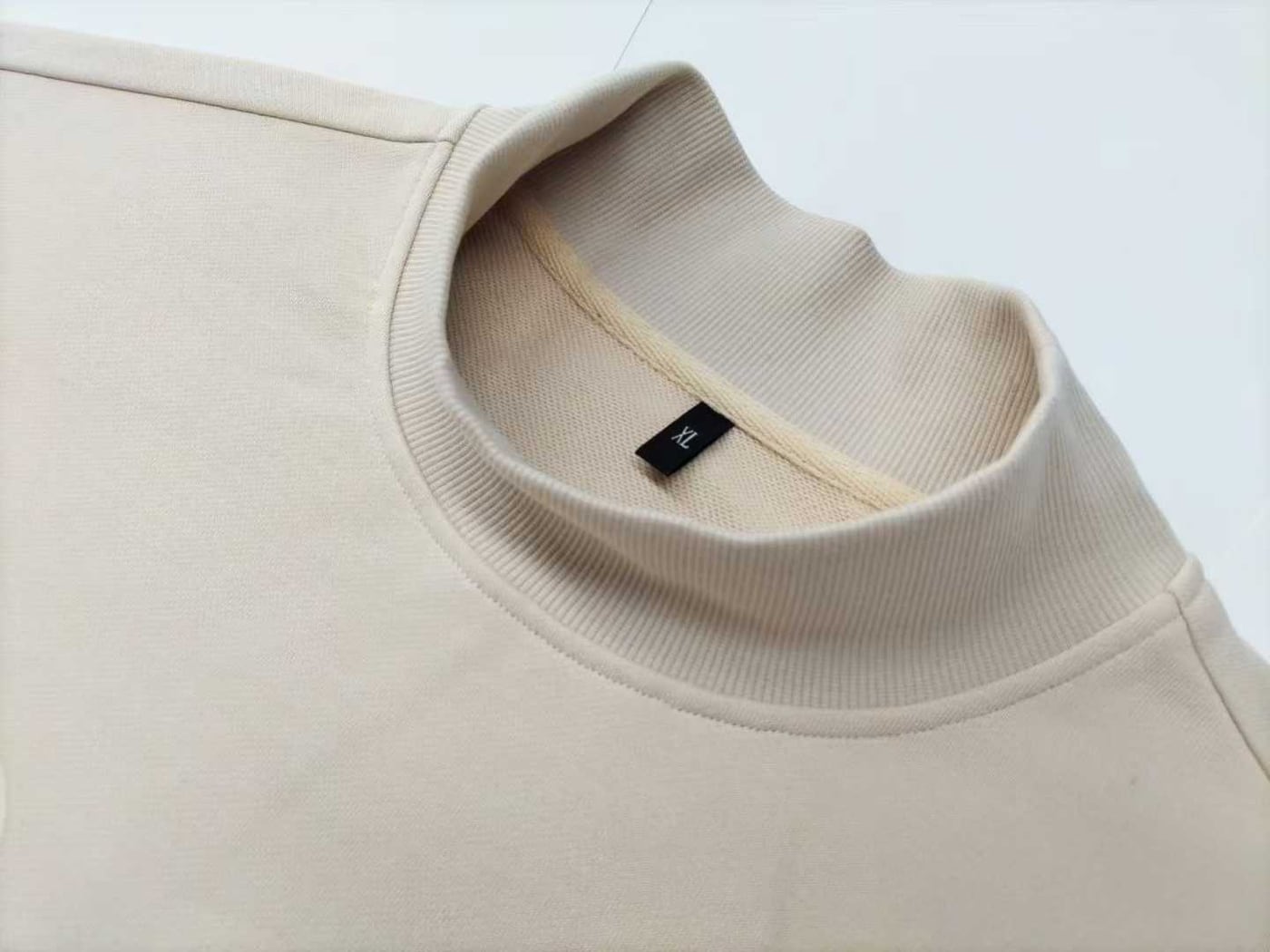
Ask where the sample came from. There is a real difference between a sample made in the sample room by a technician with time to spare, and a sample pulled off the production line during a run of the same style. Both can look correct; only one tells you what bulk will be.
Then measure it yourself: chest, body length, sleeve, rib height, and the weight of the garment on a scale. Keep that sample sealed and labelled as the reference, and let the approval rest on it rather than on photographs. A sample scorecard scored point by point beats a memory of how it felt in the meeting.
Capacity and calendar evidence
Every supplier says it has capacity. The check is the calendar, not the claim: which days are already blocked, what runs before your style, and whether the gauge you need is free in the week your order would land.
Ask for the production window in writing, in the supplier’s own units — sampling days, bulk days, and the buffer held for a failed inspection. Ours run 7–12 days for sampling once yarn and tech pack are confirmed, then 20–35 days for bulk, with final inspection at AQL 2.
5. A supplier who cannot state its own numbers should not be given a deposit, and one whose calendar only works on first-time sample approval is already behind.
Price structure sanity
Ask for the quote broken into lines — yarn, knitting, making, trims, packing, testing where relevant — rather than a single figure. You are not trying to rebuild the price. You are checking that the supplier knows what is inside it.
Three quotes on the identical bill of materials is the fastest sanity check available. If one is far below the others, the difference at that volume is almost never efficiency; it is a different yarn count, a different gauge, a lighter garment, or a trim list that quietly lost the custom label. Ask which line differs and you usually get a straight answer.
Watch for quotes that arrive before anyone asked about gauge, yarn count or colour count. A number produced without those three inputs is not a price for your product.
Payment and deposit risk
The deposit is the moment your money stops being reversible, so the paperwork around it matters more than the percentage. Check that the bank beneficiary matches the contracting entity exactly, and that the account is a company account rather than a personal one. The entity on the invoice should be the entity that ships.
Milestones are the useful lever. Tie part of the balance to the approved production sample and part to the inspection date, and state in the purchase order who pays for a re-inspection if the first one fails. Payment terms usually travel with the delivery term, so agree both in the same conversation.
Documentation readiness
Documentation is a fast test of whether a supplier is organised, because it either exists in a folder or it does not. Ask for four things. The business licence with its registered scope comes first, and the certificate with the holder’s name on it. Then the transaction certificate for the fibre lot, and the test report for the batch.
For a European or North American order, add the compliance file. Chemical restrictions are checked against the REACH restricted substances list, and fibre content against the market’s labelling rules. Cotton origin is checked against the traceability that CBP enforces under UFLPA.
Certification is available against order rather than carried as stock: STANDARD 100 for chemical safety, GOTS for organic fibre, the GRS or RWS chain for recycled or responsible wool. Say which claims you intend to make before the order is placed, because a claim you cannot document is worse than no claim.
Red flags in the first call
Most of these are visible in twenty minutes, before any money moves.
- A price quoted before anyone asks about gauge, yarn or colour count.
- A refusal to name the site where the garment will be made.
- Samples that “match the photo” but come with no specification sheet.
- No offer of a lab dip, or a shade approved from a phone screen.
- A deposit request to a personal account, or to an entity that differs from the invoice.
- Certificates shown as images with the holder’s name cropped out.
- A delivery date given without asking when your tech pack arrives.
A nine-point checklist
Print this, fill it in before the deposit, and keep the evidence beside each line. It takes a week and it cannot be answered with adjectives.
| # | Check | Evidence that passes | What it prevents |
|---|---|---|---|
| 1 | Identity and site | Registered name and address, plus the production site in writing | Paying a trader for a factory you never see |
| 2 | Supplier type | Factory, trader or agent declared, with the mill named | Responsibility shifting after the deposit |
| 3 | Sample provenance | Sample measured, weighed and sealed by you | Bulk that does not match the approved piece |
| 4 | Calendar | Sampling and bulk windows in writing, with a buffer | A ship date that slips a season |
| 5 | Price structure | Line-by-line quote on your bill of materials | A low quote that is a different garment |
| 6 | Payment setup | Beneficiary matches the contracting entity | Money that cannot be recovered |
| 7 | Licence and scope | Business licence matching the address and the activity | An entity that cannot export in its own name |
| 8 | Certificates | Holder’s name and certificate number on every document | Claims your buyer’s compliance team will reject |
| 9 | Inspection terms | AQL level and who pays for a re-inspection, in the PO | A quality argument with no agreed measure |
Nine lines, one sitting. If three come back blank, stop.
If you want the other side of the table, how we run an order describes the same sequence from our side, and the factory page shows the floor those samples come off.
FAQ
Isn’t a lower price just a better deal?
Only when the two quotes describe the same garment. A materially lower price usually means a lighter yarn count, a coarser gauge, fewer trims or a different sewing unit. Ask which line differs before treating the difference as margin.
Do I need to visit the factory before ordering?
No. Most of the nine checks can be done by email: identity, certificates, calendar, quote structure and payment setup. A visit compresses the rest, but it does not replace measuring a sealed sample yourself.
Aren’t traders always a risk?
No. A trader with a long-standing mill and its own QC can deliver consistently, and some brands prefer the buffer. The risk is not the business model, it is a trader who will not name the site making your order.
Does a certificate on the website cover my order?
Not automatically. A certificate has a holder, a scope and a validity window, and the fibre lot needs its own transaction document. Check the holder’s name and the product scope, then ask for the lot-level paperwork before you print a claim on a label.
Working on a knitwear project?
Let’s talk yarn, gauge and timing.
Send a reference or tech pack and we will come back with a practical development route.


