
Take a size S and a size XL in the same knit top, lay them flat: the chest reads wider by a predictable step, the body a little longer, and the neckline almost unchanged. That is not an accident. It is the difference between a grade that follows a size chart and a grade that follows a body.
In the sample room four questions come back with every size set: what scales, what stops scaling, what the pattern does at the edges, and how anyone is meant to check the grade without cutting every size. Most knitwear size grading rules fail on that fourth question, and the answers below stay practical for that reason.
Knitwear size grading rules: the short answer
Knitwear grading scales chest, waist and hip by a fixed increment, then holds the neckline, armhole depth and rib proportions back. Those three are fitted to the body rather than to the measurement chart, and scaling them proportionally is what opens a collar, drops a shoulder and pulls a jacquard out of shape.
None of the increments below are universal: they belong to your chart, your fabric and your fit model.
Why does the neckline stop scaling after two sizes?
The neck is the clearest case. A size chart adds a fixed step to the chest at every size, and if the neck width took the same step, the largest size would have a collar wide enough to slide off the shoulder. So neck width is graded on much smaller increments, and the collar depth and rib take up the difference.
On a knit this matters twice. The rib recovers, so a neckline that measures correct on the table can still open when it is pulled over the head, and a neckline that is held tight to compensate will not sit flat. Approve the neck on a washed sample that has been tried on, not on a flat measurement alone.
Collar depth is the second half of the same decision, and it is the half that moves with fashion rather than with size. A collar that deepens on the largest size can read as a different style, so depth is often held constant and the rib compensates.
What happens to the armhole when the chest grows?
Armhole depth has to grow, because a larger chest needs more room under the arm, but it grows less than the chest does. Put the full chest increment into the armhole and the underarm sits low, the sleeve twists forward, and the wearer feels the garment pull when they raise an arm.
The sleeve cap and the bicep follow the same logic. A cap drafted for the middle size will not fit the largest armhole once the grade is applied, and the usual symptom is a fold of fabric under the arm or a seam that sits behind the shoulder rather than on it. This is the point in a grade where a size set earns its cost, because the fault is hard to see on a measurement sheet and obvious on a body.
Should body length scale with height or with the chart?
Body length is a design decision before it is a grading decision. A cropped knit and a longline cardigan in the same base size do not share a length rule, and the length step is usually smaller than the chest step so the silhouette does not change character between S and XL.
Two checks catch most length problems. The first is the ratio of body to sleeve: a sleeve that shortens in the largest size changes how the garment reads. The second is the hem, because a ribbed hem that does not grow with the body pulls the whole garment up as the size increases.
Sleeve length is graded with the arm rather than with the body, which is where long-line styles get confused. A long-line body carrying a standard sleeve reads as two garments from different ranges.
Why do jacquards and prints break before the fit does?
A jacquard, a placement print or a cable panel is drawn for one panel width. Widen the panel by the grade and the repeat either clips at the side seam or the motif stretches, and neither reads as the same garment. The fix is a design task: re-centre the motif, keep the repeat scale, and let a border absorb the difference.
That is why patterned styles need their own size-set approval rather than an approval inherited from a plain style in the same block. The fit can be right and the print still wrong, and the print is the part the customer sees first.

What scales, and what does not
The table is a working split rather than a standard. The increments belong to your own chart; the behaviour is what repeats across styles.
| Measurement | Scales with the chart | What goes wrong |
|---|---|---|
| Chest, waist, hip | Yes, by the body increment | Increment does not match the fabric’s stretch and recovery |
| Neck width and collar depth | No, small increments only | Collar slides off the shoulder or stands away from the neck |
| Armhole depth and sleeve cap | Partly | Underarm sits low, sleeve twists, seam drops behind the shoulder |
| Body and sleeve length | Partly, and design-led | Silhouette changes character between the smallest and largest size |
| Pattern repeat and panel width | No | Repeat clips at the side seam or the motif distorts |
Read the third column as the list of things a size set exists to prove. When a buyer argues about a grade, the argument is nearly always in that column rather than in the chest measurement.
How do you check a grade without cutting every size?
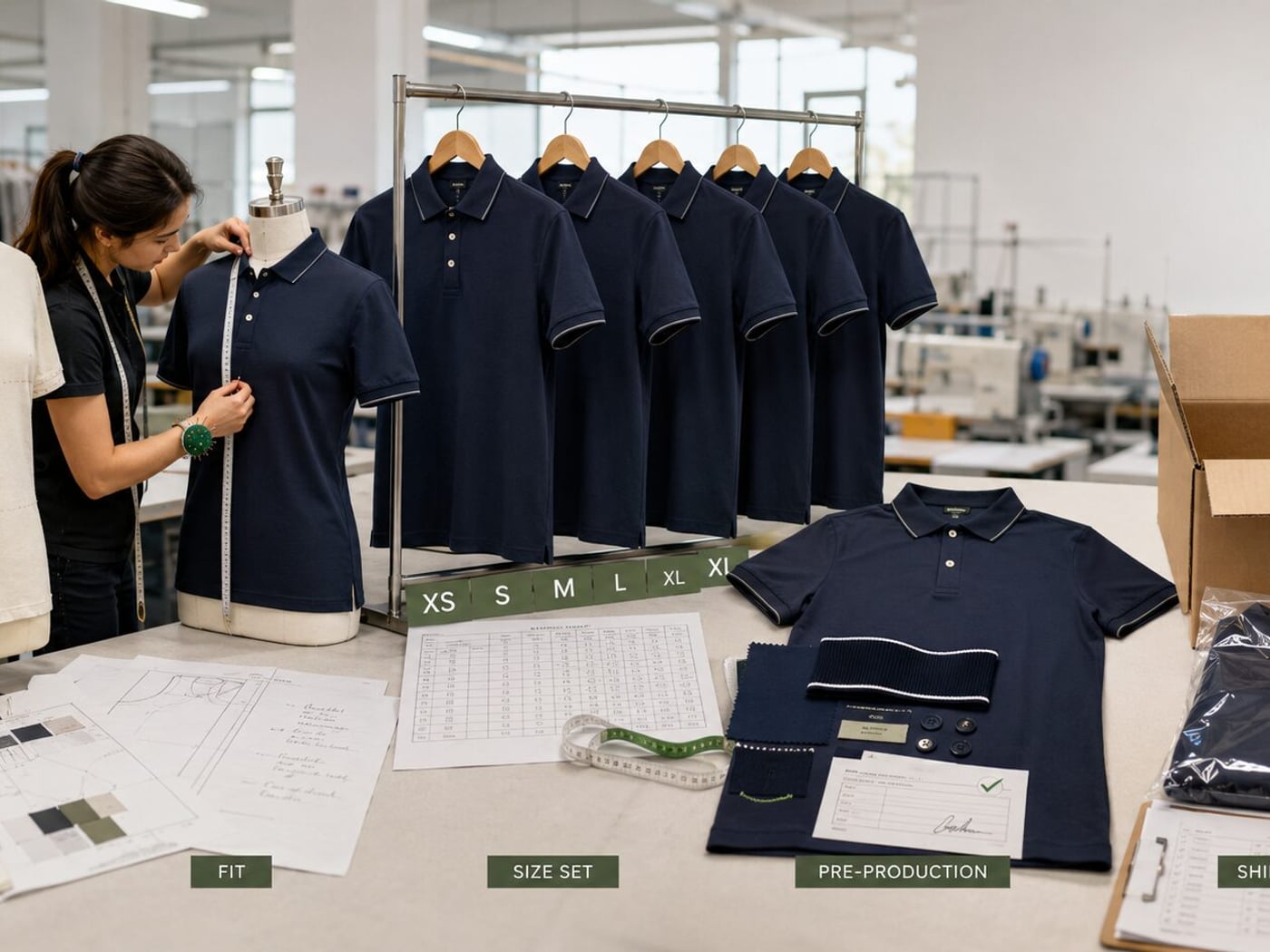
Three sizes are enough for most knitwear: the smallest, the middle and the largest. Measure every point on the sheet, then fit the three on a model or a form that matches the middle size. The grade is wrong when the largest size reads as a bigger version of the smallest rather than a garment cut for a larger body.
The middle size is the control. If it fits and the outer two do not, the grade is the problem. If the middle size also misses, the block is the problem, and no amount of re-grading will fix a block that was drafted for a different posture or fabric.
Measurements and fit disagree more often than buyers expect: a size set can measure correctly and still sit badly, because the sheet describes flat dimensions and a body is not flat. The cause is usually a point nobody wrote into the sheet.
Which points do you actually measure?
Chest, shoulder width, neck width, armhole depth, sleeve length and body length cover most of the argument. Add hem width for a ribbed hem, and add the cuff for a raglan sleeve, because raglan grading moves the shoulder point rather than the sleeve cap.
Measure with the garment flat and relaxed, on the same table, with the same tape, and note where each point starts. Most disputes about a size set turn out to be disputes about a measurement point rather than about the garment, and the fix is a diagram in the spec.
What the spec needs so the grade survives a reorder
A grade survives only if the rule is written down. That means a measurement sheet with tolerances, a grade rule for each point, and a note on which points are design-led rather than body-led. Keep them with the sealed sample and a new size can be added later without re-approving the range.
That file is also what makes a sampling and production service repeatable: the next order, the next colour and the next size all read from the same document. Without it, every size is a new development project with a new set of opinions.
If the block is still being chosen, answer the questions buyers ask before sampling first, because a grade cannot rescue a block that was never right. Once the set is approved, send the measurement sheet and the target quantities and the next step is a sample in the size you expect to sell most.
FAQ
Can we add one size without re-grading the range?
Usually yes, if the grade rule and the measurement sheet exist. The new size is calculated from the rule, sampled, and checked against the nearest approved size. If no written rule exists, the range has to be re-graded, because there is nothing to extend.
Do we need a fit model for every size?
No. A model or form that matches the middle size is enough to catch most grade faults, provided the outer sizes are measured and compared. A fit session on all sizes is worth it when the range is long or the fabric is heavy, and rarely worth it for a three-size run.
Should plus sizes use the same grade rule?
Not the same rule as the core range. A plus block is drafted for a different proportion, and applying the core increment to it usually produces a garment that is longer and wider without being better fitted. Treat the extended range as its own block with its own size set.
How many sizes should a first size set include?
Three: the smallest, the middle and the largest you intend to sell. That set proves the block, the grade and the pattern repeat in one review, and it is far cheaper than sampling every size before the first order. Add the remaining sizes after the rule is agreed.
Sources: Intertek, OEKO-TEX Standard 100, Better Work, Higg, EU Regulation 1007/2011 and US CBP.
Working on a knitwear project?
Let’s talk yarn, gauge and timing.
Send a reference or tech pack and we will come back with a practical development route.

