
The carton was open on the floor, the report said PASS, and the buyer was holding a shirt with a dropped stitch at the shoulder. The report was not wrong. It had answered a narrower question than the one the buyer thought it had answered.
That gap is worth closing before the next inspection. An apparel AQL inspection report explained in one sentence is this: a sampling decision about a lot, not a statement about every unit in it. Every line is conditional on the sample size, the defect list and the edition of the standard. Read outside those conditions, a pass means the sample stayed within the acceptance number, which is a statement about probability rather than about the carton in front of you.
Apparel AQL inspection report explained: what the verdict means
An AQL inspection report records a sampling decision. A random sample is drawn from the lot, defects are classed as critical, major or minor, and the lot passes when the defect count stays at or below the acceptance number for that sample size. A pass is not a certificate that the lot is defect-free.
The rest of this guide follows the reading order a quality engineer would use: what the document is built on, which blocks decide the verdict, and what to do when the verdict and the goods disagree.
What the report is built on
Four inputs make the numbers mean anything: the standard and its edition, the lot size and how the lot was formed, the inspection level and sampling scheme, and the defect definitions agreed in the purchase order. A report missing any of them cannot be compared with another report and cannot be defended if a retailer audits the file.
ISO 2859-1 is the reference most apparel inspections cite, and the edition matters because the tables are not interchangeable between revisions. Ask for the clause rather than the acronym, and check that the sampling scheme on the report is the one your order named.
Reading the report block by block
A working report has five blocks, and each one can invalidate the conclusion on its own.
| Block | What it should state | Where it gets misread |
|---|---|---|
| Scope and standard | Standard, edition, inspection level, single or double sampling | Edition omitted, so the acceptance numbers cannot be checked |
| Lot and sample | Lot size, sample size, how the sample was drawn | Sample taken from the top layer of cartons only |
| Defect classification | Critical, major and minor, with the definitions used | Classes written after the inspection, when the result is known |
| Counts and decision | Defects by class, acceptance and rejection numbers, verdict | Pass read as zero defects rather than as a count within limits |
| Findings | Photographs, measurement data, packing notes | No photographs, so nothing can be re-checked later |
A report that carries all five blocks can be argued with. A report that carries three is a summary, and a summary is not evidence.
Why AQL 2.5 is not a 2.5 per cent defect allowance
AQL stands for acceptance quality limit: the worst process average that the sampling plan treats as tolerable over a run of lots. It is not a target and not a licence. Two consequences follow, and both surprise buyers on their first order.
First, a passing lot can contain more defective units than the AQL figure suggests. The plan is built so a lot sitting at the limit is accepted most of the time, which means the accepted population includes lots above it. Second, a rejected lot is not proof of a bad factory, because the same plan rejects good lots a small share of the time by design.
What the limit gives both sides is a rule that applies the same way every time. That is worth more than a tighter number nobody can verify, and it is why the defect definitions matter as much as the figure.
The sample size and the acceptance number
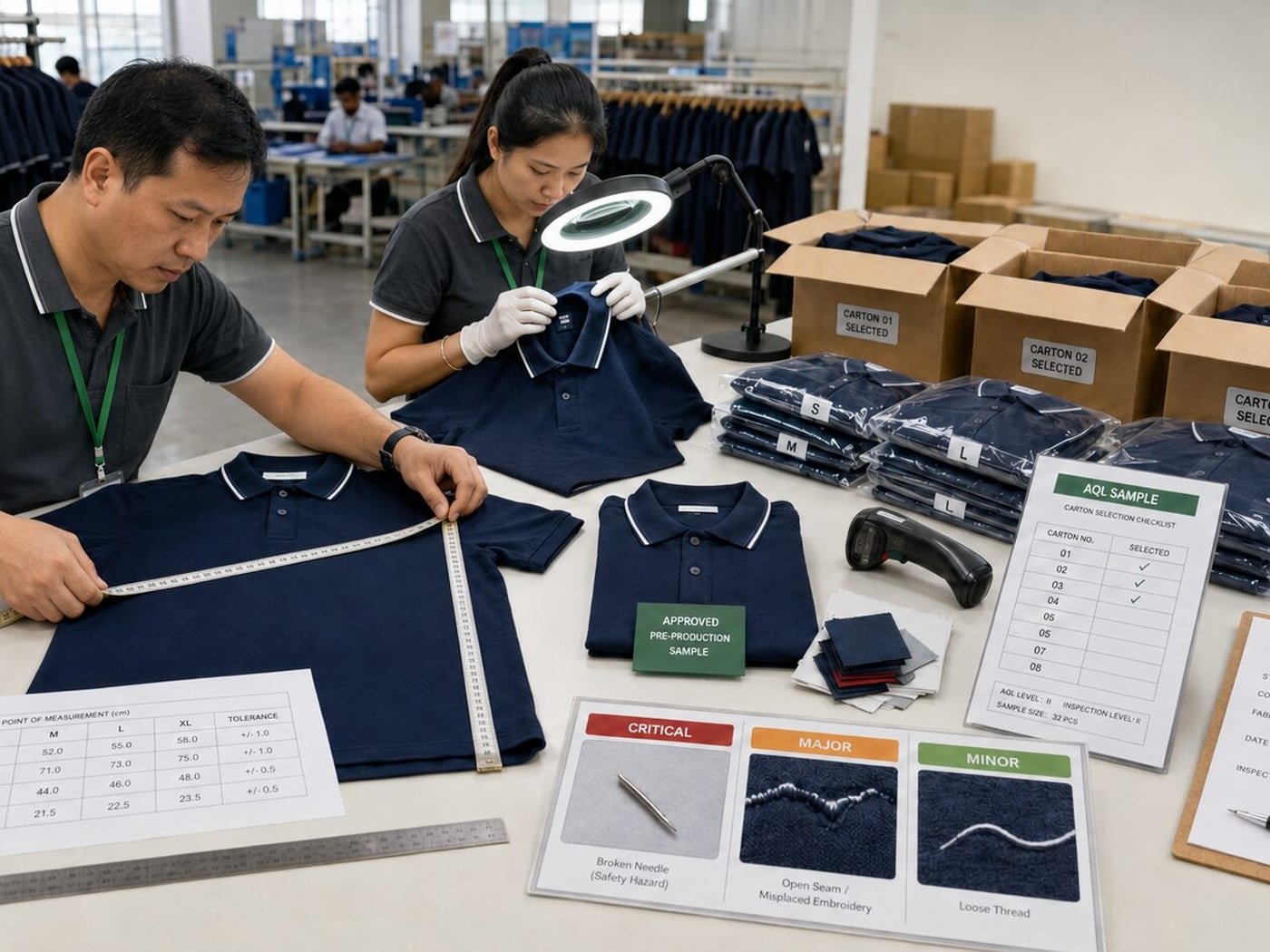
The lot size fixes a sample size through a code letter, and the AQL then fixes the acceptance and rejection numbers. Read the three together. The same acceptance number applied to a larger sample is a looser decision, and a report that does not state the sample actually drawn cannot be checked at all.
Do the arithmetic before you read the verdict. If a report logs eight major defects against an acceptance number of ten, the lot passes and the buyer who reads only the word PASS will never know that the margin was two pieces. That margin is the number worth tracking across orders, because it moves before the verdict does.
Critical, major and minor
The classes are contractual rather than universal. A critical defect can injure the wearer or break a legal requirement: a needle fragment, a restricted substance above its limit, a drawcord that fails a safety test. A major defect stops the garment being sold at full price: a hole, a broken seam, a wrong size label. A minor defect is a deviation a customer would accept: a loose thread, shade variation inside tolerance.
The definitions have to exist before the inspection, because a list written afterwards can make any lot pass or fail. Many programs set the critical class at zero acceptance by agreement, which is a separate decision from the AQL figure and should be written as one.
Where the report ends and the regulation begins
An AQL inspection checks workmanship against your specification. It is not a compliance audit, and it does not certify anything. If the market requires fibre labelling under EU Regulation 1007/2011, the label is checked against the written composition, not against a visual defect list. If the goods ship to the United States, country of origin marking is a document requirement under CBP rules rather than an AQL point.
Restricted substances sit outside the sampling plan as well. OEKO-TEX Standard 100 tests articles against a limit list, and a certificate names the article it covers; a photograph of a label is not a substitute. Traceability claims for recycled or organic content need their own chain-of-custody documents, which is where a certification body such as Control Union issues certificates, and where a Higg profile answers a facility question rather than a product one.
Keeping the two files separate is not pedantry: a retailer that finds a certificate filed inside an inspection report will ask which of the two was audited.
From report to decision
At the atelier, the decision follows a fixed order, and each step leaves a document: confirm the report’s inputs, compare counts against the acceptance numbers by class, read the measurement block against the sheet, review the photographs, then agree the disposition in writing.
| Finding | Usual next step | What to record |
|---|---|---|
| Critical defect found | Hold the lot; 100 per cent check or rework | Defect type, count, unit numbers, photographs |
| Major defects above acceptance | Reject or rework, then verify on a second sample | Corrected sample and the re-inspection result |
| Minor defects within acceptance | Accept, and log the count | Count and category, so the trend stays visible |
| Measurement outside tolerance | Re-measure, then rework if confirmed | Raw measurements by size and by point |
Log the counts even when the lot passes. Three passed lots with the minor count climbing is a process moving toward a rejection, and there is no other place that signal appears.
What to send with the inspection request
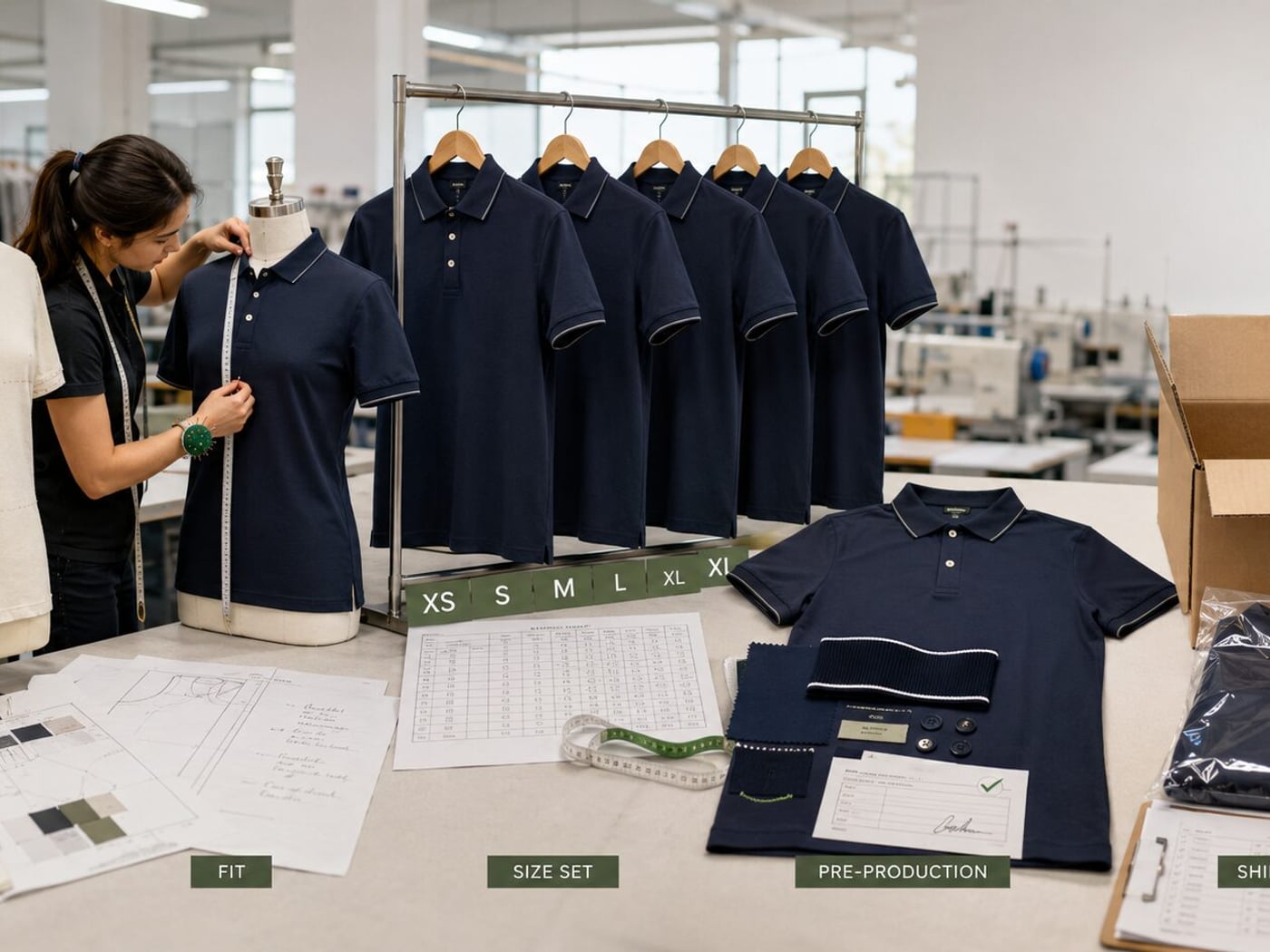
The inspector measures the goods against what you send. A request without a reference produces a report about workmanship in general, which is not what anyone needs at the end of a production run.
Send the approved sample, the measurement sheet with tolerances, the defect definitions by class, the packing and labelling requirements, and the artwork references. Then ask for the report format in advance, so the blocks you care about exist before the inspection starts.
For a first order, agree the inspection scope with the supplier at the same time as the price. The factory quality process is easier to hold to when the scope is written down, and the questions buyers ask before sampling cover the rest of the document set.
FAQ
The factory says the lot passed AQL 2.5. Why did our warehouse find defects?
Passing means the sample stayed within the acceptance number, not that the lot is clean. A passing lot can still contain defective units, and the ones your warehouse finds are the ones the sample did not draw. If the share is far above the limit, the question becomes whether the lot was formed as declared.
Can we ask for zero defects instead of an AQL?
You can set zero acceptance on a class, and many programs do that for critical defects. Asking for zero on every class means a single minor finding rejects the lot, which most bulk runs cannot hold, so the practical result is usually a reworked lot and a later ship date.
Does a failed inspection mean the lot is unusable?
No. A rejection is a decision about the sample, and the goods may be reworkable. The report should say which class failed and how many units were affected, and that is what decides between sorting, rework and a remake.
How do we set an AQL for a first order?
Start from the market. Mass retail commonly sits at 2.5 on major defects, while promotional goods often accept a looser figure, and critical stays at zero by agreement. Then check that the figure matches the defect list, because a limit applied to vague definitions produces arguments rather than decisions.
Sources: Intertek, Control Union, Higg, OEKO-TEX Standard 100, EU Regulation 1007/2011 and US CBP.
Working on a knitwear project?
Let’s talk yarn, gauge and timing.
Send a reference or tech pack and we will come back with a practical development route.

