
The number that starts more arguments in a knitwear quality file than any defect rate is a pilling grade. It arrives in a requirement as 4, or 3–4, or as the phrase minimal pilling, and it almost never travels with the method that produced it. Two laboratories can test the same sweater against grade 4 and return different verdicts without either being wrong.
Knitwear pilling test requirements usually fail in the wording rather than the testing. A requirement written in the language of a result leaves the lab to choose both the test and the standard of judgment.
Knitwear pilling test requirements: the short answer
Knitwear pilling test requirements need four things to be executable: a named method and its edition, the test conditions including any pre-treatment, the grading scale and the acceptance level, and the sample to be tested. A grade without a method is an opinion. A method without an acceptance level is a report nobody can act on.
Everything else is detail that supports those four. What follows is how the gap usually appears, then the parameters that close it.
The retrospective: what a target grade leaves out
Take the common version. A buyer specifies grade 4, the factory sends a swatch to a laboratory, and a report comes back with a number on it. Everyone relaxes. Six months later the buyer is looking at a garment in a store and wondering why the surface looks rough, and the file holds a grade that cannot be compared with anything.
Nothing in that sequence is dishonest. The requirement was incomplete in a way that only shows up when two reports are placed side by side. One lab used a Martindale instrument, the other a pilling box; both reported a grade on a five-point scale, but the two instruments abrade the fabric differently.
The buyer wanted to know how the garment would look after a winter of wear. The report answered a narrower question: how one swatch behaved under one machine for a defined number of cycles. Closing that gap is the job of the requirement.
What the laboratory actually needs from you
A test house can only work with what the brief contains. Four inputs decide whether the report is comparable with the one your other supplier sends next season.
The first is the method: pilling tests exist in several forms and the names are not interchangeable. The second is the condition: cycles or rubs, pressure, whether the sample is washed first, and how it is relaxed before testing. The third is the grading protocol: which scale, whether half grades are allowed, and under what lighting the assessment is made. The fourth is the sample itself: a swatch from bulk, a garment, or a panel from a stated position.
Ask the laboratory which edition of the standard is current before the requirement is signed. A requirement pinned to a superseded edition produces a report that cannot be compared with a current one.
| Method family | Action on the fabric | What it stresses | Typical use |
|---|---|---|---|
| Martindale abrasion and pilling | Flat rubbing against an abradant in a circular path | Surface fibre movement under low, repeated pressure | Woven and knitted apparel, especially wool and blends |
| Pilling box | Tumbling inside a lined box | Free movement and fibre migration across the surface | Knitted garments, sweaters and hosiery |
| Random tumble | Tumbling in a cork-lined chamber | Fuzz and entanglement in a loose, chaotic motion | Knits where the surface is expected to stay clean |
The three families answer different questions. A fabric that passes one and fails another has told you which wear condition it tolerates, not that one laboratory is wrong.
Parameter by parameter: where requirements go soft
Cycle count is the parameter buyers most often leave to the lab. A low count and a high count can both be legitimate, and they answer different questions: short-cycle tests catch a surface that destabilises quickly, long-cycle tests show how the fabric settles once fibres have migrated.
Pre-treatment is the second soft spot. Many programs test the fabric as delivered, while the customer will wash the garment before wearing it. If the care label permits machine washing, the requirement should say whether the sample is tested before or after a wash.
Grading conditions are the third. Pilling is assessed by eye against a photographic scale, so lighting, viewing angle and the number of assessors all affect the result. Naming the scale without naming the viewing conditions leaves that variable open.
The fourth is sample position. On a knitted garment, the surface at the side seam, the underarm and the centre front behaves differently. State where the swatch comes from, or accept that two reports may describe two parts of the same garment.
Writing a requirement the laboratory can execute
Good wording is short and specific. It names the standard, the edition, the condition, the grading scale and the acceptance level, and it says what happens if the result falls below the line. It does not describe the desired feel, because a laboratory cannot grade an adjective.
| What buyers write | Why it fails | What to write instead |
|---|---|---|
| “No pilling” | No fabric passes; no scale defined | A named method, condition and minimum grade |
| “Grade 4” | No method, no conditions | Grade on a stated scale, under a stated method and cycle count |
| “Test to international standard” | Several standards apply | Standard number and edition, confirmed with the lab |
| “As per previous order” | The file may not contain the method | Repeat the full requirement on every order |
| “Sample from the bulk” | Position and timing unclear | Swatch position, production stage and pre-treatment stated |
Every row has the same root: a claim that sounds like a specification but cannot be measured by anyone who was not in the original conversation. Writing the method down also protects the factory, because a defensible requirement is one both sides can check against a report.
What to send, and when to send it
Send the sample the bulk will actually be made from. A swatch from a development lot tests the development lot; a swatch cut from a bulk roll tests what the customer receives. If both matter, ask for both, because a change of yarn lot or finishing can move the surface.
Timing matters commercially. Pilling results usually arrive after the fabric is booked, which makes a failure expensive to fix. Where a new yarn or blend is involved, put the test before bulk approval and make the result a condition of sign-off rather than a report filed afterwards.

Reading the report without over-reading it
A pilling report is a statement about one sample under one method. It is not a prediction of how every garment in the order will age, and it is not a warranty. What it gives you is a comparable number, provided the next report uses the same method, conditions and grading protocol.
Keep the requirement identical across seasons and suppliers, and change it deliberately when the product changes. A heavier yarn, a brushed surface or a cashmere blend behaves differently from the fine-gauge cotton it replaced, so the acceptance level should move with the product rather than stay fixed because it was once written down.
Defects found at inspection are a separate question, and the two get confused in quality meetings. Inspection sampling follows an AQL plan; a pilling test follows a laboratory method. A program needs both.
Where the requirement sits in the quality plan
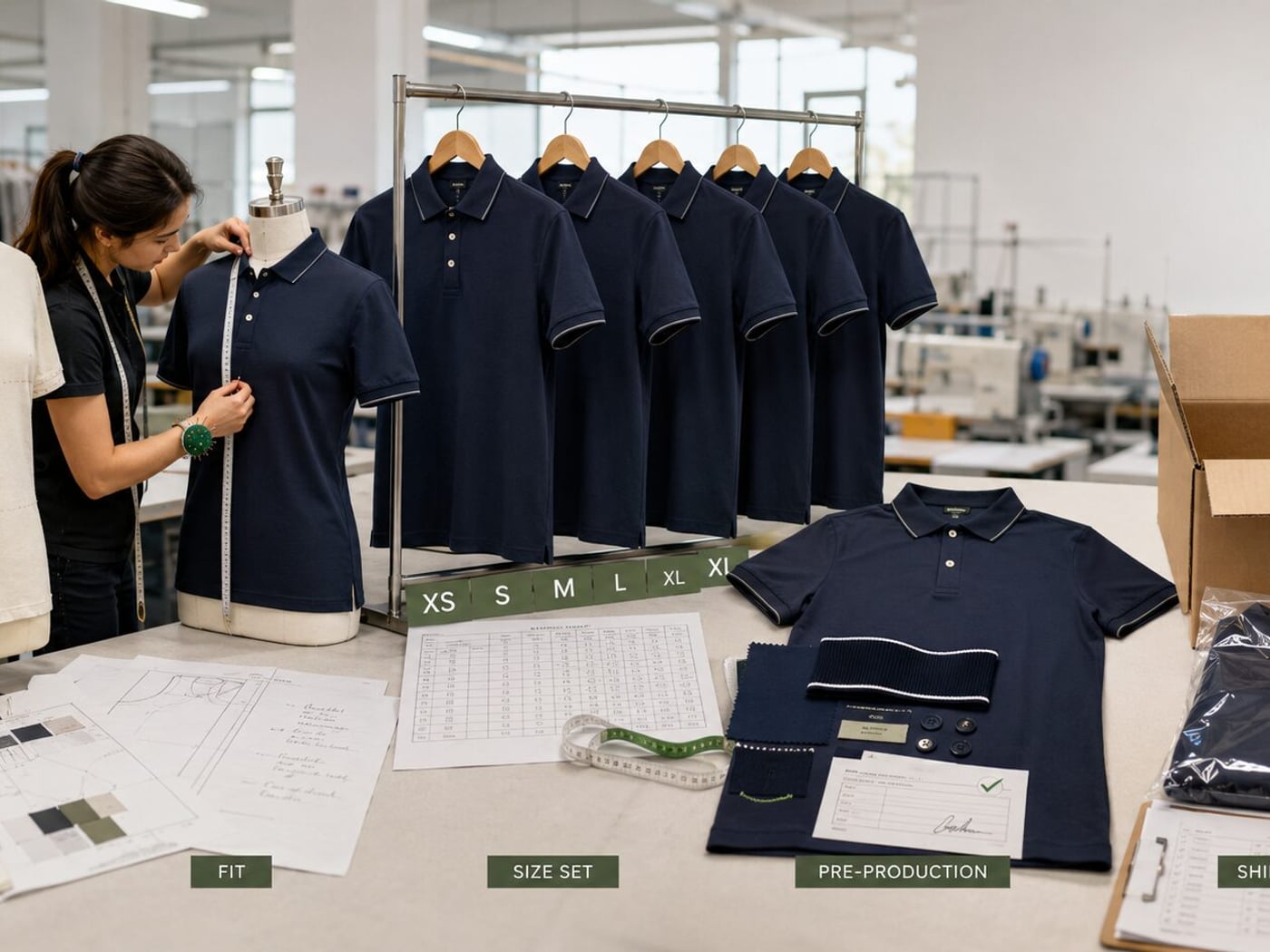
A quality plan has three layers: material tests, in-line checks and final inspection. Pilling belongs in the first, alongside shrinkage, colour fastness and fibre content, because it describes the material rather than the make.
That placement matters when a claim goes on a hangtag. A test report supports a statement about the fabric; it does not certify the garment. The same distinction applies to yarn certification: a mill can supply OEKO-TEX Standard 100, GRS or RWS yarns by requirement with traceability documents where available, which is not the same as a certified finished product.
FAQ
Which pilling method should we specify?
Follow the market your product sells into and the method your existing reports use. Martindale is common for wool and blends, the pilling box for knitted garments. Ask the laboratory to confirm the current edition before the requirement is signed.
Should we test fabric or the finished garment?
Test what you are buying. A bulk fabric swatch answers the material question; a garment test answers how seams and panels behave. Many programs start with the fabric and confirm on the garment when the construction is new.
Can we set one grade for every product?
You can, but it will not mean the same thing across a cotton jersey, a brushed fleece and a cashmere blend. Set the level per product family and keep the method identical, so the comparison between seasons stays valid.
What happens if the result misses the requirement?
Decide that before testing. Options include rejecting the lot, re-testing a second sample, changing the finish, or accepting with a documented deviation. A requirement with no stated consequence is a report rather than a specification.
Agreeing the test before the first bulk
The whole requirement fits on half a page: method, edition, conditions, sample, scale, level and consequence. Writing it once and reusing it is the least expensive quality control available, because it removes the argument that starts when two reports disagree.
Send the requirement with the tech pack, not after the first complaint. Our program notes show how quality criteria are fixed before bulk at the atelier, and the questions buyers ask before sampling cover the checks alongside a pilling test. Sampling is 7–12 days after fabric and tech pack approval, and bulk production is typically 20–35 days after sample approval.
Sources: Intertek, Control Union, Higg, OEKO-TEX Standard 100, EU Regulation 1007/2011 on textile fibre names and US CBP informed compliance publications.
Working on a knitwear project?
Let’s talk yarn, gauge and timing.
Send a reference or tech pack and we will come back with a practical development route.

