
The reference arrived by courier on a Tuesday: a knit top, worn twice, no label and no measurements. The sample room cut it from the photograph, and the neckline came back wide, because the original had a rib that had already relaxed. Two sample rounds later, the buyer sent a measurement sheet that had been sitting in a drawer since the first call.
That sequence is less a communication failure than an information one: a reference garment manufacturing brief is data. When the data arrives incomplete, the people cutting the sample fill the gaps with judgement, and their judgement is calibrated to a different fit, a different fabric and a different market. The brief is what replaces judgement with instruction.
Reference Garment Manufacturing Brief: What to Send, and What Each Part Prevents
A reference garment manufacturing brief is the physical sample plus the written record of what to keep and what to change: flat measurements, fibre and weight, trims, colour references, decoration files and size range. Without that record the factory reproduces a photograph, and the first sample becomes the brief.
Send the parts below together. Sent one at a time, they arrive after the pattern has already been drafted.
Send the Garment, Not Just Its Photo
Two garments are better than one. The first is the cutting reference, which may be opened at the seams and marked. The second stays intact as the comparison piece for the sample review, so nobody argues about what the original looked like in week six.
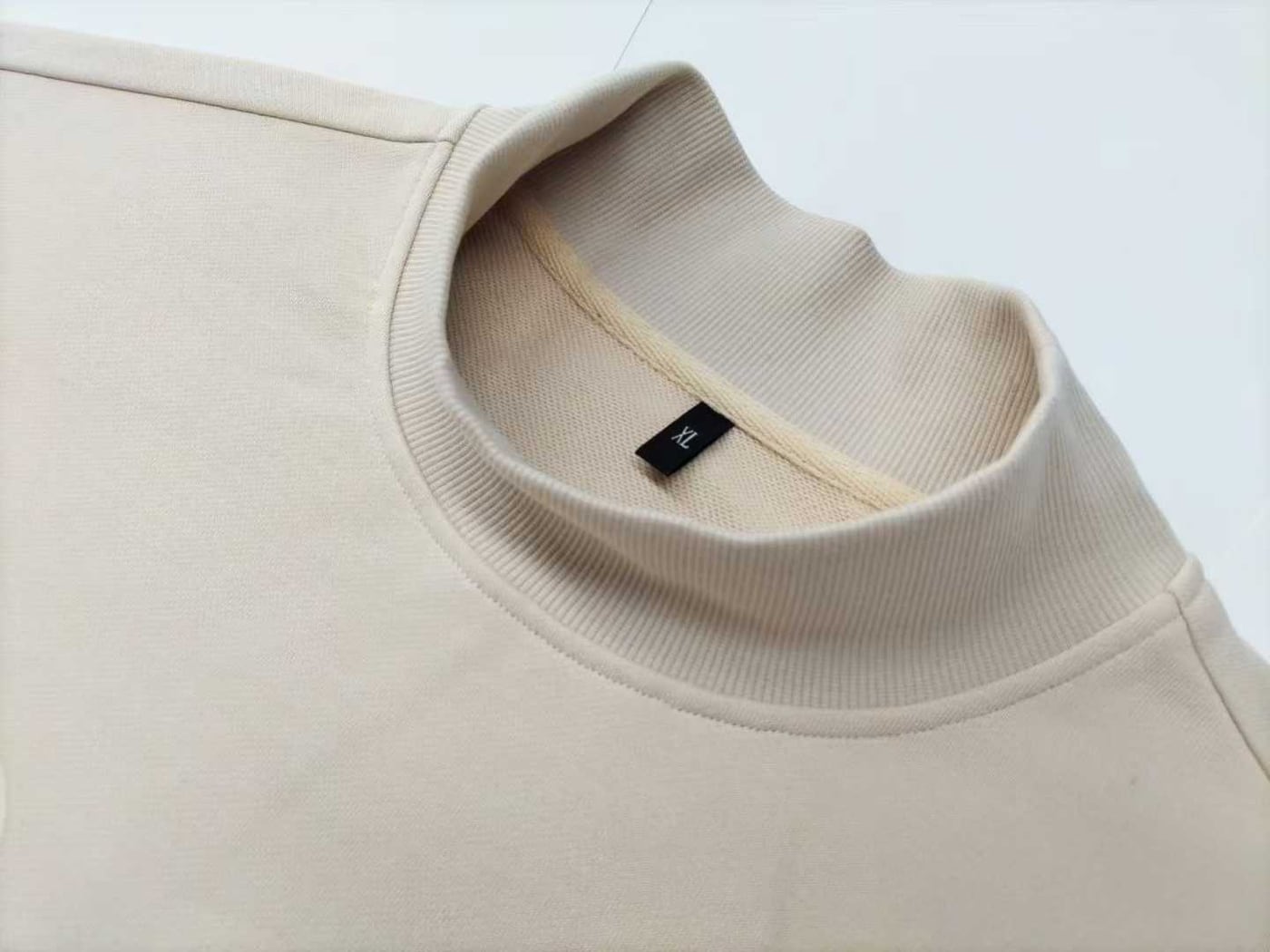
Say what the reference has been through. A garment that has been worn and washed has already shrunk, relaxed and lost some of its surface; a garment straight from a shop has not. Photograph it flat, on a body and inside out, and note the fabric weight if you know it, because a photograph cannot show weight, drape or the way a rib recovers.
Shipping the reference is its own small task. Send it as a sample with a declared value and a description that matches what it is, because a parcel held at customs delays the whole brief, and keep the tracking number with the file so the sample room can confirm the day it landed.

Mark What Stays and What Changes
A reference garment without markup implies that everything is to be copied, and that is rarely true. Tape an arrow on each panel that changes, number the notes, and write a keep-or-change list in the same order. “Keep the collar, change the cuff, shorten the body by one size step” is an instruction; a paragraph of adjectives is a discussion.
The list should cover the panels a pattern cutter actually touches: neckline and rib, shoulder and armhole, sleeve length and cuff, body width and length, hem, pocket, and any seam that carries a decoration. If a detail is to be kept, say so explicitly, because silence is read as permission to improve it. Number the notes and photograph each panel with its note visible, so a factory working in another language can follow the sequence without translating adjectives.
Flat Measurements: The Parameter That Ends Arguments
A knit relaxes. Measure the reference flat on a table after it has rested, not hanging and not stretched, and measure the same points on the sample when it comes back. Those two sets of numbers are the only reliable comparison between a garment you own and a garment someone else cut.
| Point | How it is measured flat | Why it decides the sample |
|---|---|---|
| Chest width | Across the body below the armhole, relaxed | Sets the fit block and the size grade |
| Body length | From the high point of the shoulder to the hem | Moves with shrinkage and the wearer’s height |
| Shoulder | Seam to seam across the back | Decides whether the sleeve sits on or off the shoulder |
| Sleeve | From the shoulder seam to the cuff edge | Reads long or short on the arm, not on the sheet |
| Neck width | Inside the rib, relaxed, seam to seam | The first dimension a wearer notices |
| Rib depth | Depth of the cuff and hem bands | Decides whether the band holds or rolls |
Add a tolerance to each point and a note on stretch. A rib that recovers to its measured width after being pulled is behaving correctly; a rib that stays stretched has failed, even when the flat number matched on the day it was checked.
Fabric, Yarn and Hand Feel
Fibre content, yarn type and gauge explain most of what a buyer describes as hand feel. Send a swatch of the fabric you want, or the closest one you have, and describe it in physical terms: how it drapes, how it recovers, whether it has surface texture, whether it is opaque at the weight you need.
If the reference stretches, measure it relaxed and again after a firm pull, and note how far it returns. That recovery figure explains most complaints about a knit that grew after a week.
Words such as soft and premium mean different things in different rooms. A measured weight, a fibre percentage and a gauge give the mill something to match, and a swatch gives them something to beat. If the programme needs OEKO-TEX Standard 100, GRS or RWS fibre, say so at this stage, because certified yarn has to be ordered with the bulk rather than substituted at the end.
Trims, Labels and Decoration
Trims carry the details a wearer touches: button size and finish, zip brand and length, thread shade, the woven label in the neck, the care label and any hangtag. Send the physical trim where you have it. A photograph of a button rarely survives the sampling room’s translation into a purchase order.
Decoration arrives as artwork rather than a picture: a vector file, a placement measurement from a fixed point, and the finished size. A logo described as “about this big on the chest” will be a different size on a small and a large, because the chest moves with the grade.
Where the Development Cost Builds Up
None of this shows up as a line on a quotation, and all of it shows up in the number of sample rounds. Each missing input turns into a question at the sample review, and each question turns into a change after the pattern is cut.
| Brief input | What it prevents | If it is missing |
|---|---|---|
| Reference garment | Guessing at silhouette and hand | The sample is cut from a photograph |
| Keep-and-change markup | Rebuilding panels that were already right | Every detail is renegotiated at review |
| Flat measurements | Drift between the reference and the sample | Two samples, two different bodies |
| Fabric swatch and weight | A body cloth that behaves differently | Approval rests on a cloth you cannot buy |
| Trims and artwork | Late substitution | A zip, button or logo that cannot be sourced in time |
| Size range and grading | Re-cutting a size set | The grade is corrected after the first sample |
The arithmetic is straightforward: a complete brief costs a week of preparation, and an incomplete one costs a sample round at 7–12 days plus the weeks lost while the buyer and the factory disagree about what the reference actually was.
What Happens After the Brief Arrives
The sample room reviews the brief against the reference, confirms the fabric and the trims, and flags anything that cannot be sourced as described. Sampling then takes 7–12 days after fabric and tech pack approval, and bulk production typically runs 20–35 days after sample approval. The minimum order is 300 pcs per style, and inspection follows AQL 2.5.
The review is also where a factory should say what it cannot do. A reference with a hand-embroidered yoke may be reproducible only as a machine approximation, and that is better heard before the sample than after it.
Before that, one conversation is worth having: send the reference and the brief through the contact page, then ask what is ambiguous. A factory that asks three specific questions in the first week is doing the work a brief is meant to make possible. The sampling and production service starts from that review, and the questions buyers ask before an order cover the rest.
FAQ
Is a photo and a link to the product not enough?
A photograph shows colour and shape, not weight, stretch or recovery. Send the garment or a swatch as well, because those three properties decide whether the sample behaves like the reference on a body.
We do not have a tech pack. Can you work from the garment?
Yes. The reference garment plus measurements, trims and artwork becomes the tech pack, and the sample room fills the gaps with you rather than for you. It costs one conversation more than a finished pack, not a sample round.
Can you copy this sample exactly?
We can match the construction and the measurements within the tolerances you set. Exact copying depends on the fabric and the trims still being available, and on the reference not carrying protected design rights if it is another brand’s product.
Do we need to send two garments?
It helps. One garment can be opened and marked for cutting while the second stays intact for comparison at the sample review, so the discussion is about the sample rather than about memory.
Sources: OEKO-TEX Standard 100, EU Regulation 1007/2011, US CBP informed compliance, Better Work, Intertek, Higg.
Working on a knitwear project?
Let’s talk yarn, gauge and timing.
Send a reference or tech pack and we will come back with a practical development route.

