
AQL 2.5 sets an acceptance number for an inspection; it does not say what counts as a defect. Two buyers can look at the same 300-piece shipment with the same sampling plan and reach opposite conclusions, because one counts a float on the inside of a sweater as a fault and the other does not. What settles that before the inspection is a defect library.
A knitwear defect classification guide is usually written after the first claim, which is the worst possible time. Written before the order, it costs a sample, a camera and an hour with the factory. Written after, it costs an argument about whether the goods were ever wrong.
A knitwear defect classification guide, written before the claim
A knitwear defect classification guide records what counts as a defect in a given order: the defect family, how it is measured or photographed, the severity it carries and the point in production where it should be caught. Agreement on those four things is what makes an inspection decision repeatable.
The guide has four working parts, and each is short: the family, the evidence, the tier and the catch point. Together they turn a subjective inspection into a decision that two people can reach independently and still agree on.
What a defect library is, and what it is not
A defect library is not a list of everything that could go wrong, and copying another brand’s version rarely helps, because the tiers depend on the fabric, the colour and the price point the garment sells at. A visible float on a chunky sweater in a pale colour is a major defect; the same float on the inside of a dark, heavily textured garment may be recorded and released.
It is also not a substitute for the sample. The approved sample remains the reference for fit and finish; the library supplies the words and photographs that say what an approved finish tolerates. Without both, an inspector is asked to compare a garment against a memory of a garment.
What the library does replace is a habit. Most factories and most buyers already carry an unwritten version of it, held by whoever has been in the sample room longest. Writing it down is what stops that knowledge from leaving with the person.
The five families worth recording
A defect library is a photographed, named list of the faults the factory and the buyer agree to call faults, each with a severity tier and a reference photo. Without it, “defect” means whatever the inspector saw that morning, and the same garment passes one week and fails the next.
Five families cover most of what appears on knitted garments: a stitch that has dropped, a yarn floating where it should not, a neckline join that has gone wrong, a stain, and a shade that does not match. Recording them in that order follows the production sequence, which makes the catch point easy to write.
| Defect family | How it looks | Typical cause | Caught at | Default tier |
|---|---|---|---|---|
| Dropped stitch | A vertical run where a needle failed to knit | Needle damage, yarn tension, yarn fault | On the machine or at mending | Major when visible on the front |
| Float | A loose yarn crossing the back of the panel | Pattern setting, carrier stop, yarn path | During knitting or first inspection | Major outside, minor inside |
| Neckline linking fault | Uneven or twisted join at the neck edge | Linking alignment and tension | At linking, before wash | Major, affects fit and wear |
| Stain or mark | Oil, dye or handling mark on the garment | Machine oil, wet handling, packing | End of line under inspection light | Critical if it will not clean out |
| Shade variation | Panel-to-panel or garment-to-garment difference | Yarn lot, dye batch, panel order | At cutting and at packing | Critical across a shipment |
The cause column is what turns a library into an improvement tool. A dropped stitch traced to needle damage and one traced to yarn tension lead to different conversations, and only one of them is a conversation about the yarn.
Severity: critical, major and minor
Severity is the part buyers and factories argue about, and the part that has to be agreed rather than assumed. Three tiers are enough, provided each one says what happens to the lot.
| Tier | Definition | Effect on the lot |
|---|---|---|
| Critical | Affects safety, function or a legal claim | Handled by agreement outside the general acceptance count |
| Major | Visible and would stop a sale at full price | Counts towards the acceptance decision at inspection |
| Minor | Visible under close inspection only | Recorded in the report, not counted against the lot |
Write the tier against the defect, not against the mood of the inspection. A library that leaves a stain at major without saying whether it must come out in cleaning will be renegotiated on every shipment, and the renegotiation is where the real cost sits.
Two rules keep the tiers honest. A tier is set on the sample, with both sides present, rather than on a photograph sent later. And a tier changes only when a written note explains why, because a tier that drifts quietly is the same as no tier at all.
Photographs, scale and the reference card
Every entry needs a photograph taken on the fabric and colour of the order, under the light the inspection will use, with a scale in the frame. A defect photographed on white cotton from another order is an illustration rather than a standard, and an inspector holding a cream sweater cannot map it onto what is in front of them.
Keep one card per defect: photograph, tier, the size or measurement limit that separates minor from major, and the part of the garment it applies to. Laminated cards travel to the inspection table; the digital file stays with the order documents. That duplication is deliberate, because the table is where the decision is actually made.
Where the cost of a defect builds up
Cost accumulates by stage, and it grows faster than most buyers expect. Caught at the machine, a dropped stitch is a mend. Caught at end-of-line inspection, it is a mend plus a re-inspection of the lot. Caught after packing, it is a sort, a reopened carton and a delivery at risk. Caught after shipment, it is freight, credit and a customer who now checks every carton.
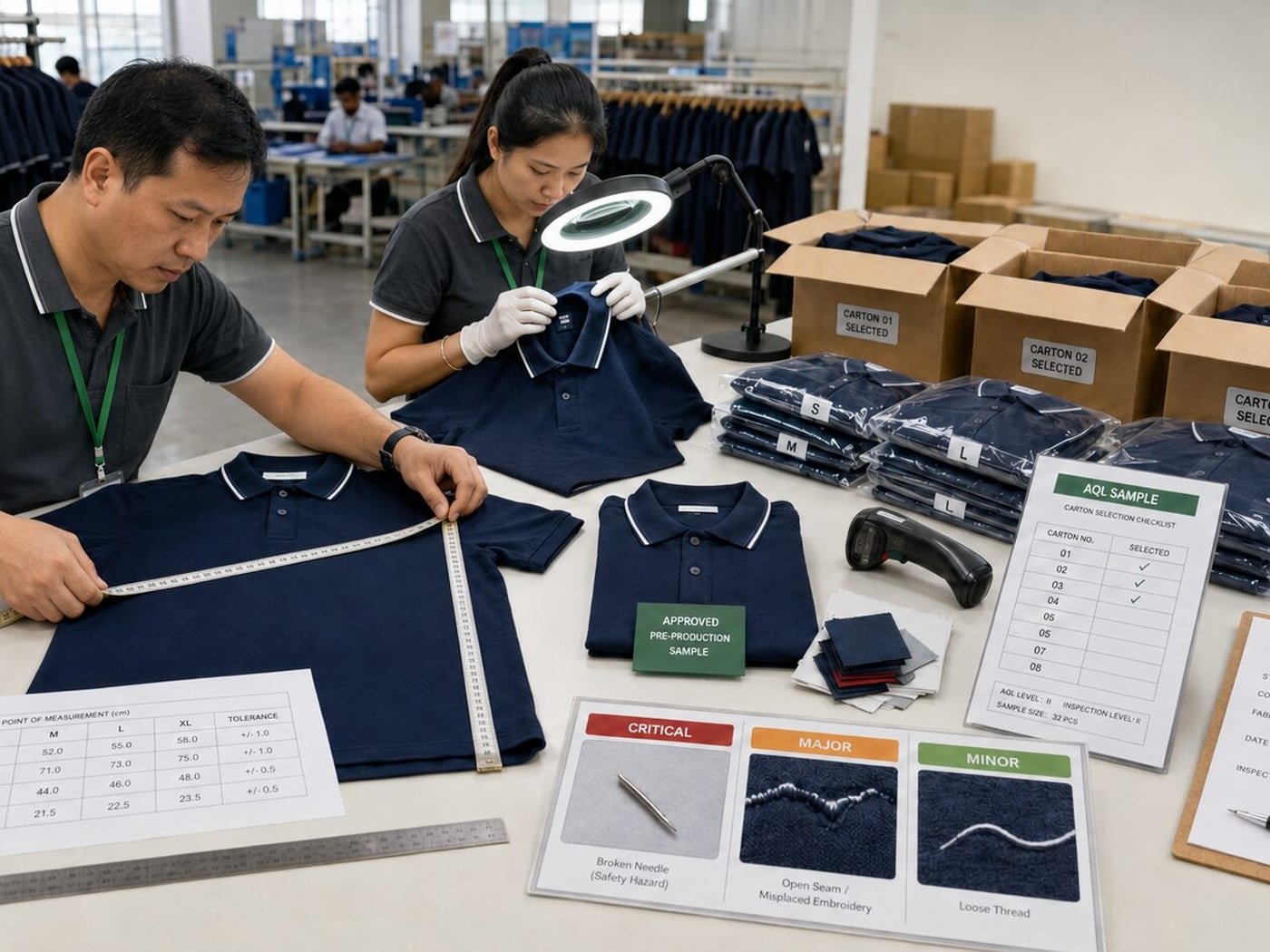
The calendar adds to it. Bulk production typically runs 20–35 days after sample approval, so a lot held for rework at the end of that window has no room to recover inside it, and the next milestone moves with it. That is the argument for putting defect definitions in the order documents rather than in a post-mortem.
Writing the classification into the order
The library only works if it is referenced. Sample approval fixes the finish, the inspection at AQL 2.5 tests the lot, and the library supplies the definitions both of those steps depend on. Attach it to the purchase order as an annex, number the entries, and require the inspection report to cite the entry number for every defect it records.
That citation is what makes a report readable at a distance. “Twelve units, entry four, major, left front panel” is a line a buyer can act on; “some issues with the fronts” is a line that generates a call. The quality process in the atelier is only as precise as the definitions it is given.
Keeping the library alive
Revise it after every order. Add a photograph when a defect appears that the library does not name, retire entries for constructions the range no longer uses, and change a tier only with a note that explains the change. The version belongs in the file name, beside the tech pack it accompanies.
A library two seasons old is usually a record of a different fabric and a different supplier, and inspectors can tell. The version that gets used is the one printed for the current order and signed by both sides.
Related reading: How to Verify Fiber Content Before Approving Garment Labels.
FAQ
Can we use a standard defect list instead of building one?
A standard list gives you the families and the vocabulary. It cannot give you the tier for your fabric, colour and price point, and the tier is the part an inspector actually needs at the table.
How many entries should the library hold?
As many as occur on your orders, plus the ones the factory flags as likely on the construction. A list of forty entries nobody has seen will not be opened during an inspection.
Does AQL 2.5 replace the library?
No. AQL 2.5 sets how many pieces are checked and when a lot is accepted; the library decides whether a given piece is defective in the first place. The two documents answer different questions.
Who signs off the library?
The buyer and the factory together, on a physical sample. A library signed by one side is a set of opinions, and it will be renegotiated at the first claim that reaches the desk.
If the quality document is the missing piece, send the style and the last inspection report to the production team and ask for the defect list to be agreed before the sample is approved. Past programmes are summarised in the case studies.
Sources: Intertek on textile testing methods, OEKO-TEX Standard 100 on restricted substances, EU Regulation 1007/2011 on fibre names and labelling, US CBP informed compliance on import documentation, and Control Union on certification scope.
Working on a knitwear project?
Let’s talk yarn, gauge and timing.
Send a reference or tech pack and we will come back with a practical development route.

