
The wash report came back with the body longer than the approved sample and nobody could say whether the garment had grown or the measurement had moved. One person had measured it flat on a table, another had washed it, a third had pressed it, and nobody had written down the conditions. The number was real. It just could not be repeated.
Knitwear dimensional stability testing is usually described as a wash test, and that description is where the trouble starts. The figure in the report reflects the wash cycle, the drying method, the conditioning and the pressing as much as it reflects the yarn, and unless all four are recorded, the figure cannot be repeated or argued with.
Knitwear dimensional stability testing: what has to be recorded
Knitwear dimensional stability testing records how a garment’s measurements change through a defined wash and dry cycle: the length, the width and any twist, measured before and after under stated conditions, with the conditioning, the pressing and the tolerance written alongside so that another lab can repeat the result.
Without those conditions, the test measures the operator rather than the garment. With them, the result becomes a specification the bulk can be checked against, and a mill, a factory and a brand can compare the same number.
Why the first wash report is usually unusable
Most first reports fail on documentation rather than on the garment. The measurement points are named but not defined, so the chest is taken at the armhole on one sample and two centimetres below it on the next. The sample is measured straight off the machine, before the loops have relaxed, and the resulting figure looks like growth that never happened.
Others fail on conditioning. A knitted garment absorbs and releases moisture, and a sample measured in a dry room reads differently from one measured after a night in a standard atmosphere. That difference is often larger than the change the test is meant to detect, which is why conditioning is part of the method rather than a preliminary step.
Pressing is the third gap. A garment pressed flat before measurement will hide length that returns after a few hours on a hanger, and a garment measured while still warm will read short. Pressing has to be defined, applied the same way before and after, and noted on the record.
Conditioning and pressing: the two variables that decide the number
Conditioning means letting the sample reach equilibrium before it is measured, in a defined temperature and humidity, for long enough that successive weighings or measurements stop moving. The practical version is simple: lay the sample flat, unstrained, in the same room for the same time before every measurement, and write that time down.
Pressing is the harder variable because it is a judgement. A light steam to remove creases and a firm press with weight are different treatments, and both are defensible as long as they are applied identically before and after the wash. Define the treatment once, apply it to every sample, and record it with the result.
Both variables matter more on soft yarns. A cashmere or a loose-knit lambswool will respond to steam and to resting far more than a compact cotton piqué, so a protocol written for one product cannot be pasted onto another without a check.
The measurement protocol, step by step
The protocol below is the version that produces a repeatable number. It is not the only valid method, but each step exists because skipping it has produced an argument later.
- Define the measurement points and mark them on the garment, not on a drawing, so the same point is found twice.
- Condition the sample flat, unstrained, for a fixed period in a fixed room.
- Measure and record every point, with the tape tension stated.
- Wash to a stated cycle, with the detergent, temperature and load recorded.
- Dry by a stated method, flat or line, and record which.
- Condition again for the same period, then press with the defined treatment.
- Measure again at the same points and record both sets of numbers side by side.
- Calculate the change per point, compare with the tolerance, and sign the record.
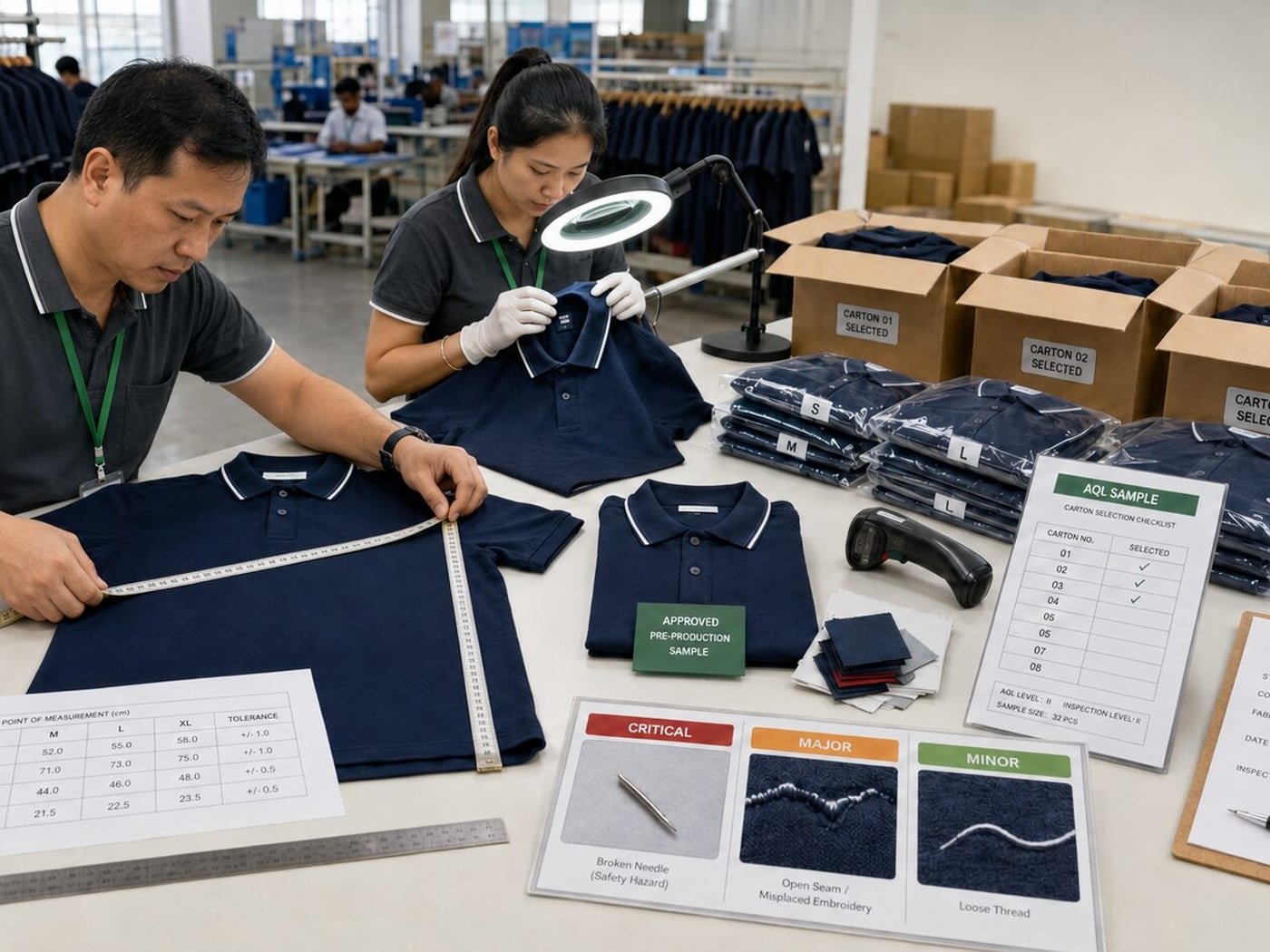
Reading the result: length, width, twist and shape
A single percentage hides more than it shows. Length and width move independently, and a garment can lose width while gaining length as the loops relax downwards. Twist is a separate observation: a side seam that spirals after washing is a knitting or finishing problem, and it will not appear in a length measurement at all.
Record the four readings separately, then judge them against the product. A relaxed-fit sweater with a little length growth may still be inside its tolerance; a fitted knit dress where the same growth pushes the hem past the knee is a different case entirely.
Setting a target per product, not per factory
There is no universal shrinkage figure that suits a piqué polo, a fine-gauge cashmere crew and a heavy lambswool cardigan. The tolerance follows the product, the yarn and the fit: a garment with ease can absorb a change that a fitted garment cannot, and a garment sold as pre-shrunk is making a promise that a loose knit cannot keep without treatment.
That is why the target belongs on the tech pack rather than in a factory manual. Set it for the style, test the first sample against it, and keep the record with the approved sample so the bulk is judged against the same number.
Where the test programme goes wrong
Failures in a wash programme repeat in predictable ways, and each one has a check that takes minutes on the sample.
| Symptom | Likely mechanism | Check on the sample | Action |
|---|---|---|---|
| Body grows lengthwise | Loop relaxation under the garment’s own weight | Hang the sample for a day after pressing, then re-measure | Record both readings; do not quote the pressed one alone |
| Width shrinks | Yarn shrinkage in the wash, or a tight finishing tension | Measure the same width point before and after, unstrained | Adjust the finishing width, then re-test |
| Side seam spirals | Twist in the yarn or an unbalanced stitch structure | Lay the garment flat and follow the seam line | Treat as a knitting issue, not a wash issue |
| Surface felts | Fibre migration under mechanical action | Compare the surface under raking light after each cycle | Change the yarn or the wash instruction |
| Rib recovers slowly | Relaxation of the elastane or the rib structure | Stretch and release the cuff, then time the recovery | Test recovery separately from dimension |
Writing the result into the approval
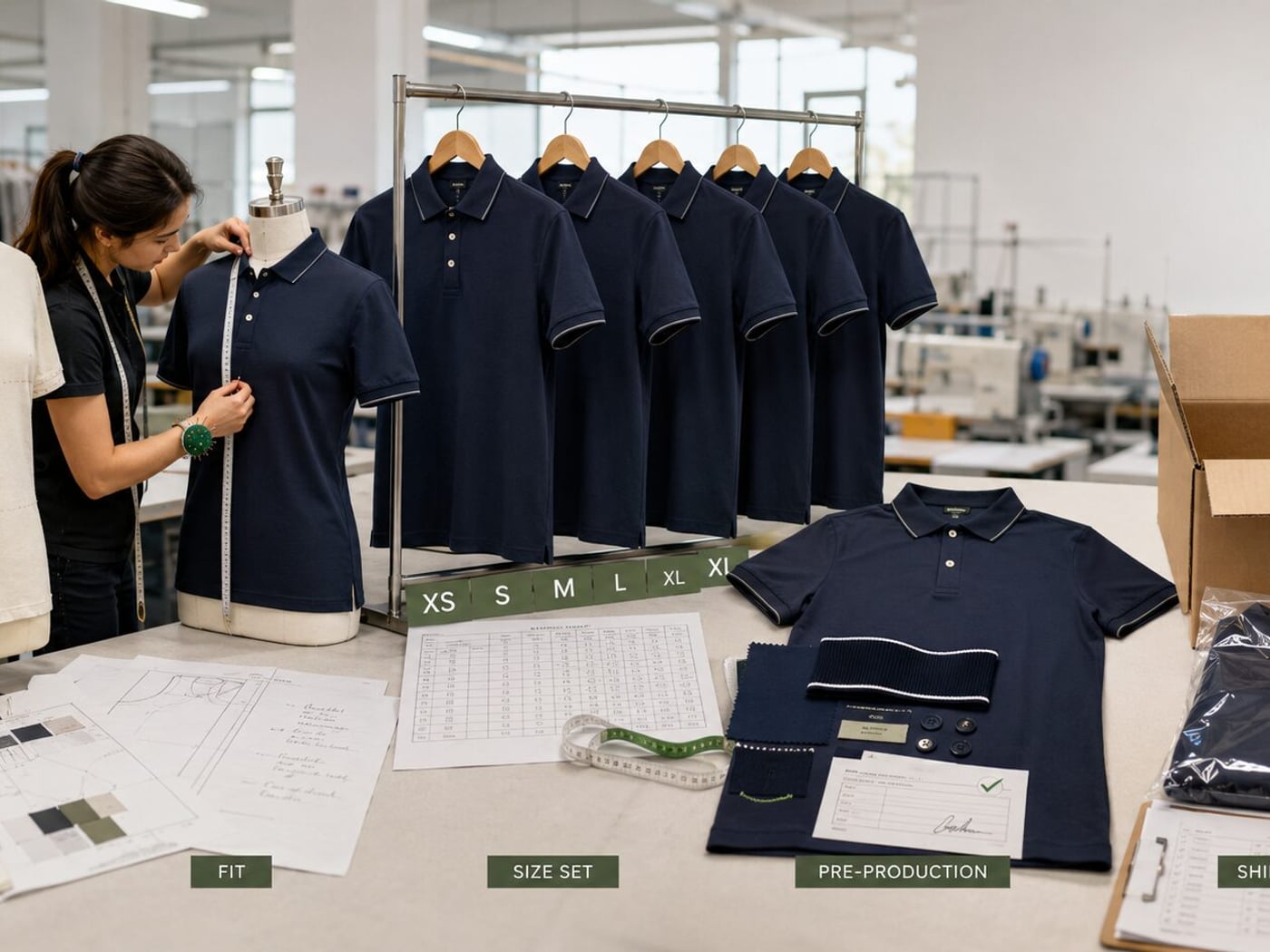
The wash record should travel with the approved sample, not sit in an email. When the bulk is inspected at AQL 2.5, the question that decides a dispute is whether the garment matches the approved sample and its stated dimensions, and a wash record attached to that approval answers it without a further test.
Where the record shows a change outside tolerance, the fix is decided before bulk, not after. A finishing width adjustment, a yarn change or an added allowance is a development decision, and the quality process in the atelier is set up to test it on a sample rather than discover it in a carton.
Two documents make the system work: a method sheet that states the conditions once, and a record sheet that repeats those conditions for every test. Sample approval, bulk inspection and any later claim can then refer to the same two pages. Examples of how that is handled across a programme are in the case studies.
FAQ
Is the supplier’s own shrinkage test enough?
It is enough if the method, the conditioning and the pressing are stated and match your product. Without those, the number cannot be compared with your sample, and comparison is the only thing the test is for.
Can we just add a shrinkage allowance instead of testing?
An allowance can cover a predictable change in one direction. It cannot cover twist, felting or a rib that stops recovering, and those are the failures a wearer notices first.
How many washes should the test cover?
The number follows the care instruction and the market. One cycle answers the immediate question; repeated cycles show whether the change settles or continues, and a garment that keeps moving after the third wash is a different problem.
Does pressing hide the real result?
It can, if only the pressed reading is reported. Record the measurement after conditioning and again after pressing, and the report shows what the wearer will see rather than what the iron achieved.
If the method is the part that keeps going wrong, send the style and the current wash record to the production team and ask for the protocol to be fixed before the next sample round.
Sources: Intertek on textile testing methods, OEKO-TEX Standard 100 on restricted substances, EU Regulation 1007/2011 on fibre names and labelling, US CBP informed compliance on import documentation, and Control Union on certification scope.
Working on a knitwear project?
Let’s talk yarn, gauge and timing.
Send a reference or tech pack and we will come back with a practical development route.

