
A knitted sample passed every check on the form and failed the moment a person put it on. On the form the shoulders were level, the hem was straight and the armholes sat clean. On the model, the left armhole pulled as soon as she raised an arm, and the hem lifted at the front when she sat. The garment had not changed. The review had measured a shape rather than a body.
Knitwear fit model vs dress form is not a choice between better and worse. Both reviews have a place, and they answer different questions: a form is a geometry check and a live fitting is a behaviour check. Programmes that run only one of them discover the other’s findings in bulk.
Knitwear fit model vs dress form: the short answer
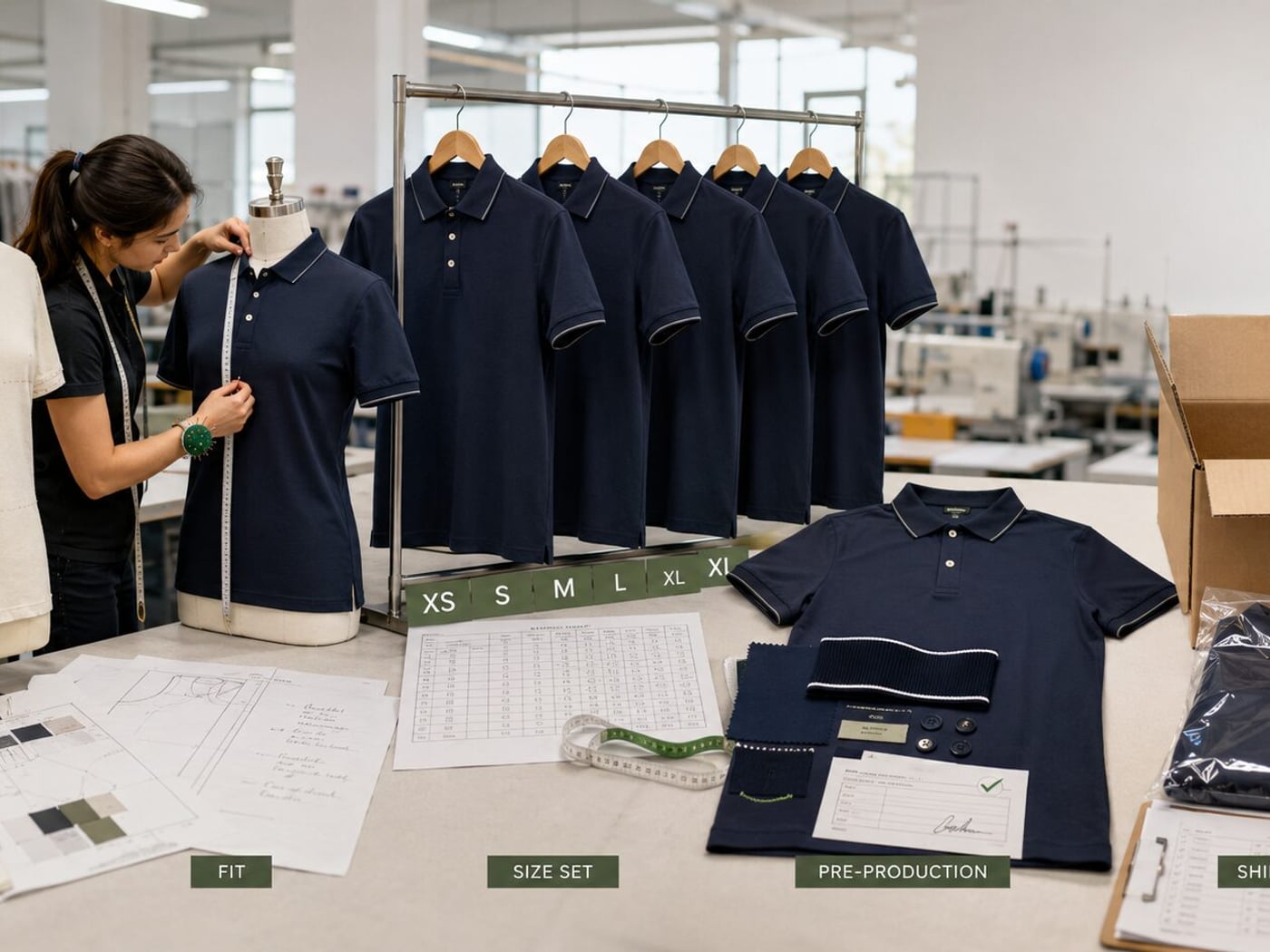
A dress form checks balance, symmetry and measurements on a static shape. A fit model checks movement, drape and comfort on a body. Use the form to confirm the pattern and the model to confirm the garment, and record both against the same measurement sheet.
The order matters less than the fact that both happen before approval. A form review that comes after a live fitting is a confirmation; a live fitting that comes after approval is a rework.
What a form does well
A form is consistent, available and patient. It holds the same shape every time, so a measurement taken today can be compared with one taken last month. It shows symmetry, because both sides can be seen at once. It shows proportion, because the whole garment is visible at a glance. And it photographs well, which makes it useful for a record.
It is also the right place to check the things that are true of a garment rather than of a wearer: whether the two fronts match, whether the neckline is centred, whether the sleeves are set at the same angle, whether a cable panel sits where the drawing put it.
What a form cannot do is move. It has no posture, no shoulder slope beyond the one it was made with, and no weight shifting from one hip to the other. A garment can be perfectly balanced on a form and pull somewhere on a person, and the form will never say so.
What only a live model shows
A live fitting shows the garment under gravity and in motion. It shows whether the armhole gapes when an arm is raised, whether the sleeve twists when the arm bends, whether the hem rises when the wearer sits, whether the neckline sits away from the collarbone, and whether the knit clings where it should hang.
It also shows comfort, indirectly. A model who keeps tugging a hem or adjusting a shoulder is reporting a fit problem without using words, and that observation is worth more than a measurement that happens to be inside tolerance.
The model has to be the right model, though. A fit model should represent the target customer’s size and proportions, not a runway body, and her measurements should be recorded so the results can be read against the size chart. A fitting on the wrong body produces comments that cannot be generalised.
Setting up a fit session
Choose the body. Use a model whose measurements sit at the middle of the size range being developed, and record those measurements with the notes. One model is enough for a first fitting; two are better when a range spans a wide size band.
Fix the underlayers. The same bra, the same base layer, the same shoes. A change of underwear changes the fit of a knit more than most buyers expect, and the comparison between two samples collapses if the underlayers change.
Run the same poses every time. Standing relaxed, arms forward, arms raised, seated, and a walk across the room. Photograph each, from the front, the side and the back.
Record while it happens. Note the pose, the location of the pull or the gape, and the direction of the problem. A comment that says “armhole pulls” is much less useful than one that says “pulls at the left armhole when the arm is raised above the shoulder”.
Setting up a form review
Match the form to the size. A form that is padded to the right chest but not the right shoulder slope will produce balance comments that belong to the form. Check the form’s own measurements before trusting its verdict.
Pin consistently. If the sample is pinned to the form, pin it the same way each time and photograph the pins. A pinned garment can be made to look balanced, which is exactly the failure this review is meant to catch.
Measure on the form and off it. Take the sheet measurements flat and again on the form, and keep both. The difference is the garment’s behaviour under its own weight, and it is the number that predicts how it will hang on a person.
Comparing what each review catches
The two reviews overlap less than buyers assume. This is the split we use.
| Check | Dress form | Live model | What a failure looks like |
|---|---|---|---|
| Balance and symmetry | Clear | Obscured by posture | One front longer, or a hem that rises |
| Measurements | Repeatable | Affected by movement | A number outside the sheet |
| Drape under gravity | Partly | Clear | A hem that stands away or clings |
| Movement and gape | Not visible | Clear | An armhole that opens when the arm lifts |
| Comfort and adjustment | Not visible | Clear | Tugging, hitching, or a collar that will not sit |
| Photography for the record | Easy | Needs a session | No image to compare against next time |
When the two reviews disagree
They will disagree, and the disagreement is informative. A form that says balanced and a model that says the hem lifts usually means the pattern is correct but the garment lengthens at the front under movement, which is a stitch or a hem-weight question. A model that says fine and a form that says the hem is off-level usually means the sample was pinned into balance, and the true garment is not.
The resolution is to go back to the pose that produced the finding and repeat it, then measure the garment in that state. If the finding survives the repeat, it is a real characteristic and the pattern or the specification has to change. If it disappears, it was a pin, a posture or a bad day.
Recording the review so it can be acted on
A fit review is only useful if the comments can be executed. That means a location, a direction, a magnitude where possible, and a reference photograph. It also means a record of who was in the room and what the garment was measured against.
| Field | What to record | Why it matters |
|---|---|---|
| Sample identity | Style, size, sample number, date | Ties the notes to one garment |
| Model or form | Body measurements, or the form’s measurements | Makes the finding interpretable |
| Poses run | The list, in order | Allows a repeat |
| Findings | Location, direction, and the pose that produced it | Turns an impression into an instruction |
| Photographs | Front, side, back, and the detail | Shows what the note describes |
| Decisions | Change, accept, or re-sample | Prevents an open question reaching bulk |

Where fitting programmes go wrong
Three failures repeat. A fitting run on a model who does not represent the size range. A form review treated as a fitting, so movement is never checked. And comments that describe a feeling rather than a location, which cannot be executed and cannot be checked on the next sample.
The fix is procedural rather than technical: fix the model, fix the poses, fix the record. The sampling and production service runs both reviews against one measurement sheet, the case studies show how often a fitting finding traces back to a missing record, and the questions buyers ask before sampling are worth settling before the first fitting.
Where the two reviews still disagree after a repeat, the photographs usually settle it. Send the pose, the sheet and the sample photographs and the finding can be read against the garment rather than against a memory of it.
FAQ
Can a dress form replace a fit model?
No. It can confirm balance, symmetry and measurements, but it cannot show movement, drape on a body or comfort. Use it as the first check rather than the only one.
How many models do we need?
One is enough for a first fitting when the range has a single size band. Two are better when the range spans a wide band, because a garment that fits the middle can fail at the ends.
What should the model wear underneath?
The same base layers every time, and the ones the customer is expected to wear. Changing underwear changes a knit’s fit more than most buyers expect and makes two fittings incomparable.
Do we need to attend the fitting in person?
Not necessarily, if the session is photographed from the agreed poses and the notes record the location and the pose. What cannot be delegated is the decision about which findings to act on.
Sources: Intertek, OEKO-TEX Standard 100, Better Work, Higg, EU Regulation 1007/2011 and US CBP.
Working on a knitwear project?
Let’s talk yarn, gauge and timing.
Send a reference or tech pack and we will come back with a practical development route.

