
Take two sweaters knitted from the same yarn, on the same machine, to the same panels. Wash one and mill the other, and they will differ by a size, by a hand you can feel through a bag, and by a surface that photographs differently. Nothing in the knitting changed. The finishing did.
That is why a knitwear finishing specification is not a note about laundry. It is the document that tells the next order how the garment was made to feel, and without it the second run is a new garment that happens to use the same yarn.
Knitwear Finishing Specification: What the Sheet Has to Record
A knitwear finishing specification records the route — wash, mill or press — the conditions used, the appearance standard the result was judged against, and the sample that was approved. The parameters belong to the factory’s tests; the buyer’s job is to fix the look, the hand and the measurements that follow.
Three parts, then: the sequence, the acceptance standard, and the physical reference.
Two Sweaters From One Yarn
Washing relaxes the knit and lets the stitches settle. Milling, or fulling, works the fibre while it is wet so the surface felts and the fabric tightens, which is where a lambswool sweater gets its density. Pressing sets the shape and the surface, and too much of it produces a shine that never washes out.
The three are sequential in most programmes, and each one moves the measurements. A washed-only sweater keeps more of its knitted size; a milled one comes out smaller and firmer; a pressed one holds the shape it was pressed into until the first wash.
Washing: What It Changes
Washing is the step that decides whether the garment feels relaxed or tight. It also decides shrinkage, and shrinkage is the number that turns a size chart into a complaint. The sheet should say whether the measurement standard is taken before or after finishing, because a sweater measured green will never match one measured finished.
Drying is part of the wash. Flat drying keeps a panel square, while hanging it wet lets the garment stretch under its own weight and pulls the body length out of the measurement band. The sheet should say which, because the two produce different garments from the same process.
Washing also releases any residual tension in the yarn. A panel that looked even on the machine can develop a slight skew after washing, and the sheet should record whether the panels were dried flat or hung, because the difference shows at the side seam.
Milling and Fulling: Where the Hand Comes From
Milling is the step buyers ask for by describing a feeling: denser, softer, more like a proper sweater. The process works the fibre into a felted surface, and the amount of work decides whether the result is a light bloom or a compact, almost woven hand.
Ask for a milled and an unmilled swatch in the same yarn, kept together. The pair explains the choice to a buyer faster than a paragraph, and it is the only practical way to judge whether the felt has gone too far before a bulk lot follows it.
It also shrinks the garment, and it does so unevenly if the panels are milled separately. Ask whether the garment is milled in pieces or after making, because the seams behave differently and the measurement loss is not the same across a sleeve and a body.
Pressing and Steaming: Shape and Shine
Pressing sets the finished dimensions and the surface. A light steam relaxes the knit without flattening it; a hard press closes the stitch definition and can leave a sheen on dark shades that reads as wear before the garment has been worn.
Pressing also sets the neckline and the cuffs, and those are the edges a garment looks tired at first. A neckline pressed flat and wide will not recover with wear, and a cuff pressed hard loses the rib recovery that keeps it on the wrist.
The sheet should say which, and it should say what the garment must not look like. “Pressed, no shine, stitch definition visible” is a standard an inspector can apply. “Well finished” is not.
| Route | Effect on hand | Effect on measurement | Risk |
|---|---|---|---|
| Wash only | Relaxed, open, soft | Small change; mostly relaxation | Skew at the side seam if dried hanging |
| Wash and mill | Denser, felted, warmer | Noticeable shrinkage; uneven if milled in pieces | Over-milling makes a stiff, small garment |
| Wash, mill and press | Set, smooth, defined | Dimensions fixed to the press | Shine on dark shades; flattening |
What the Sheet Must Record
A finishing sheet that says “wash and press” is a note. A sheet that a second factory could follow is a specification.
| Field | What to write | Why it matters on the next order |
|---|---|---|
| Route and sequence | Wash, mill, press, in order | Sequence changes the result more than any single step |
| Conditions | Confirmed by the factory’s tests, recorded as run | Repeatability, not guesswork |
| Appearance standard | Hand, surface, shine, stitch definition | Gives the inspector something to judge |
| Measurement point | Before or after finishing, with the tolerance | Stops two sheets measuring different garments |
| Approved sample | Sealed, finished, labelled with the route | The physical reference for both sides |
| Care label | The wash and dry instructions the finish supports | Keeps the label honest after finishing |
Where the Sequence Goes Wrong
Finishing faults are usually sequence faults. A garment pressed before it is fully dry keeps a crease that was never meant to be set. A garment re-pressed after a repair shows a second shine along the same edge. A garment milled after the seams are joined loses more length than the pattern allowed, because the seam stops the panel shrinking evenly.
Each of those is visible in a finished sample and invisible in a plan, which is why the approved sample is finished exactly as the bulk will be.
The Sample That Anchors It
Finish the sample the way the bulk will be finished, then seal it. A sample that was pressed for the photograph but will be washed in production is not a reference for anything, and the difference shows up as a size complaint rather than a finishing complaint.

Photograph it from the side as well as the front. Finishing shows in profile: the shoulder line, the drape at the hem and the way the collar sits are all consequences of the route, and none of them is visible in a flat lay.
Label the sealed bag with the finishing route and the date. Six months later, when a reorder is discussed, the bag is the only object that settles what “the same hand” meant.
Matching the Care Label
The care label is a promise about the finished garment, not about the yarn. If the finishing route leaves a milled surface that pills with abrasion, the label cannot promise a smooth knit; if the press is the only thing holding the shape, a domestic wash will undo it.
Fibre content on the label follows the destination’s rules — in the European Union, Regulation 1007/2011 — and the care instructions have to be true for the finished article. If the programme uses OEKO-TEX Standard 100, GRS or RWS fibre, the certificate reference belongs in the same file as the finishing record, with traceability documents where available.
Who Signs It Off
Finishing is approved by the person who can see the garment on a body, and it is recorded by the person who ran the process. The buyer signs the appearance standard and the measurement point; the factory signs the conditions it used. Both signatures belong on the same page, because a dispute about hand is a dispute about who agreed what.
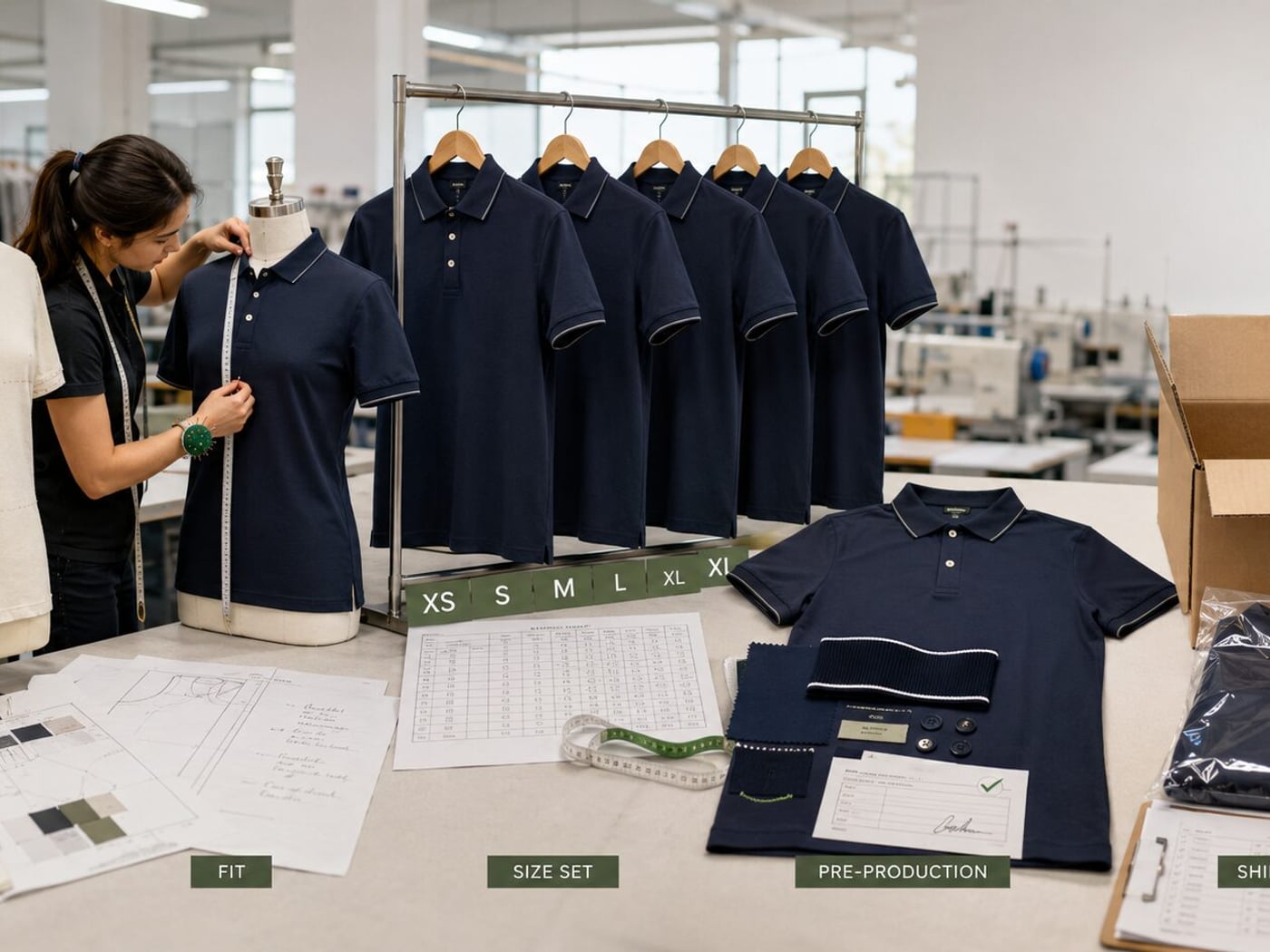
Sampling takes 7–12 days after fabric and tech pack approval, and bulk production typically runs 20–35 days after sample approval. The atelier and quality process page describes where finishing sits in that sequence, and the sampling and production service covers the sign-off. Buyers who want the questions in advance usually start with the questions buyers ask before an order.
FAQ
Do we need to specify the washing temperature?
The factory sets the parameters from its own tests, and the sheet records what was run. What the buyer must specify is the result: the hand, the appearance and the finished measurements.
Can finishing change the size of a sweater?
Yes, and milling changes it most. That is why the measurement standard has to say whether it applies before or after finishing, and why the approved sample is measured finished.
What causes shine on a pressed sweater?
Too much heat or pressure, usually on a dark shade. It is a finishing fault rather than a yarn fault, and it does not wash out, so it has to be caught at the press.
Should the care label mention the finishing route?
It should describe what the finished garment needs, which the finishing route determines. A label that promises a gentle wash on a garment that was milled hard is a label that will produce returns.
Sources: Intertek, OEKO-TEX Standard 100, Better Work, Higg, EU Regulation 1007/2011, US CBP.
Working on a knitwear project?
Let’s talk yarn, gauge and timing.
Send a reference or tech pack and we will come back with a practical development route.

