
The most useful document in a quality dispute is the one nobody looks at until the dispute begins: the approved sample, sealed, dated and signed. Everything else in the file exists to explain it.
That sounds like administration until the first disagreement. Then the question is not who remembers the shade, but which garment was approved, in which version, and whether it was washed before or after approval. Retention is a set of decisions, and the order of those decisions is what makes the file usable a year later.
Apparel approved sample retention: the short answer
Seal the sample after the wash trial, label it with the date, style, colour and version, and keep it with the measurement sheet and the test records. Keep a second copy at the factory and a photographic record of the sealed bag. Retention means the same object, unchanged, for the life of the order and its reorders.
The sections below take the decisions in order, from what gets sealed to who is allowed to open it.
Why the file decides the argument
A quality dispute is usually not a disagreement about the garment in front of the two parties. It is a disagreement about the reference. One side remembers a softer hand, the other remembers a tighter stitch, and neither can prove which was approved.
A sealed sample moves the argument to a comparison. The question becomes whether the bulk matches the sealed piece, and that is a question two people can answer in a room without reconstructing a conversation from memory. That is the whole value of retention, and it is why the seal has to be broken only for a reason.
There is a commercial reason as well as a procedural one. A supplier that keeps a sealed sample can accept a return without arguing about intent, and a buyer that keeps one can reject a lot without accusing anyone. The file turns a relationship question into a comparison, which is easier to have twice a season.
What gets sealed, and when
Not the first sample. The sealed sample should be the garment that passed everything: the fit, the colour, the decoration, and the wash trial. Sealing before the wash means sealing a garment that has not been tested, and the first thing the two parties will disagree about is what the wash did to it.
Seal one piece in each colour, and keep a second piece unsealed for handling and comparison. The unsealed piece is the one people touch; the sealed one is the one that decides. Photograph the sealed bag with the label visible, because the photograph is what circulates when the sample itself cannot.
Seal the decoration too. Where the style carries embroidery or print, the sealed piece keeps the decoration that was approved, because a strike-off on paper and a print on fabric are different documents. When a program runs more than one fabric weight, seal one piece per weight rather than one per colour.
| Record | What it proves | How to keep it |
|---|---|---|
| Sealed sample | The approved construction, hand and colour | Bagged, labelled, dated and signed by both sides |
| Measurement sheet | The dimensions and the tolerances | Versioned file, referenced in the purchase order |
| Wash record | How the sample behaved in the test | Photographs before and after each cycle |
| Test reports | Fibre, colourfastness and restricted substances | Report number on the purchase order |
| Photographs | What the sample looked like on the day | Dated, with a scale in frame |
| Approval message | That approval actually happened | Saved as a file, not left in a mail thread |
The second column is the point. Each record answers a different question, and a file with five of the six is a file with a gap that will be found at the worst moment.

What the wearer sees at month six
The customer never sees the file. They see the shirt after six months of wear, and what they notice is whether the collar still sits, whether the black has faded unevenly and whether the seam at the shoulder has held. Every one of those is an outcome the sealed sample was supposed to predict.
That is why retention is not a legal exercise. A buyer who can put the sealed sample beside a returned garment sees immediately whether the customer is describing a fault or describing normal wear. Without it, every complaint is negotiated rather than assessed.
Photographs: the version that counts
A photograph is not a substitute for the sample, and it is the only record that survives a lost bag. The useful photograph has four things: a date, a scale, the same lighting as the approval and the label visible beside the garment.
Take three: the full garment flat, the detail that was hardest to make, and the inside where the seams and the backing live. The third is the one buyers forget, and it is the one that answers a question about construction rather than appearance.
Shoot the inside as well as the outside. Seam allowance, overlock, backing and label placement are all visible from the inside, and a returned garment is usually inspected from that side first. A photograph of the inside is the quickest way to answer a construction question without unpacking the sealed bag.
Digital files and version control
Approval happens across emails, which is where versions multiply. The file version that matters is the one attached to the message that says approved, not the one that was discussed afterwards. Save that version with a date in the name and reference it in the purchase order.
Do the same for the specification. A specification that was updated after approval describes a different garment, and a bulk order checked against the updated file will fail against the sealed sample. Keep the approved version and mark later changes as a new version, even when the change looks small.
Storage, access and the handover
The sealed sample goes somewhere dry, dark and flat, because a bagged garment stored on a hanger in daylight will change colour and shape while it waits. Label the outside of the bag as well as the label inside it, so nobody has to open it to find out what it is.
Give the factory a second sealed piece. A file that exists at one site only is a file that disappears when a warehouse moves or a buyer leaves. Two copies in two places is the practical minimum, with the photographs held by both.
Record the location in the file. A sample that exists but cannot be found is the same as a sample that was lost, and a paper index with a shelf reference takes a minute to write and saves an hour of searching. Review the index once a season and dispose of anything older than the reorder window, with a note of what went.
The retention path in five steps
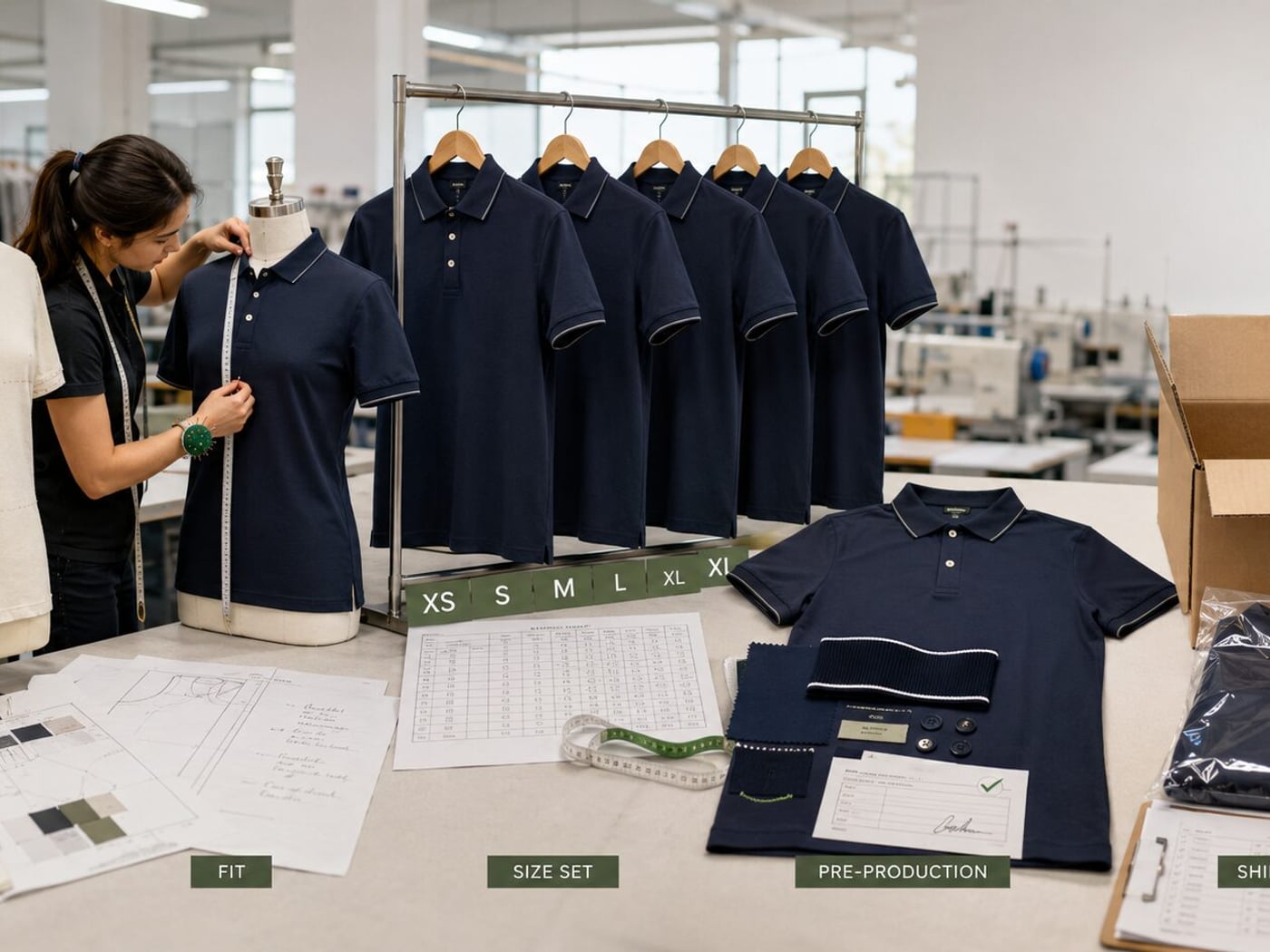
Step one: approve the sample against the measurement sheet and the test reports. Step two: wash it, and record what changed. Step three: seal, label, date and sign. Step four: photograph the sealed bag, the detail and the inside. Step five: reference the sealed sample and the file version in the purchase order, so the order points at the reference rather than at a memory.
None of those steps takes a day. Write the date on the bag in ink rather than on a printed label that fades, because handwriting survives a warehouse. Together the steps are the difference between a production service that can answer a question two seasons later and one that has to start again.
Who keeps what, and for how long
Keep the sealed sample, the measurement sheet and the test reports for as long as the style can be reordered. A reorder two years later is checked against the same file, and a file that was cleared out when the season ended cannot support it.
Keep the photographs for longer than the samples, because they take no space and they carry the date. The questions buyers ask before sampling are easier to answer when the last order left a record, and the case files show what that record looks like in practice.
FAQ
Should the sealed sample be the pre-production sample?
Yes, provided it has passed the wash trial and the measurements. The pre-production sample is the garment bulk is supposed to match, which is exactly what the seal is for.
How many sealed samples should each side keep?
One each, in different buildings, plus an unsealed piece for handling. Two copies in one place are not a backup, and an unsealed piece keeps the sealed ones from being opened for every question.
What if the factory says the sealed sample was lost?
The photographs, the measurement sheet and the test reports carry most of the evidence, and the second sealed copy usually exists. If none of them survive, the next order should start with a new approval rather than an assumption.
Do photographs replace a sealed sample?
No. A photograph proves what a garment looked like under one light on one day; it cannot prove hand, weight or stretch. Keep both, and treat the photograph as an index to the sample rather than a substitute.
Sources: Intertek, Control Union, Higg, OEKO-TEX Standard 100, EU Regulation 1007/2011 and US CBP.
Working on a knitwear project?
Let’s talk yarn, gauge and timing.
Send a reference or tech pack and we will come back with a practical development route.

