
In a collaboration, the artwork is almost never the problem. Two studios can agree a graphic in an afternoon. What fails is the path the artwork takes afterwards: which version went to the sample room, who was allowed to change it, and which of the four people copied on the email had the authority to say yes.
Collaboration knitwear approval workflow is therefore a document problem rather than a design problem. The design brief says what the piece should look like; the workflow says which file is real, and that is the part that decides whether the bulk matches the sample.
Collaboration Knitwear Approval Workflow: Who Signs, and on What
A collaboration knitwear approval workflow names one approver per decision, locks the artwork at each stage, and records every version with a date and an owner. Two brands in one garment need one signature per subject — artwork, colour, fit, labelling — rather than two signatures on everything.
That structure is what stops a late change from arriving as a preference rather than an instruction.
The Wearer Notices the Second Version
A collaboration sells to someone who knows the reference material. They have seen the original graphic, the lookbook and the announcement, and they will notice if the print on the sleeve is the earlier draft, or if the jacquard reads backwards on one panel.
That is the commercial reason for version control. The customer is not comparing the garment with a specification; they are comparing it with a memory of the campaign, and a version error reads as a fake rather than a mistake.
What a Collaboration Adds to a Normal Approval
A single-brand approval has one voice, even when that voice changes. A collaboration has two, and the two are rarely in the same meeting. One brand owns the graphic and the other owns the garment, so the artwork decision and the fit decision sit with different people who both believe they are the final approver.
That is not a conflict of interest; it is a structure that has to be drawn. Write down who owns what before the first sample, and accept that the answer will feel obvious only after it has been written.
A collaboration also multiplies the people who can ask for a change. A studio, a licensee, an agent and a marketing lead can each send a note, and each note looks like an instruction to a factory that cannot see the org chart.
Name the Approvers Before the Artwork Arrives
| Subject | Who decides | Who cannot decide |
|---|---|---|
| Artwork and placement | The brand that owns the graphic | The factory, the agent, the sales team |
| Colour and materials | The buyer, with the brand’s approval | The mill, on a nearest match |
| Fit and measurements | The buyer’s technical lead | The pattern room, after sampling |
| Labels and legal content | The brand’s compliance lead | The factory, from a previous order |
| Final bulk release | One named person per brand | Anyone copied on the thread |
The last row matters most. A collaboration with two brands and no single release authority will produce a bulk order that each side believes the other approved, and the argument arrives when the cartons are already packed.
Lock the Artwork at Each Stage
Artwork moves through at least four states: concept, placement drawing, production file and approved file. Each state should have a version number and a date, and only the approved file should reach the sample room.
Keep the states in one folder structure rather than in an email thread. A folder per stage, a read-only approved file and a log beside it is unglamorous and it works; a thread with forty attachments is how a concept drawing reaches the cutting table by mistake.
Locking means the file cannot be edited in place. A shared drive where anyone can overwrite the working file is not version control; it is a hope. Ask for the approved file to be read-only, and for the production file to carry the same version number as the approval note.
Record the Version, Not Just the Change
A revision log that says “logo moved” is not enough. The record needs the version it replaces, the reason, the person who asked and the person who approved, because in a collaboration those four facts are usually held by four different companies.
| Field | What it holds | Why it matters later |
|---|---|---|
| Version number | Sequential, never reused | Identifies the file on the sample |
| Date and stage | When it was issued and for what | Separates a sample file from a bulk file |
| Requested by | The person who asked for the change | Shows the instruction trail |
| Approved by | The named approver for that subject | Settles authority after the fact |
| Where used | Sample, bulk, or both | Explains a difference between pieces |
Sample Boards and the Physical Record
Collaborations usually need a sample board: the garment, the approved artwork, the colour dips and the label, photographed together and signed by both brands. That board is the object people point at when a question arises, and it removes the ambiguity of two separate approval emails arriving a day apart.
Build the board at the sample stage and update it at bulk release. A board that is only assembled at the end documents a decision rather than guiding one, and the difference shows in how many changes arrive after the sample.
Prove the Artwork Survives the Process
A graphic that works on a flat file may not survive a jacquard, a print or an embroidery. Each method has its own minimum line weight and its own way of distorting a shape, and a collaboration graphic is often finer than the mill is used to.
Ask for the artwork to be tested in the actual technique before the bulk file is released: a knitted swatch for jacquard, a printed panel for screen or digital, an embroidered strike-off for a logo. Approve that physical proof, not the file, and keep it with the version record.

Labels and Legal Content
A collaboration puts two brands on one label, and that raises questions the factory cannot answer. Which name goes first, which trademark symbol appears, whose care instructions apply, and which fibre content is declared are decisions for the brands and their advisers.
Two brands on a label also means two sets of expectations about size and fit, and those have to be reconciled before the grade is set. A collaboration that sells into both brands’ channels needs a size chart both can publish, not two versions of the same garment.
Fibre content follows the destination’s rules, which in the European Union means Regulation 1007/2011, and origin marking matters for the United States. Where the programme uses OEKO-TEX Standard 100, GRS or RWS fibre, the certificate reference belongs in the same file, with traceability documents where available. None of that is a marketing decision, and none of it should be settled by a label designer working alone.
Run the Approval in Sequence
One sequence works for most collaborations. Agree the approvers and the version format before the first sketch. Issue the placement drawing and approve it. Test the technique on a physical swatch. Approve the sample with the artwork and the fit together. Lock the bulk file, then release the order.
Each step produces one document and one signature. When something goes wrong three months later, the sequence answers the question that always comes first: which version was approved, and by whom.
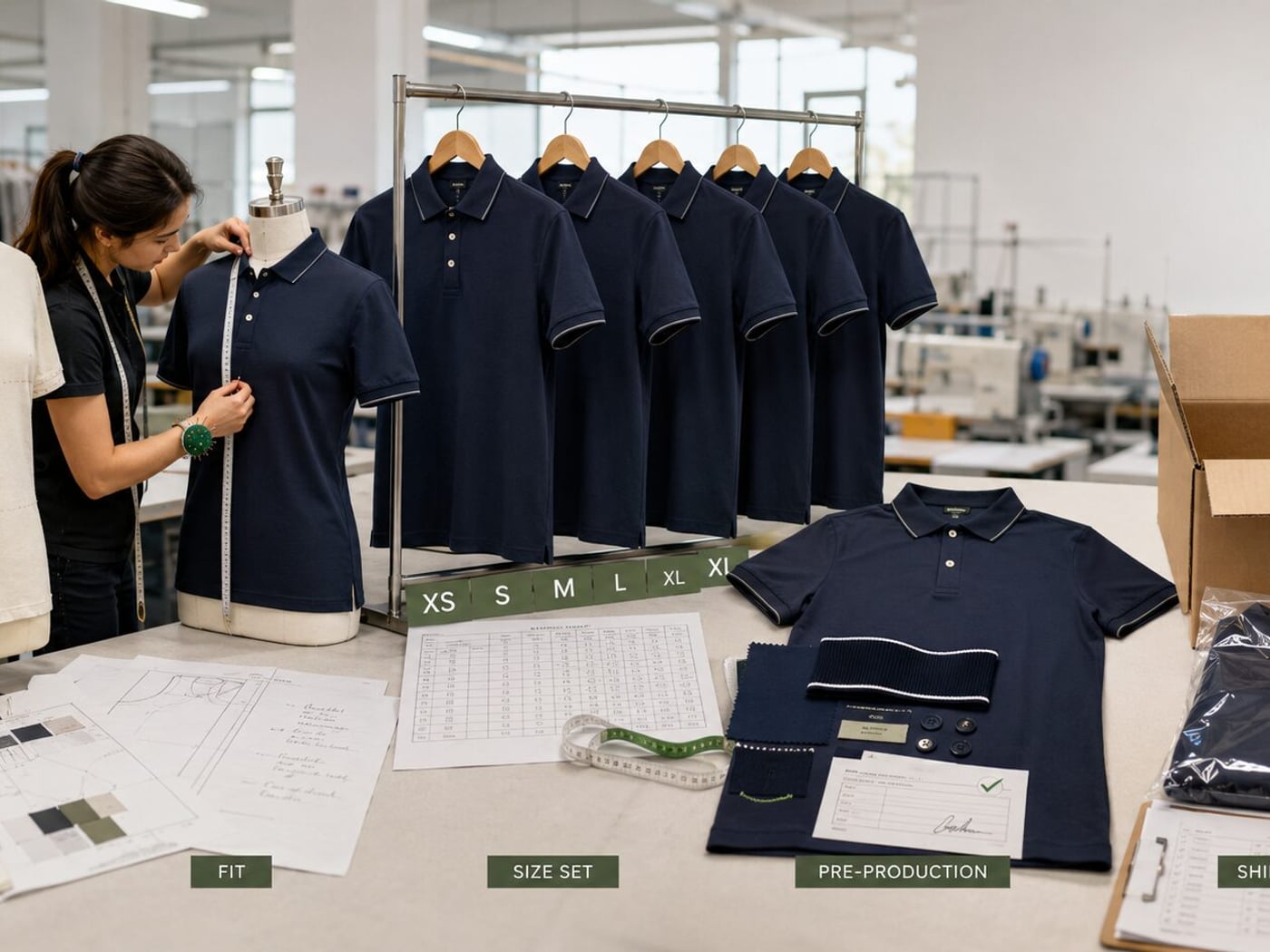
The collaboration knitwear programme runs on that sequence, and the sampling and production service shows where each approval sits. Sampling takes 7–12 days after fabric and tech pack approval, bulk production typically runs 20–35 days after sample approval, and the minimum order is 300 pcs per style. The atelier and quality process page describes how version records are held with the order.
FAQ
Can the two brands approve different parts?
Yes, and they should. Assigning artwork to the brand that owns it and fit to the buyer’s technical lead is faster than requiring both signatures on every decision, provided the split is written down.
What if the factory receives artwork from two sources?
Then the version record decides. Only the file that matches the approved version and the approval note should enter production, and anything else should be returned to the named approver rather than reconciled in the sample room.
Do we need a physical proof for a simple graphic?
For a knit, print or embroidery detail, yes. A file cannot show how a stitch or an ink edge behaves, and the physical proof is the only thing both brands can sign with confidence.
Who owns the artwork after the collaboration ends?
That is a legal question between the brands, not a production one. Agree it in the collaboration agreement, and make sure the factory knows whether it may reuse a file or must return it.
Sources: Intertek, OEKO-TEX Standard 100, Better Work, Higg, EU Regulation 1007/2011, US CBP.
Working on a knitwear project?
Let’s talk yarn, gauge and timing.
Send a reference or tech pack and we will come back with a practical development route.

