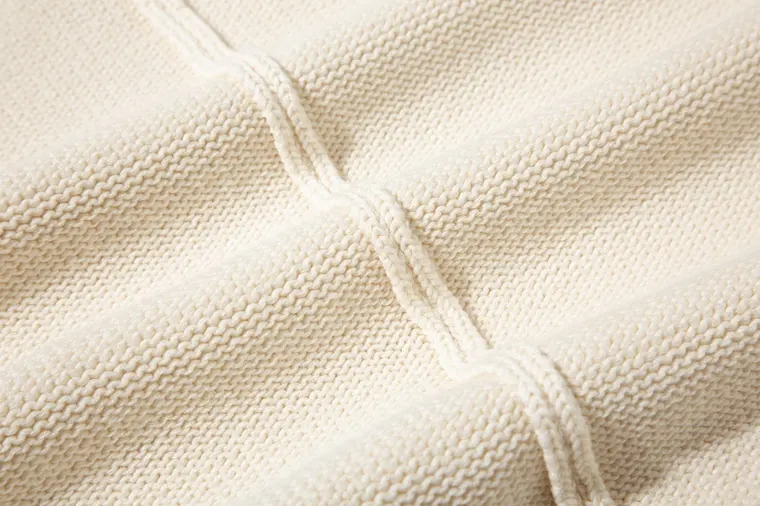
Two quotes for the same sweater: €31 cut-and-sew, €39 fully fashioned. The difference is about 25%, and it is not margin. It is machine time, linking labour and a lower tolerance for error — three costs that appear nowhere on the quote sheet but decide the price.
Fully fashioned is worth understanding before you choose it, because the premium buys specific things: a cleaner armhole, less bulk at the seam, and a shape that holds after washing. It does not automatically buy a better garment, and on the wrong style it buys cost with no visible benefit.
What “fully fashioned” actually means
In a fully fashioned garment, each panel is knitted to its final shape. The machine increases and decreases stitches so the panel widens at the chest and narrows at the waist, and the armhole curve is knitted rather than cut. The panels are then linked — a stitch-by-stitch joining process — rather than sewn with a seam allowance.
Cut-and-sew works the other way: a panel or a tube is knitted to a width, then cut to the pattern and sewn. It is faster, and it wastes yarn at the cut edges, but the machine time per panel is lower and the skill requirement at making is different.
| Factor | Cut-and-sew | Fully fashioned |
|---|---|---|
| Knitting time per panel | Lower; constant width | Higher; shaping adds transfers and cycles |
| Yarn waste | Higher at cut edges | Lower; panels are knitted to size |
| Making | Sewing with seam allowance | Linking, often hand-fed |
| Seam bulk | Visible, especially at the armhole | Minimal; the join follows the stitch |
| Shape stability | Depends on seam and fabric | Better; the shape is in the panel |
| Defect tolerance | A cut can remove a fault | A fault in the panel is a reject |
| Cost per piece | Lower | Higher, typically by a meaningful margin |
Where the extra cost sits
- Machine time. Shaping means more passes and more transfers. On a fine gauge the difference in minutes per panel is small in absolute terms and large as a share of the piece cost.
- Linking labour. Linking is skilled work. It is slower than overlocking and it cannot be rushed without showing at the seam.
- Rejection rate. A dropped stitch or a shaping error cannot be cut away. The panel is scrap, and that cost is spread across the run.
- Planning. Shaped panels have to be knitted in sequence and matched to sizes; the scheduling is less flexible than cutting from a roll.
Against that, the yarn saving is real. On a coarse gauge, the waste from cutting can be significant, and fully fashioned recovers part of the premium there. On a fine gauge the yarn saving is smaller and the labour premium dominates.
Where it pays back
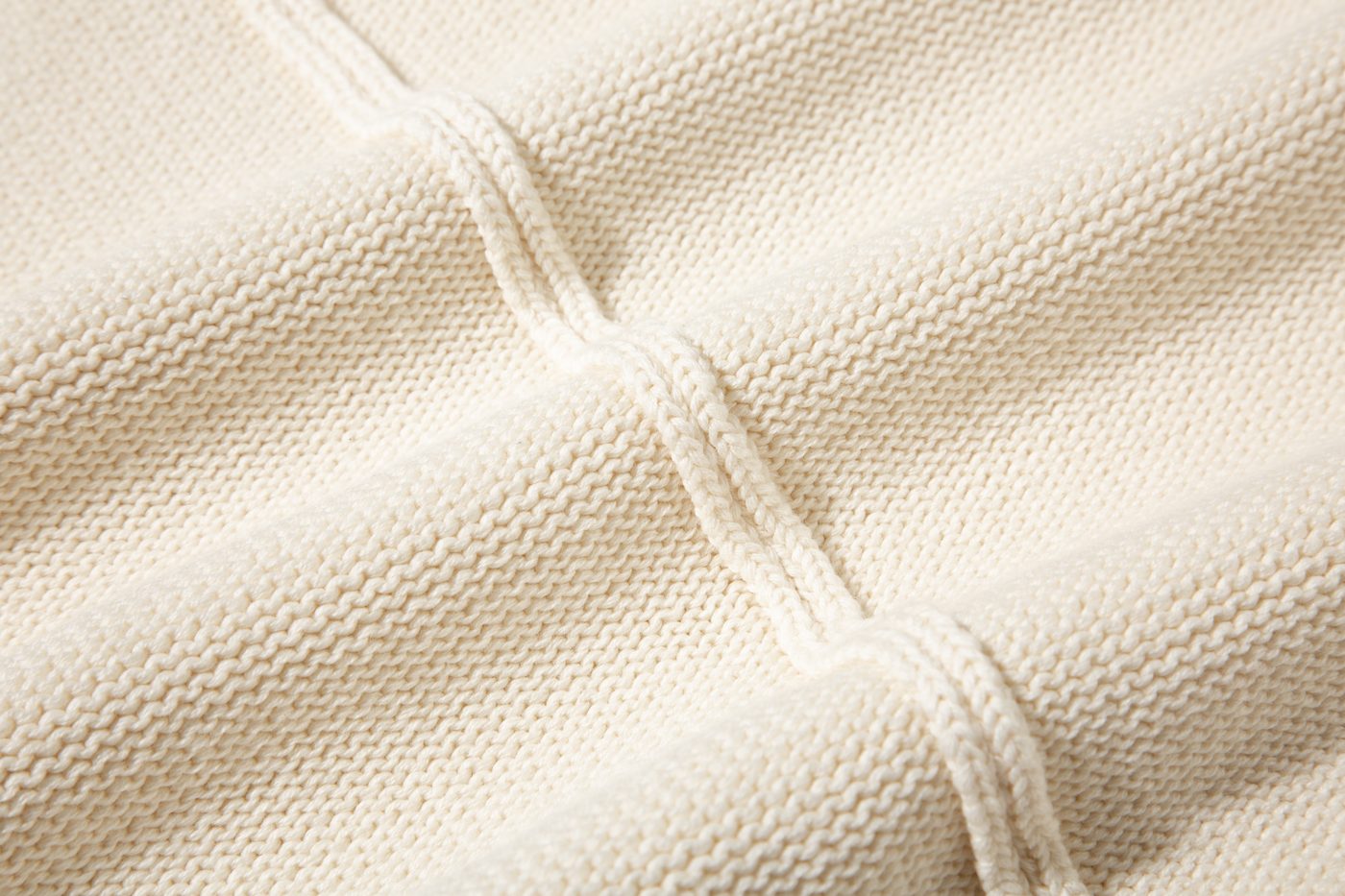
- Set-in sleeves and shaped armholes. The join sits flat, which is exactly where cheap knitwear looks cheap.
- Fitted or tailored silhouettes. The shape is knitted in, so it survives washing better than a sewn curve.
- Fine-gauge premium knits. The seam is visible at this gauge; linking is part of the product.
- Light colours and close-fitting styles. Seam bulk shows through, and a linked seam removes it.
It pays back less on boxy, oversized shapes where the armhole is straight and the seam is not on show, and on heavy gauges where the seam is hidden by the fabric’s own bulk.
How to check a fully fashioned sample
- Measure after linking, not before. Linking pulls the panel slightly; the measurement that matters is the joined garment.
- Look at the armhole from the inside. A linked armhole should show a continuous row, not a seam allowance folded back.
- Check panel length consistency. Shaped panels are knitted in sequence; a variation of more than a few millimetres between left and right front suggests a machine or tension issue.
- Wash it. Fully fashioned holds shape better, but the yarn still shrinks. Compare the washed measurement with the spec, not with the dry sample.
- Check the shoulder join. This is where linking skill shows first: a puckered or wavy shoulder will not press out.
What to put in the tech pack
Fully fashioned styles fail when the shaping is left to the factory. The pack should state the shaping plan — where the increases and decreases fall, the armhole curve, the panel count — and the linking standard for each seam. Our sweater tech pack checklist covers the pages that carry this, and the atelier page describes the gauge band and shaping we develop with our knitting partners.
If the design is a first sample, ask for a panel photo before linking. It is the cheapest moment to catch a shaping error, because the panel can still be re-knitted rather than the garment remade.
When to choose it
| Situation | Recommendation |
|---|---|
| Premium fine-gauge knit, visible seams | Fully fashioned |
| Oversized boxy shape, heavy gauge | Cut-and-sew is usually enough |
| First order with a tight budget | Cut-and-sew, unless the seam is the product |
| Repeat order of a proven fit | Fully fashioned, if the fit depends on the armhole |
| Jacquard or intarsia panels | Fully fashioned where the pattern has to align at the seam |
FAQ
Is fully fashioned the same as seamless?
No. Fully fashioned garments are knitted to shape and then linked; seamless garments are knitted as a tube with no joining at the side. Both reduce seam bulk, but they are different constructions.
Does fully fashioned mean better quality?
It means a different construction with less seam bulk and better shape stability. Quality still depends on the yarn, the gauge, the finishing and the inspection.
Can fully fashioned be done at 3 gauge?
Yes, but the yarn saving is larger and the shaping is coarser. At heavy gauges the cost premium is often offset by reduced cutting waste.
Why is the sample so much more expensive than bulk?
Because a single shaped panel consumes a machine slot and a linking session that would otherwise be shared across a run. The sample premium is labour, not material.
Sources: ISO 8559-1 (size designation) and ISO 6330 (washing procedures).
If you are choosing between the two constructions, send the shape and the gauge. We will quote both and tell you where the premium shows on the garment — and where it does not.
Working on a knitwear project?
Let’s talk yarn, gauge and timing.
Send a reference or tech pack and we will come back with a practical development route.