
The test report landed two days after the container sailed. The shirts were at sea, the buyer’s quality team had the paperwork, and the one result that mattered — colourfastness to washing — had come back below what the brief allowed. Nothing could be done except book a retest and hope the next lot behaved, which is what happens when testing is treated as a final gate rather than as a scheduled step.
An apparel third party testing timeline is a plan rather than a formality. It places each test at the stage where the result can still change a decision, and it leaves calendar room for the retest that a failure will require.
What Is a Realistic Apparel Third Party Testing Timeline?
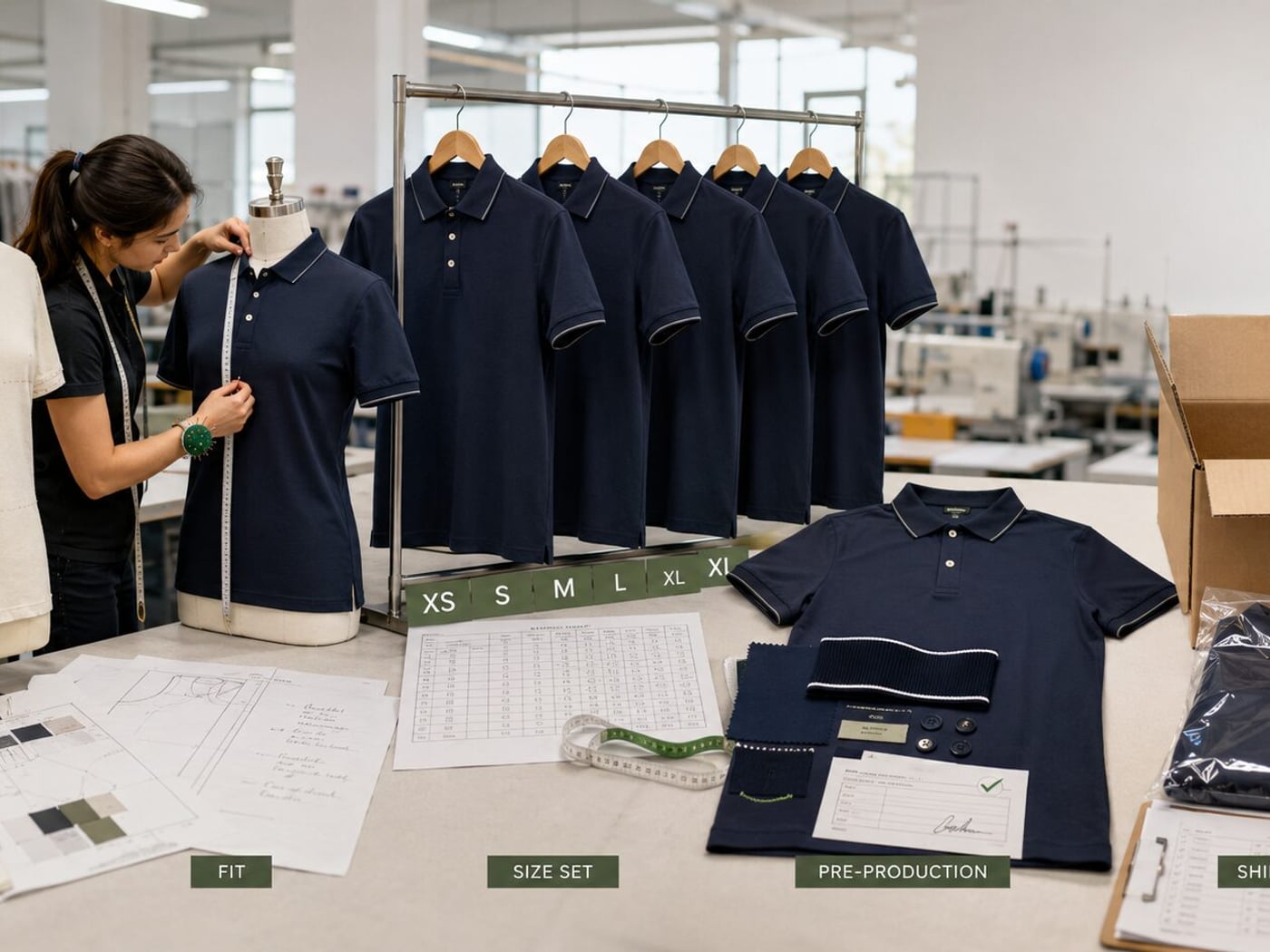
Third-party apparel testing belongs at four points: on the yarn or fabric before bulk, on the sample before approval, on pre-production materials, and on the bulk shipment. The earliest point that can answer a question is the least costly place to ask it, and the last point before shipping is the most expensive.
Most programmes test at one point only, usually the sample, and treat the report as a pass mark for the whole order. That works until something changes between the sample and the bulk: a different dye lot, a substituted yarn, a finishing step moved to another line. The report then describes a garment that no longer exists in the shipment.

The Report That Arrived After the Container Sailed
That failure was not a lab problem. The lab did what it was asked and reported on time. The programme had booked the test against the shipment date rather than against the production schedule, so the result arrived with nothing left to act on.
What changed afterwards was the order of operations. The test was moved to the fabric stage, the report was made an approval condition rather than a shipping formality, and the calendar gained a stated buffer for a retest. None of that adds a step to production; it moves a step earlier, where a result can still redirect the dye lot or the finish.
Four Points Where a Test Can Change a Decision
Each stage answers a different question, and each has a different cost when it goes wrong. Testing at the yarn stage answers whether the material is what the order says it is. Testing at the sample answers whether the construction will meet the standard. Testing at pre-production answers whether the bulk materials match the approved sample. Testing at bulk answers whether the shipment matches what was approved.
| Stage | What it can establish | What a result can still change |
|---|---|---|
| Yarn or fabric | Fibre composition, yarn count, shrinkage potential | The yarn lot, the spinner, the construction |
| Sample | Colourfastness, pilling, dimensional stability, pH | The finish, the dye route, the stitch density |
| Pre-production | That bulk materials match the approved sample | Which rolls or lots go into production |
| Bulk | That the shipment matches the approved standard | Whether the shipment ships, is reworked or is rejected |
Read the table from the bottom up. The later the stage, the fewer options remain, and the more expensive the same finding becomes. A shrinkage result at yarn stage is a conversation; the same result at bulk is a commercial dispute. A programme with four test points does not do four times the work; it asks the same questions earlier, when an answer can still change a dye lot rather than a shipping date.
Building the Calendar Backwards
Start from the delivery date and subtract the fixed intervals: the freight booking, the inspection window, the packing and finishing allowance, the bulk production window, and the lab’s quoted turnaround. What remains is the latest date on which a sample can be sent for testing and still return in time to act on.
The lab turnaround is the number buyers underestimate, because it is quoted for a standard service and does not include sample preparation, courier time or the queue at the start of a season. Ask for the turnaround in writing, add the transit, and then add a buffer for a retest that would need a fresh sample from the same lot. A timeline with no buffer is a timeline that becomes a crisis on the first failure.
Where the Testing Budget Actually Goes
Testing cost is not a single line. It builds from the number of test methods, the number of distinct fabrics, the number of colourways within each fabric, and the number of retests. Order quantity barely moves it, which is why a 300-piece run and a 3,000-piece run often carry similar lab bills.
That structure has a practical consequence for planning. Consolidating fabrics and colourways reduces the bill more than reducing the test list, and testing a base fabric once rather than per colour can be sound when the colours come from the same dye route. Where each colour is dyed separately, each colour is its own evidence.
The last component is the one nobody budgets for: the retest. When a result fails, the fix usually needs a new sample, which means a new courier, a new test fee and a delay that may consume the buffer. A programme that budgets for one retest per season is rarely surprised; one that budgets for none pays for it in air freight.
How to Write the Testing Plan Into the Purchase Order
A testing plan that lives in an email does not survive a change of buyer. Write it into the purchase order as a line of its own: which methods, on which materials, at which stage, who pays, and what happens if a result falls outside the agreed limit. The clause does not need to be long, but it does need a stated acceptance limit, because a requirement to meet the buyer’s expectations is not a condition a lab can test.
Once it is in the order, the calendar follows from it. The factory knows when to hold material back for sampling, the lab knows what it is receiving and when, and the buyer knows which report closes the order. That is a dull paragraph in a commercial document, and it is the difference between a timeline that holds and one that depends on somebody remembering.
Retests, Corrective Action and the Reorder File
A failed result is useful only if it names the cause. “Colourfastness failed” is not actionable; “colourfastness to washing at the stated temperature failed on the darker shade, which was dyed on a different route” tells the mill what to change. Ask the lab for the method, the condition and the result, not just a pass or fail.
Then keep the file. Approved test reports, the sample they refer to, the material lot and the corrective action belong together, because the next order will be judged against them. Our knitwear manufacturer questions page covers the questions buyers raise when a report and a sample disagree.
Bulk, Inspection and Reorder
Testing sits alongside inspection rather than replacing it. Minimum order is 300 pcs per style. Sampling runs 7–12 days after fabric and specification approval, and bulk production typically runs 20–35 days after sample approval. Inspection is carried out to AQL 2.5 unless the buyer’s own plan replaces it, and the services page sets out how sampling, production and inspection fit together.
Our factory works to the buyer’s testing plan where one exists and to AQL 2.5 where it does not. What matters is that the plan is agreed before the first sample is cut, so the calendar has room for the result and the result has somewhere to go.
FAQ
Is factory testing enough without a third-party lab?
Factory inspection checks workmanship, measurements and appearance. It cannot produce an accredited fibre composition or colourfastness result, and most buyers need that evidence for their own compliance file. The two activities answer different questions and do not replace each other.
Do repeat orders need testing again?
Usually yes, at least on the material. A repeat order from a new dye lot or a substituted yarn is a new material even when the style is unchanged, and the risk that made the first test necessary has not gone away. A reduced test list on a repeat order is a reasonable compromise; no test at all is a bet.
Does every colour need its own test?
Not always, but the assumption should be checked rather than assumed. Colours dyed on the same route from the same base can often be covered by one report, while a dark shade dyed separately may need its own. Ask the lab what the report will cover before the samples are sent.
What is the minimum order and lead time?
Minimum order is 300 pcs per style. Sampling takes 7–12 days after fabric and specification approval, and bulk production typically takes 20–35 days after sample approval, with inspection to AQL 2.5 unless the buyer’s plan replaces it.
Sources: Intertek testing, Control Union certification, Higg, OEKO-TEX Standard 100, EU Regulation 1007/2011, US CBP informed compliance.
Working on a knitwear project?
Let’s talk yarn, gauge and timing.
Send a reference or tech pack and we will come back with a practical development route.


