
Imagine a sample that meets a brief for softness but fails the fit review. The brief had asked for a premium soft hand, and the mill delivered a brushed, limp jersey that felt lovely on the table and collapsed at the shoulder after a day of wear. Nobody had said anything about recovery, weight or how the fabric should hang, because the brief had used a word instead of a description.
Last modified: November 23, 2026
Hand feel is the hardest property to pin down in a fabric hand feel specification and the easiest to argue about, because every buyer has a different hand in mind when they write soft. The remedy is not a better adjective but a short list of properties, each with a reference and a stated tolerance.
How Do You Write a Fabric Hand Feel Specification?
A fabric hand feel specification converts touch into describable properties: surface, drape, weight, stretch and recovery, each tied to a reference garment or swatch and a stated tolerance. It replaces adjectives such as soft and premium with comparisons a mill can act on and a buyer can verify at approval.
The work is mostly subtraction. A brief that asks for soft, smooth, premium and comfortable is asking for four things that can pull in different directions. A brief that asks for a dry surface, a moderate drape, a mid weight and good recovery is asking for a fabric that can actually be knitted.

Five Properties That Describe a Hand
Five properties cover most of what a buyer means by hand, and each can be described without instruments. They are not independent: changing the weight changes the drape, and adding a finish changes the surface, so a brief should say which property matters most when the trade-offs arrive.
| Property | What it describes | How to compare it | Where it goes wrong |
|---|---|---|---|
| Surface | Friction, hairiness, whether the face is dry or slick | Stroke with the fingertips and look under raking light | Read as softness when it is only smoothness |
| Drape | How the fabric falls under its own weight | Hold a swatch by one edge and watch the fold | Confused with weight |
| Weight | Mass per area, and the sense of substance | Weigh a known area of the same size | Judged by thickness instead |
| Stretch and recovery | How far it gives and whether it returns | Pull across and along, release, watch | Tested in one direction only |
| Loft | Thickness and the air the structure traps | Pinch between finger and thumb, compare swatches | Mistaken for warmth on its own |
Read the table as a checklist for the brief rather than a test protocol. A buyer who states a position on all five has described a fabric; a buyer who states two has described a preference.
Reference Garments Beat Adjectives
The most useful sentence in a sourcing brief is a comparison: this hand, but lighter, or this surface, but with more recovery. A reference garment gives the mill a physical target, and it gives the buyer something to point at when the sample arrives.
Send the reference with the brief, not after the first sample. Photograph it, measure it, and note which property is the one that must not change. A reference without a priority invites the mill to match the average and miss the point.
Turn “soft” and “smooth” into approval instructions
Softness and smoothness belong on separate lines of the fabric hand feel specification. For softness, ask the reviewer to bend or compress the swatch and compare the resistance to the approved fabric. For smoothness, compare how the skin-facing surface feels when stroked in the same direction. A lofty, soft fabric can still have a rougher surface than a firmer sample. Write which face is being assessed and whether the observation is made before or after the intended finish and care treatment.
Give the mill a physical target and, if one is available, a physical boundary sample. An example approval note might read: Skin-facing side must feel no rougher than swatch R under a light stroke along the length. When folded over the palm, the fabric should bend as readily as swatch R. Swatch B shows the dry, boardy handle to reject. Repeat the comparison on a sample washed and dried to the proposed care instructions. Attach the physical references or keep matched copies at buyer and supplier, using the same identifiers on the spec and the sample tags.
When a lot sits close to the boundary, exchange the same cut of fabric with the supplier. Lay the pieces flat, match orientation and feel the correct side. Have reviewers record observations separately before discussing a result; this makes disagreements about which property changed easier to resolve. If stiffness needs an instrumental result, ASTM’s fabric stiffness method addresses bending properties. It does not replace an approved reference for surface touch or overall hand.
Drape and Weight Are Not the Same Thing
Weight is how much the fabric weighs; drape is how it behaves under that weight. A heavy fabric can drape softly if it is loosely structured, and a light fabric can stand away if it is tightly knitted. Buyers who ask for a heavier hand often want more drape, and a heavier fabric is not the only way to get it.
That confusion costs sample rounds. If the real requirement is that the garment should fall rather than cling, say so, and let the structure and the gauge be chosen around that. Weight is a consequence, not always the cause.
Matching Hand Feel to the Garment
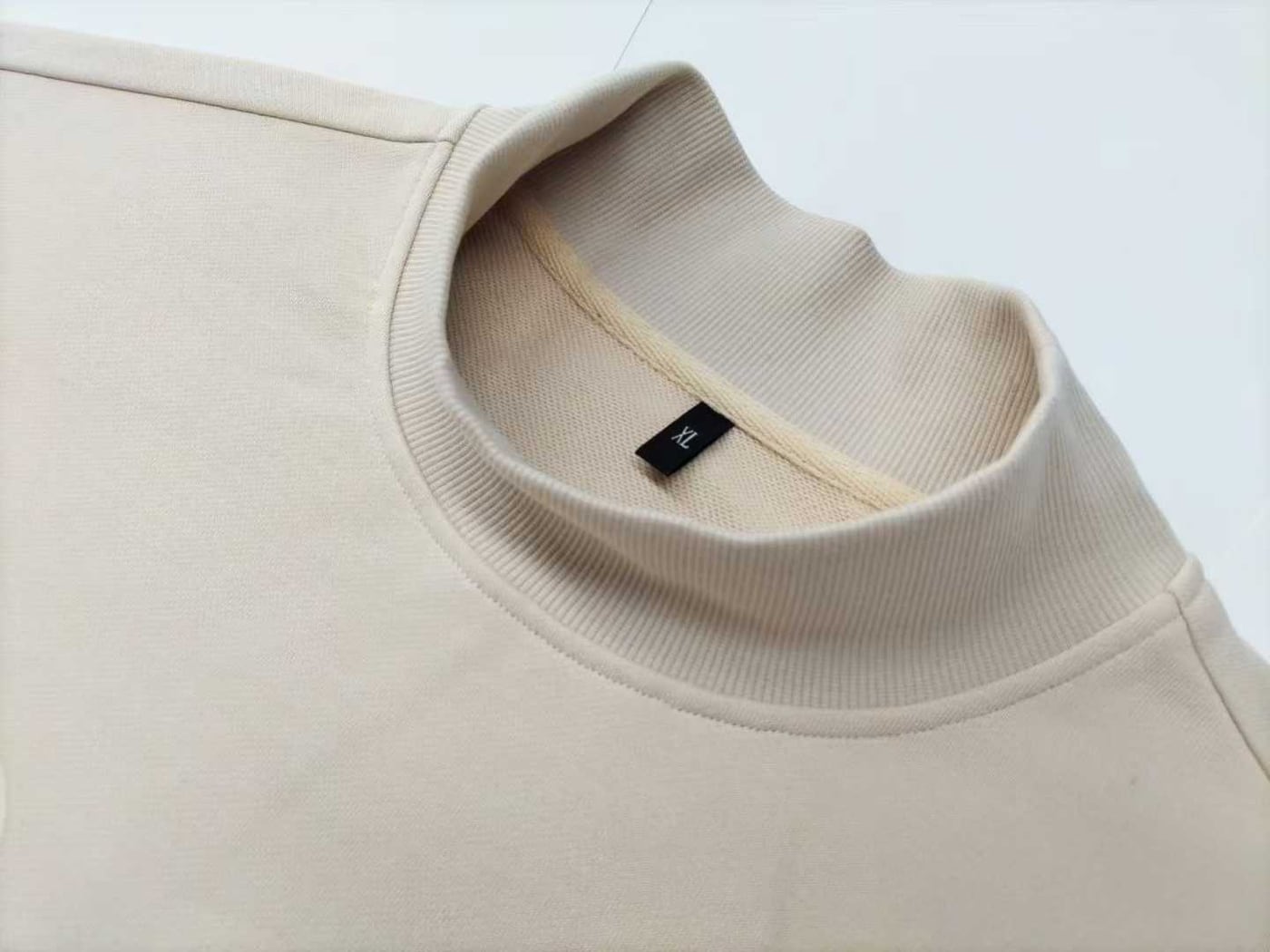
Hand feel is not a single target across a range. A T-shirt, a hoodie and a cardigan each need a different balance, and a fabric that makes a good boxy tee can make a poor hoodie because the construction uses it differently. Set the target per style, even when the range shares a yarn.
The practical order is to describe the garment first and the fabric second. A close-fitting rib top needs recovery and a surface that does not cling; a loose oversized tee needs drape and enough weight to hang straight; a hoodie needs substance and a structure that holds its shape at the hood. Each description points to a property that takes priority when the trade-offs arrive.
Where a range shares one fabric across several styles, that priority has to be written per style or the shared fabric will suit one garment and fight another. It is usually better to choose the fabric for the hardest garment in the range and adjust the others around it.
What You Can Check Without Instruments
Most hand-feel checks need a table, a window and two people. Lay the swatch flat and look across it at a low angle to see the surface. Hang it over the edge of the table for an hour to see the drape. Pull it gently in both directions and release it to see the recovery. Compare it against the reference with both in the same light.
Write down what you saw rather than what you felt. A note that says the surface is drier than the reference and the drape is softer is repeatable; a note that says the hand is nicer is not, and it will not survive the next buyer, the next mill or the next season.
Sending the Brief: A Sequence
The order matters, because each step narrows the next:
- Name the garment and how it will be worn, including the layer beneath it.
- State the five properties, with a priority when they conflict.
- Attach the reference garment or swatch and say which property must hold.
- Ask for two candidates rather than one, with the difference explained.
- Wash both to the intended care label and compare again.
- Approve the fabric and the care label together.
Step four is the one that produces useful information. A mill asked for one fabric will give you its closest match; a mill asked for two will show you the trade-off it would otherwise make silently.
Bulk, Inspection and Reorder
Bulk runs on the approved fabric and care route. Minimum order is 300 pcs per style. Sampling runs 7–12 days after fabric and specification approval, and bulk production typically runs 20–35 days after sample approval. Inspection is carried out to AQL 2.5 unless the buyer’s own plan replaces it.
Hand feel is not usually an inspection criterion, and pretending otherwise creates disputes. What inspection can check is the fabric reference, the weight and the finish against the approved sample. Keep a sealed swatch with the order file so that a reorder can be compared physically, and treat a change of yarn lot as a reason to compare again.
The order file should carry three things: the fabric reference, the sealed swatch and the priority note that says which property must not move. When a mill changes a yarn lot, compare the new swatch against the sealed one before production rather than after delivery, and check recovery first, because it is the property most likely to shift and the hardest to see on a table.
Where the garment is a knit, the relationship between knitwear manufacturer questions and hand feel is worth understanding before the brief is written, because gauge choices move the hand more than most buyers expect. A case study from a previous programme is often the quickest way to show what a stated hand looks like in production, and the contact page is where a brief and a reference can be sent together for review.
Questions about communicating fabric hand feel
Can hand feel be measured objectively?
Partly. Weight, thickness, stretch and recovery can be measured, and surface friction can be assessed with instruments in a laboratory. What remains subjective is whether a buyer likes the result, so the specification pairs measurements with a reference and a stated priority.
What is a good reference for a hand feel brief?
A garment the buyer already sells, or a swatch from a previous order, provided it is clean and has been washed as the customer would wash it. A worn garment is a better reference than a new one for anything involving drape and surface.
How many fabric options should we ask for?
Two is usually right. One gives the mill no room to explain a trade-off; three or more turns the sampling budget into a comparison exercise. Ask for two with a note on how they differ.
What is the minimum order and lead time?
Minimum order is 300 pcs per style. Sampling takes 7–12 days after fabric and specification approval, and bulk production typically takes 20–35 days after sample approval, with inspection to AQL 2.5 unless the buyer’s plan replaces it.
Sources: OEKO-TEX Standard 100, EU Regulation 1007/2011, US CBP informed compliance, Better Work, Intertek testing, Higg.
Working on a knitwear project?
Let’s talk yarn, gauge and timing.
Send a reference or tech pack and we will come back with a practical development route.


