
A pre-production sample and the first bulk garment are the same design and rarely the same garment. One is knitted and made up by a sample machinist, in sample-room yarn, often finished by hand. The other is made by a line operator, in a bulk lot, on a machine that has been running for hours, and it is pressed in a batch with thirty others.
That difference is not a defect in either garment. It is why a signed PP sample cannot, by itself, release a bulk run, and why first production garment approval exists as a separate gate with its own record.
First production garment approval: the short answer
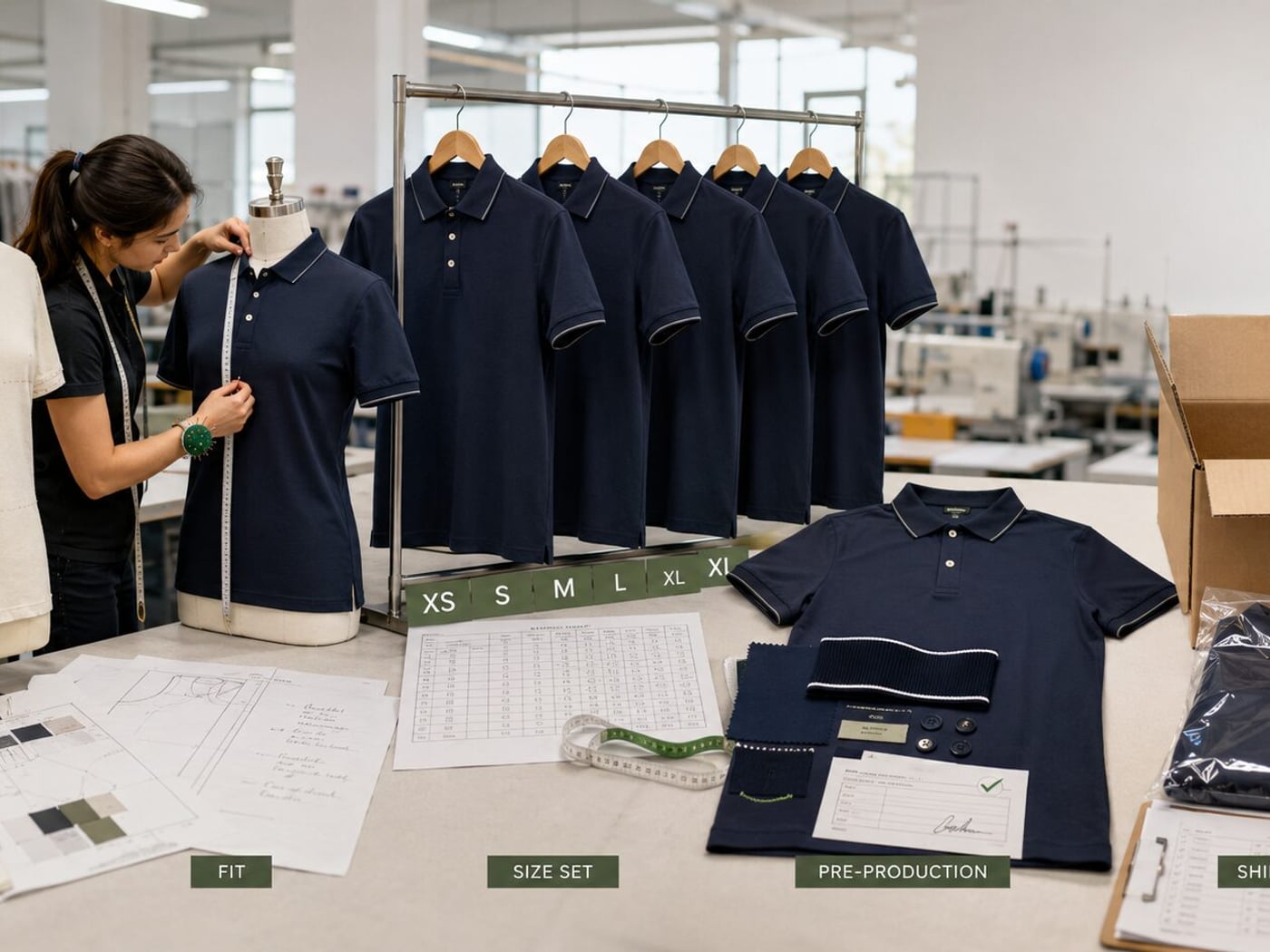
First production garment approval is a sign-off on the first garment made on the bulk line, compared against the approved PP sample and the measurement sheet. It confirms yarn, stitch, make-up, trims, labels and finishing before the rest of the run is made, and it is recorded separately from the final inspection.
It is not a repeat of the sample approval. It is a check that the line is making what the sample room approved, at the moment when stopping is still affordable.
Five ways the first bulk garment differs
Even when nothing is wrong, five things have changed between the sample and the line. The yarn lot is different, so the shade and the handle can shift slightly. The operator is different, so the seam allowance and the tension can shift too. The machine has been set by someone else. The trims come from the bulk order rather than the sample box. And the finishing happens in a batch, under time pressure, rather than one piece at a time.
Any one of those can move a garment by enough to fail a measurement or read as a different surface. Four of the five cannot be checked on a sample, because the sample never had them.
Why the sample room is not the line
A sample room is built to make one garment well. A line is built to make many garments the same. The skills are different, and the incentives are different: the sample room is judged on whether the sample is right, the line on whether the run finishes on time.
That is not a criticism of either. It explains why the first garment deserves its own inspection. The line is doing something the sample room never did, and the person closest to the comparison is the one who notices the drift.
The decision path: first panel, first garment, release
First panel. Check the first knitted or cut panel before assembly: stitch, width, colour and weight. A panel that is wrong is cheap to fix; a garment made from it is not.
First garment. Check the first complete piece off the line against the approved sample and the measurement sheet. Compare the front, the back, the trims, the labels and the finish, then measure it in the state the sheet names.
Release. Sign the record, note any deviation and the corrective action, and only then let the run continue. If the first garment fails, the line stops until the cause is fixed and a second garment is approved.
The gate costs a few hours at the start of a bulk window that typically runs 20–35 days after sample approval. Finding the same fault at the final inspection at AQL 2.5 costs a rework, a re-inspection and, often, a shipping decision made under pressure.
What to compare, side by side
The comparison is only meaningful if it is made against the approved sample rather than against memory. This is the table we run.
| Dimension | PP sample | First production garment | What to check |
|---|---|---|---|
| Yarn | Sample-room lot | Bulk lot | Shade, handle and stitch against the standard |
| Machine setting | Set by the sample room | Set by the line technician | Gauge, stitch length and panel width |
| Make-up | One operator, one piece at a time | Line operator, paced work | Seams, edges, trims and symmetry |
| Trims and labels | From the sample box | From the bulk order | Button or zip match, label placement and wording |
| Finishing | Hand finished | Batch pressed and packed | Surface, measurements and shape after pressing |
| Measurement | Relaxed, before wear | Relaxed, from the batch | Same points, same state, same tool |
Read the table twice: every row is a place where a garment can be right in the sample and different in bulk without anyone making a mistake.
Who signs, and on what record
The record is the part that makes the gate real. Without it, the approval is a conversation on a factory floor, and the conversation is not available to the buyer three weeks later.
| Field | What to record | Why it matters |
|---|---|---|
| Style and order | Style code, order number, colour, size | Ties the garment to the run |
| Date and line | The day, and the line or unit | Locates the batch if a fault repeats |
| Comparison | What was compared, and against which sample | Shows the standard that was used |
| Measurements | Recorded values, with the state stated | Separates growth from error |
| Photographs | Front, back, detail, beside the sample | Makes the comparison reviewable |
| Deviations | What differed, and whether it was accepted | Prevents a silent change becoming the standard |
| Signatures | Factory and buyer, dated | Fixes the release decision |
The checks that only work on a real garment
Some checks cannot be made on a sample because the sample does not carry the conditions. Seam behaviour under a paced operator, the way a batch press flattens a stitch, the label sewn with the bulk thread, the button from the bulk order that is a shade off the sample button: these are the faults that reach a shop rather than a sample room.
A production programme that includes a first-garment gate catches them at the start of the run, when a correction is a machine setting rather than a rework. The questions buyers ask before sampling cover the same territory from the buyer’s side, and they are worth asking before the first order rather than after it.
What to do when the first garment is not the sample
Stop, and find the cause rather than the symptom. A measurement that has moved is usually a machine setting or a panel width. A surface that has changed is usually the yarn lot or the pressing. A trim that is wrong is usually a substitution made on the bulk order without a note.
Then decide whether the deviation is acceptable, and record the decision. A deviation that is accepted silently becomes the new standard by default, which is how a range drifts between the first order and the third.

Where the record lives
The record belongs with the approved sample, not in an email thread. The next order will compare its first garment against the same sample, and the file is what makes that comparison possible a year later. The case studies show how often a drift traces back to a document rather than a machine, and the pattern holds here too: the garment was made correctly to a standard nobody wrote down.
When the first garment is approved and the record is filed, the run continues with a standard rather than an assumption. That is the whole value of the gate, and it is why it sits at the start of the window rather than at the end.
If the release is still a verbal agreement, ask the factory two questions before the run starts: what will be compared, and who will sign. A factory that can answer both has a gate; one that cannot has a conversation. Send the style and the approved sample and we will confirm which points are checked and what the record will contain.
FAQ
Is first-production approval the same as the final inspection?
No. First-production approval happens at the start of the run, before the rest is made; the final inspection at AQL 2.5 happens at the end. Both are gates, and they catch different faults.
Do we need to attend the first-garment check?
Not always in person, if the factory photographs the comparison and records the measurements against the approved sample. What cannot be delegated is the standard: the sample and the sheet have to be the ones the buyer approved.
How long does the gate add to the schedule?
A few hours at the start of the bulk window. Against that, a fault found at the final inspection costs a rework and a re-inspection, and both sit after the published 20–35 day window rather than inside it.
What if the bulk yarn is a slightly different shade?
Check it against the approved standard under the agreed light, as you would a lab dip, before the first garment is made. A shade difference is easier to judge on yarn than on a finished run.
Sources: Intertek, OEKO-TEX Standard 100, Better Work, Higg, EU Regulation 1007/2011 and US CBP.
Working on a knitwear project?
Let’s talk yarn, gauge and timing.
Send a reference or tech pack and we will come back with a practical development route.

