
The lot was held for a week over two centimetres. The buyer measured the chest two and a half centimetres below the armhole, which is the convention their team had used for years. The factory measured at the armhole itself, which is what the drawing showed. Neither measurement was wrong. The point of measure had never been drawn, so both sides were measuring a different garment.
A garment POM measurement guide exists to close that gap, and it is worth writing before the first sample rather than after the first dispute. Nobody in that argument was careless, which is the uncomfortable part. A measurement sheet without anchors, state and tolerance is not a specification. It is a set of numbers that two people can each read correctly and still disagree about.
Garment POM measurement guide: the short answer
A garment POM measurement guide defines each point of measure by its start anchor, end anchor, garment state, tool and tolerance. Those five fields, plus the rounding rule, are what make a measurement repeatable. A number without them is an opinion with a decimal place.
The guide is a checklist before it is a document. Each field closes a question that would otherwise reopen during inspection, when the goods exist and the answer is expensive.
What a point of measure is, and what it is not
A point of measure is a line between two named anchors on a garment in a named state. The name of the measure is not the definition. “Chest” means nothing until it says where the tape starts, where it ends, and whether the garment is lying flat, hanging or being worn.
It is not a size chart. A size chart gives the graded values; a POM sheet gives the method. Two factories can match a size chart and still measure to different anchors, which is why the method has to travel with the numbers.
It is also not a tolerance. The tolerance is the band around the value, and it belongs to the point, not to the sheet. A blanket tolerance applied to every measurement is the second most common cause of a rejected lot.
Six fields every POM needs
Write all six for every point, in the order below. A point that is missing one of them will produce a disagreement eventually.
| Field | What it answers | Example of a weak answer |
|---|---|---|
| Name | Which measurement this is | Chest, with no qualifier |
| Start anchor | Where the tape begins | From the side seam |
| End anchor | Where the tape finishes | To the other side |
| State | Flat, relaxed, hanging or worn | Measure normally |
| Tool and tension | Tape or rule, and how hard to pull | Use a tape |
| Tolerance | The permitted band around the value | Plus or minus a bit |
Two more details belong beside them: the rounding rule, because a sheet that records halves and quarters will disagree with a sheet that records tenths, and the grading increment, because a measure that does not move between sizes is usually a missing field rather than a design decision.
Tolerance is set per point, not per sheet
Different points move for different reasons. A chest width on a knitted body can relax and grow; a shoulder seam on a stable knit barely moves. A body length on a hanging garment can stretch under its own weight; a cuff width is held by rib. The tolerance should follow the behaviour, not the convenience of one number.
Knitted garments usually need the wider band, and often an asymmetric one, because a knit that grows is more common than a knit that shrinks. A tolerance that is symmetrical on paper can still fail a bulk lot if the garment only ever moves in one direction.
The grading increment is the same argument in another form. If size medium and size large differ by an increment that the pattern cannot hold, the sheet is asking for something the construction does not deliver, and the sample will show it before bulk does.
How to define a POM set, step by step
List the points the product needs. Start from the garment type, not from the last sheet. A scarf has no armhole and a cardigan has a front opening that a pullover does not.
Write both anchors and photograph them. A photograph of a tape in position removes more ambiguity than a paragraph. Keep the photograph with the sheet, and update it when the pattern changes.
Fix the state and the rest time. Say whether the garment is measured flat, relaxed or hanging, and how long it rests after pressing before it is measured. A knit measured straight off the press and one measured the next morning can differ.
Set the tolerance and the increment per point. Do it once, in writing, and use the same logic for every size.
Approve the sheet on one signed sample. The approved sample is the physical reference for the sheet, and it should be the same piece the pattern was approved on.
Use the same sheet for the PP sample, the bulk check and the reorder. A sheet that is rewritten for each stage is a new specification, and the earlier approvals stop meaning anything.
Knitwear moves: state, rest and re-measure
A knitted garment is not dimensionally stable in the way a woven one is. It relaxes after knitting, it grows when it hangs, and it changes again after washing. That is not a defect; it is the material. The sheet has to name the state in which the number is true.
Measure flat and relaxed, with the garment at rest, and record which state was used. Then re-measure after a wash, because the number that matters to the customer is the one after the first wash rather than the one in the sample room. A buyer’s first conversation with a manufacturer is a good place to settle which state will be used for approval.
The measurement sheet as a contract
The sheet is the document both sides point at when a measurement is questioned, so it needs the fields that make a document usable: a version number, a date, a signature from each side, and a reference to the approved sample.
| Sheet element | What it contains | Why it matters |
|---|---|---|
| Version and date | The revision number and the day it was issued | Stops an old sheet being used by mistake |
| Reference sample | The approved sample identifier | Ties the numbers to a physical garment |
| Points and values | Every POM with its graded values | The numbers that will be checked |
| Method notes | Anchors, state, tool, rounding | Makes the numbers repeatable |
| Tolerances | The band for each point | Defines pass and fail |
| Signatures | Buyer and factory, dated | Fixes the version that was agreed |

Why another product’s POM sheet fails here
Copying a sheet from a similar product is the fastest way to inherit a disagreement. A woven shirt sheet measures a chest at a different anchor from a knitted body, a trouser sheet has no equivalent for a hem drop, and an accessory sheet has no armhole at all. The numbers travel; the method does not.
The better starting point is a blank sheet and a list of the decisions the garment actually makes: where it opens, where it is fitted, where it hangs, and where the fabric moves. A sample room that measures against the same sheet for the sample, the pre-production piece and the bulk check will catch a drift early; one that measures three ways will find it at the port.
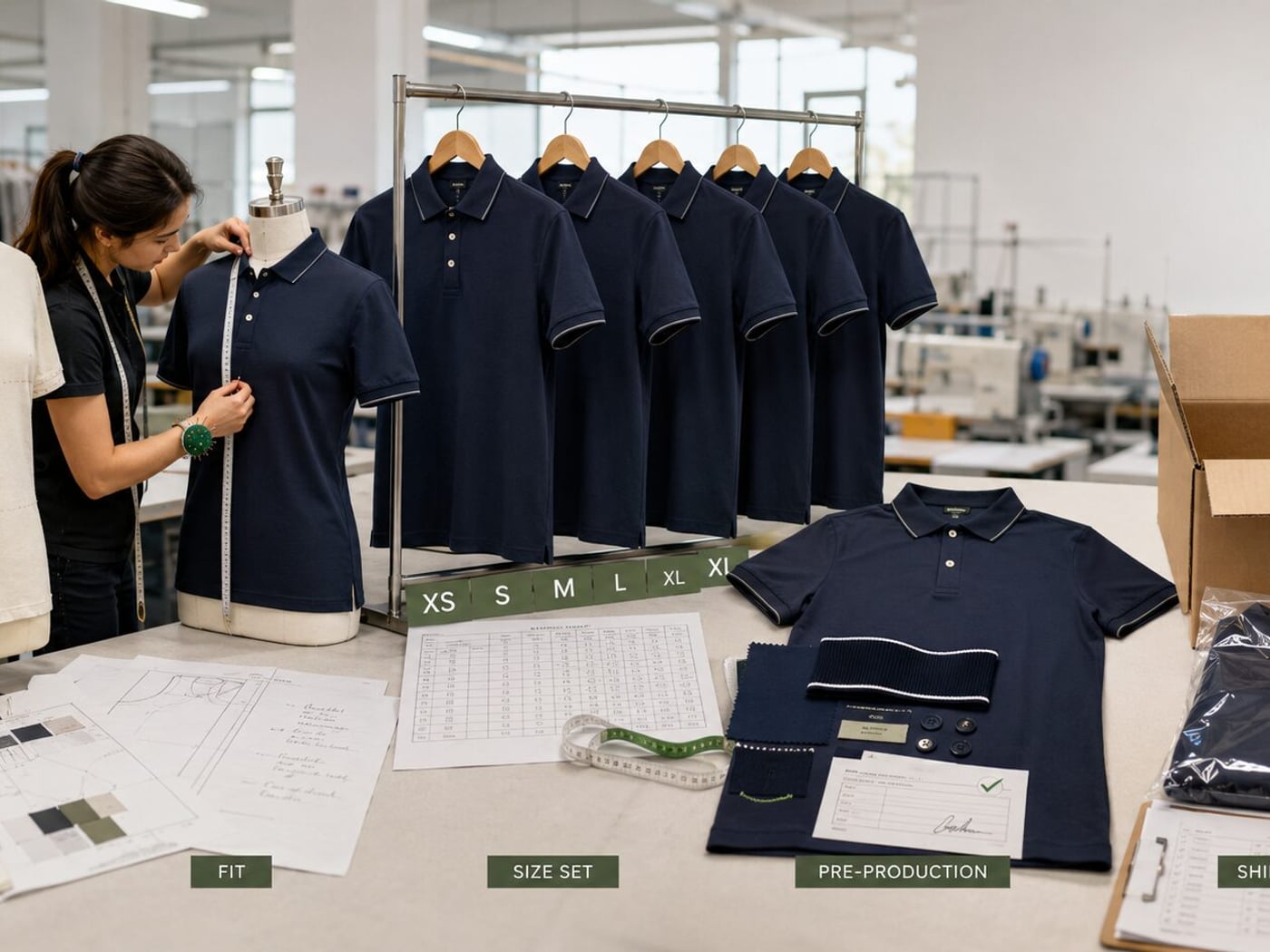
Where the method usually breaks
Four breaks account for most disputes. An anchor described in words that two people read differently. A state left unstated, so one side measures flat and the other hangs the garment. A tolerance that was set for the sheet rather than for the point. And a version of the sheet that circulated by email without a date.
All four are cheap to fix before sampling and expensive after. The case studies show how often a schedule slip traces back to a document rather than a machine, and the pattern is consistent: the garment was made correctly to a sheet that did not say what it meant. When measurement is the question, send the sheet with the style and we will mark the points that are still ambiguous before a sample is cut.
FAQ
Is defining points of measure not the factory’s job?
The factory can propose a method, and a good one will. The buyer still has to approve it, because the buyer owns the fit. A method agreed only inside the factory is a method the buyer will disagree with at inspection.
Do we need to measure every point on every garment?
No. The inspection samples measurements against the sheet at AQL 2.5, and the points that move most are checked most often. What matters is that every point on the sheet has a defined method, not that every point is measured on every piece.
What should we do when two measurements disagree?
Re-measure both ways on the same garment, with the sheet in front of you, and find which field was read differently. The answer is nearly always the anchor or the state, and settling it is a sheet revision rather than a negotiation.
Can we reuse a woven POM sheet for knitwear?
No. Knitted garments relax, grow and change after washing in ways a woven sheet does not account for. The anchors may look similar, but the state, tolerance and rest time are different, and those are the fields that decide the check.
Sources: Intertek, OEKO-TEX Standard 100, Better Work, Higg, EU Regulation 1007/2011 and US CBP.
Working on a knitwear project?
Let’s talk yarn, gauge and timing.
Send a reference or tech pack and we will come back with a practical development route.

