
The certificate buyers ask for first rarely decides whether a garment can carry a GOTS label. The request usually goes to the yarn spinner, because that is where the word organic appears; a scope certificate comes back, and the label artwork goes to the printer.
Then a retailer’s compliance team asks for the transaction certificates that connect the yarn to the fabric and the fabric to the garment, and the file has nothing in it. The cotton was organic. The chain was not documented.
The pattern is worth internalising before the first order: GOTS is a chain-of-custody standard that also sets processing rules. The claim rests on the weakest link, not the strongest. What follows is the order in which to build the chain, and where it usually fails.
GOTS certification covers processing, not just the fibre
GOTS certification covers the whole processing chain, not the cotton field alone: ginning, spinning, knitting, dyeing, finishing, sewing, and the labelling that follows. A GOTS certified garment needs every unit in that chain to hold a valid scope certificate, and every handover between them to be covered by a transaction certificate. Fibre alone proves nothing.
That is wider than most buyers expect from a fibre standard. Organic content is the starting condition; the standard then regulates what may be done to it — which dyes, auxiliaries and accessory materials — and requires each operator to be certified.
It helps to keep the standards apart. A GOTS fabric that also holds an OEKO-TEX STANDARD 100 certificate is common, and the two answer different questions: one is a chain-of-custody claim about organic fibre, the other a substance test on the article. Holding both is normal; treating either as evidence of the other is not.
Transaction certificates and who holds them
A transaction certificate links a quantity of certified material to a specific buyer, invoice and date. It is issued by the seller’s certifier, and it is the only thing that turns “we bought organic yarn” into “this order contains that yarn”.
| Stage | Who is certified | Document produced | What it must show |
|---|---|---|---|
| Ginning and spinning | Yarn spinner | Scope certificate plus transaction certificate | Certified fibre quantity sold to a named buyer |
| Knitting and dyeing | Knitter or dyehouse | Scope certificate plus transaction certificate | Receipt of certified yarn, output quantity, order reference |
| Sewing and finishing | Sewing unit | Scope certificate plus transaction certificate | Cut and packed quantity, buyer, delivery date |
| Trims and accessories | Trim supplier, where claimed | Scope certificate, where applicable | Which accessory materials are covered |
| Labelling and export | Brand or exporter | Labelling release from the certifier | Approved label artwork and grade |
Transaction certificates are issued after the fact, against an invoice. A brand that asks for them in June is asking the chain to reconstruct paperwork that should have been raised as the goods moved.
Scope certificates for the sewing unit
The sewing unit is the link most often missing, because it is the easiest to overlook and the hardest to replace late.
A scope certificate states which operations a company is certified to perform, at which site, for which product categories. A sewing contractor can hold one covering cutting and sewing but not screen printing, in which case the print goes to another certified unit or leaves the claim. The document is specific about operations; “works to GOTS” is not.
Two checks resolve most of the risk. Does the scope certificate name the site that will actually run your order? Groups with several units sometimes present the certificate of the most complete site for work done elsewhere. And does the scope cover your product category — a knit top is not a woven shirt?
Dyes and auxiliaries that are permitted
The processing rules are where GOTS departs most sharply from a fibre-only claim, and where a certified spinner can still produce an uncertifiable fabric.
Dyes and auxiliaries must come from the standard’s approved inputs and must be assessed against its criteria for toxicity and biodegradability, and the dyehouse has to record what it used, in what quantity, on which lot. A substitute dye pulled in because a colour ran short is the classic failure: the fabric is fine, the input is not on the list.
Two references sit alongside these rules rather than inside them. Legal limits remain the business of legislation, for the EU the ECHA restricted substances list, which a GOTS certificate does not replace. Process and input management is assessed by schemes such as bluesign, and a mill carrying both tells you more than a mill carrying one.
Label grades and the 70% threshold
Two label grades exist for garments, separated by how much certified organic fibre the article contains. The threshold in the grade name decides which claim you may print.
- Organic grade. Requires the article to be made almost entirely of certified organic fibres, with a small allowance for specified non-organic materials. This is the grade that supports a straightforward organic claim.
- Made with organic grade. Requires a defined minimum share of certified organic fibre — the 70% threshold the grade is known for — with the remainder subject to the standard’s rules on permitted fibres.
Below that share there is no grade and no GOTS label, however organic the cotton. The thresholds are published in the standard and are revised: read the current version on the GOTS standard pages rather than a summary, including this one.
Keep the grade and the fibre content label separate. The grade governs which organic claim you may print; the declared percentages on the care label are governed by labelling law — in the EU, Regulation (EU) 1007/2011, in the US the FTC rules. Both appear on the same garment and neither satisfies the other.
Mixing organic and conventional lots
Mixing is allowed within the rules of the chosen grade, and it is normal in commercial production. What is not allowed is mixing without records.
Contamination happens physically before it happens on paper. The same knitting machine runs a conventional lot and then an organic one; the same dyehouse batches both. Cleanout procedures, separated storage and lot identification are what the certifier inspects.
Two habits reduce the risk. Keep organic lots on a separate production window where the schedule allows it, and label every cone, roll and bundle with the lot reference that appears on the transaction certificate.
If the non-organic share carries its own claim — recycled polyester, responsible wool — that claim runs on a different chain, issued through Textile Exchange standards such as GRS or RWS. Two claims on one garment mean two document sets.
Where the chain usually breaks
Five failures account for most of the problems, and none is exotic.
- The dyehouse subcontracts a finish to a unit with no scope certificate, and the operation leaves the certified chain without anyone deciding that it should.
- The sewing unit is certified, but the site on the certificate is a different building from the one running the order.
- Transaction certificates are requested at shipping and issued late, so quantities never get reconciled against the purchase order.
- Yarn is bought from a trader who is not the certified entity, breaking the link between the certificate and the material.
- Labels are printed and sewn in before the labelling release arrives, so a grade change cannot be absorbed.
Every one of these is a scheduling problem dressed as a compliance problem.
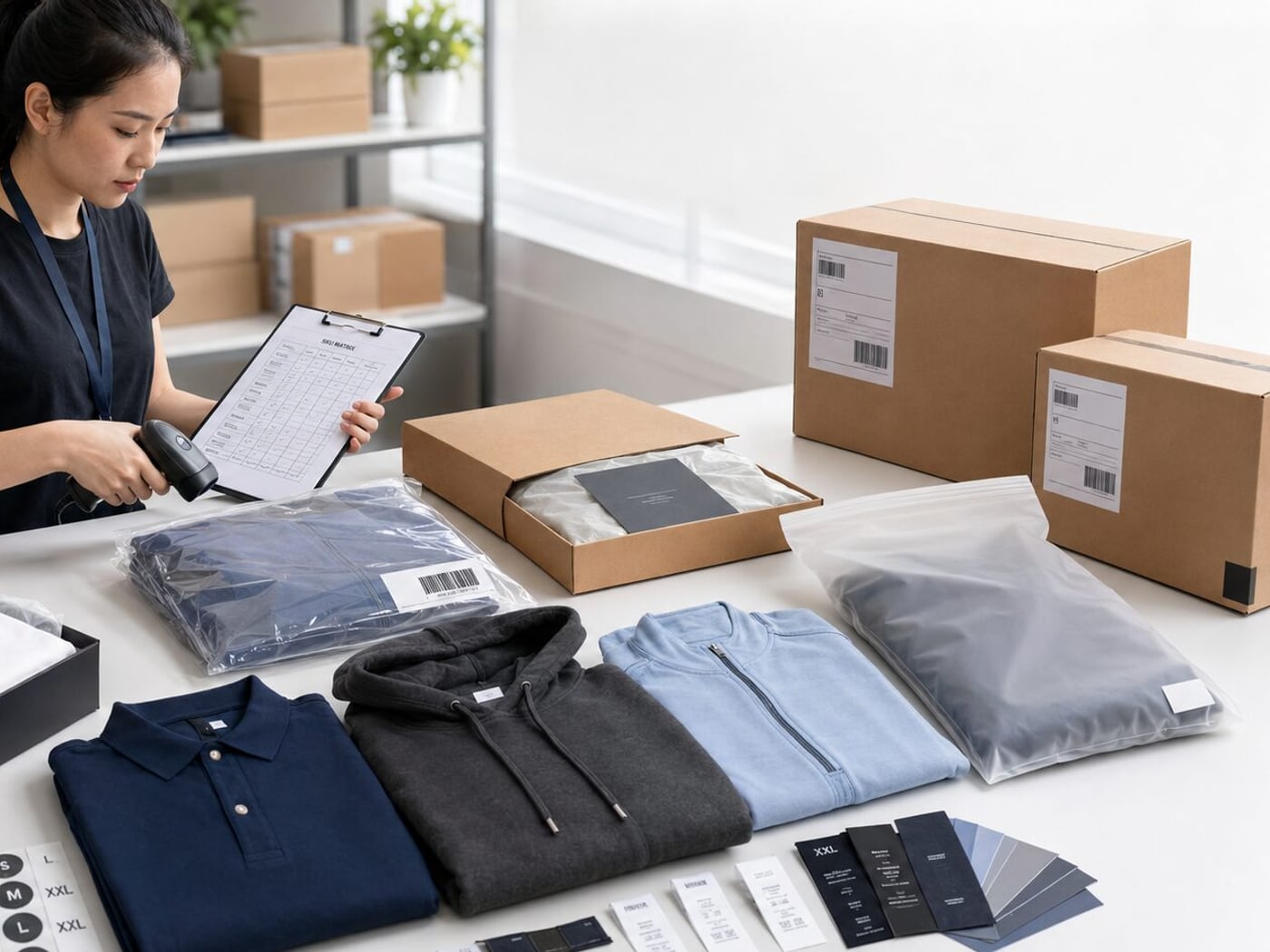
The fix is a document gate at each handover.
A document checklist per order
One page per order, checked at four points: before sampling, before bulk, before labelling, before shipment. An empty field stops the order at that gate.
| Document | Issued by | Checked at |
|---|---|---|
| Yarn scope certificate, current on the production date | Yarn spinner’s certifier | Before sampling |
| Yarn transaction certificate naming your buyer entity | Yarn spinner’s certifier | Before bulk |
| Knitting and dyeing scope certificate plus transaction certificate | Knitter or dyehouse certifier | Before bulk |
| Sewing unit scope certificate naming the actual site and product category | Sewing unit’s certifier | Before bulk |
| Dye and auxiliary input record per lot | Dyehouse | Before labelling |
| Label grade release and approved artwork | Brand’s certifier | Before labelling |
| Final transaction certificate reconciling quantity shipped | Sewing unit’s certifier | Before shipment |
GOTS coverage depends on the yarn source and on the sewing unit nominated for the order, so we confirm it per programme rather than in general.
We buy OEKO-TEX Standard 100 and GRS or RWS yarns where the brief calls for them, and we tell you which stage of a GOTS chain a given factory can document. Most of these conversations start with our custom cotton knit tops; the OEKO-TEX certificate guide covers the material-level document underneath.
If you are weighing a grade change or a new yarn source, send the style and the fibre composition to our OEM, ODM and private label team. We will confirm which stage of the chain is covered before you commit to a label.
FAQ
Is GOTS certified cotton the same as organic cotton?
No. Organic cotton is a fibre claim about how the cotton was grown. GOTS is a processing standard that also requires the fibre chain to be certified and every processing unit to hold a scope certificate, so organic cotton can be real and still not carry a GOTS label.
Does a GOTS label on the garment prove the sewing unit was certified?
Not on its own. The label is the last step in the chain, and it is issued against documents. Ask for the sewing unit’s scope certificate naming the actual site, plus the transaction certificate that covers your shipment.
Can we mix GOTS cotton with conventional cotton in one order?
Only within the rules of the grade you are labelling, and only with quantities recorded lot by lot. A blend that falls below the threshold for the lower grade cannot carry a GOTS label at all.
Is a transaction certificate the same as a scope certificate?
No. A scope certificate says what a company is certified to do, at which site. A transaction certificate says that a specific quantity of certified material moved from one named party to another on a specific date.
Do trims need to be certified too?
They need to meet the standard’s conditions for accessory materials, and where an organic claim is made for them they need their own coverage. A polyester care label or an elastane content outside the grade’s allowance can break an otherwise sound file.
Working on a knitwear project?
Let’s talk yarn, gauge and timing.
Send a reference or tech pack and we will come back with a practical development route.

